
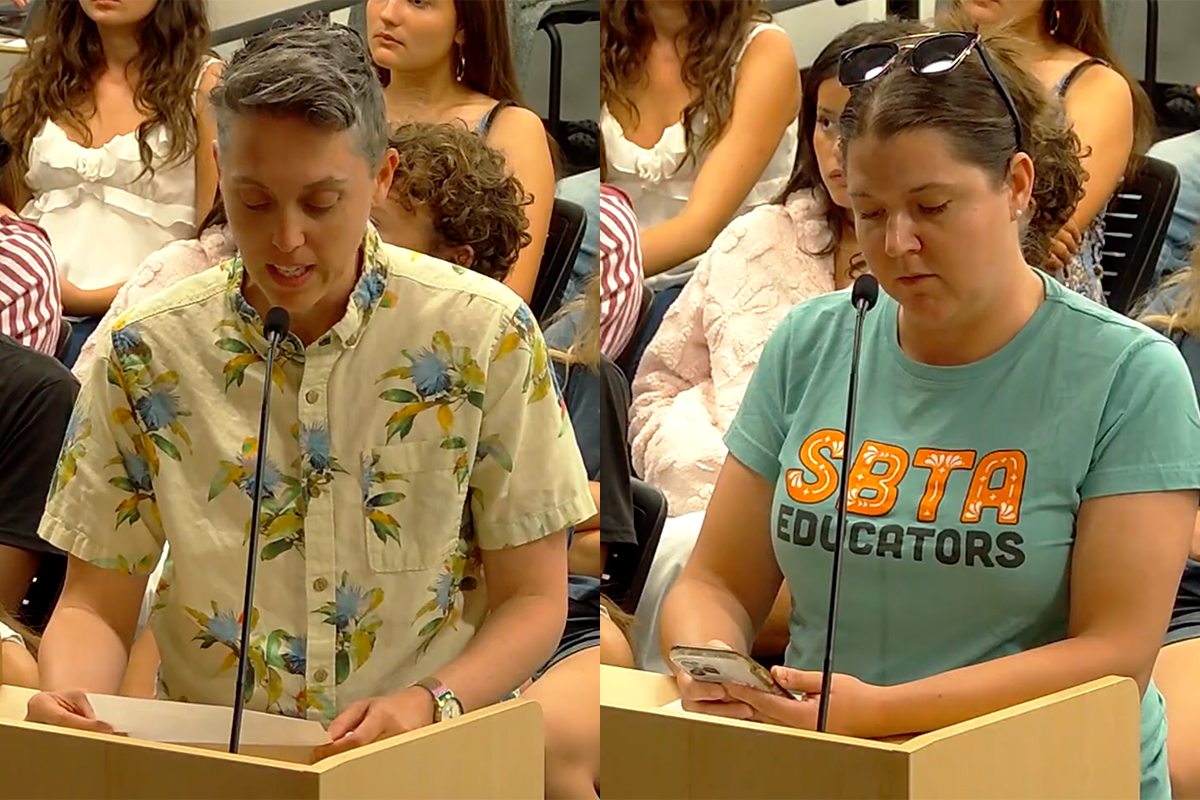
Lisa Sueyres told the Santa Barbara Unified School Board on Tuesday that her classroom hit 91.9 degrees during last week’s historic heat wave, even with two fans at full blast.
Sueyres, a performing arts teacher at La Colina Junior High School, said that students and staff are suffering and urged the board to pursue a “heat emergency” plan.
She joins a long line of teachers advocating for the same thing. And thanks to a last-minute extension to a state grant program, the district may be able to complete some air conditioning upgrades that previously hung in the balance, but teachers want to see a plan now.
Last week, Sueyres’s classroom did not dip below 85 degrees, she added. Yet no minimum day was implemented, as it was for an extreme heat forecast in August. Even then, La Colina was not included among the six schools placed on a minimum day schedule.
Only two spaces at La Colina have air conditioning, she claimed. “The district needs a concrete and equitable plan with what we have now” for cooling down campuses, she said, which includes protecting employees as well as students.
“It is not new information that temperatures continue to rise globally,” she said. “We need a plan for access to cooling spaces on all campuses.”
Teacher Kat Ross said teachers have “witnessed firsthand the effects of climate change on students in our district,” made worse by older buildings without proper ventilation, let alone air conditioning. Some classrooms reached 100 degrees last week, Ross said, and students experienced heat stress, sweating, lethargy, and difficulty concentrating.
“We need to be prepared,” Ross said. “This means having a heat response plan for temperatures inside classrooms, not just outside temperatures.”
District spokesperson Ed Zuchelli explained that because Santa Barbara’s climate has historically been mild, many schools were built without air conditioning — and old infrastructure is costly and challenging to upgrade. The older the school, the more expensive it will be because of potential issues, including the need to install ducting and test for asbestos and lead.
On the district’s end, it is not entirely for lack of trying. It has upgraded a few schools’ HVAC (heating, ventilation, and air conditioning) systems, established protocols for days with extreme heat, tinted classroom windows, and provided teachers with fans, Zuchelli has said.
It also went through the slow, complex process of applying for a state grant in 2023 to assess and replace its HVAC systems in five additional schools, said Steve Venz, the district’s chief operating officer, at Tuesday’s meeting. He explained that the grant covers up to 50 percent of the costs, while the district’s capital improvement funds would cover the remainder.
Despite pushback from legislators, applications for that grant — called CalSHAPE — closed abruptly in 2024, making $191 million in unused funds inaccessible to school districts. On August 31, the program officially sunsetted, and the remaining funds will return to utility companies, which claim they will use them to reimburse ratepayers.
At the last minute, however, legislators passed a budget trailer bill to give districts that already received the funding, such as Santa Barbara Unified, three additional years to finish projects before the state takes the money back. If this had not passed, the district would have had to give back the $6 million in funding it received, including the $700,000 already spent.
But now it can finish what it started.
Venz said the grant allowed the district to begin constructing and replacing HVAC systems at four elementary schools — Cleveland, Franklin, Harding, and Santa Barbara Community Academy — and Santa Barbara Jr. High School. These are schools with some of the district’s youngest and most socioeconomically disadvantaged students.
Those projects are on hold while the district awaits confirmation from the California Energy Commission to proceed under the grant extension.
“But we still … we’re also part of 221 school districts that are waiting for that confirmation as well,” he said.
Needless to say, it will take a while. Still, teachers want action now.
“For accountability and transparency, we need to know the plan,” Ross said, calling for a transparent, accountable timeline for installing A/C at all schools. “Let’s get this fixed so our students can perform at their best.”
Related Posts





Premier Events

Wed, Oct 14
5:30 PM
Santa Barbara
Jodi House “Paint the Town Blue” Benefit for Brain Injury Awareness

Tue, Sep 29
7:00 PM
Santa Barbara
Birds of California’s Channel Islands – Lecture and Book Signing

Tue, Sep 29
7:30 PM
Santa Barbara
Marty Stewart and his Fabulous Superlatives

Wed, Sep 30
12:00 PM
Santa Barbara
Origins of Fashion in France: Zoom Lunch & Learn

Wed, Sep 30
5:30 PM
Santa Barbara
S.B. Independent: Santa Barbara City Mayoral Forum

Thu, Oct 01
11:00 AM
Santa Barbara
In Studio: Julie Anderson Mathias

Thu, Oct 01
7:30 PM
Santa Barbara
Robert Plant with Saving Grace and Suzi Dian

Fri, Oct 02
5:30 PM
Santa Barbara
Pet Blessing at Trinity Episcopal Church

Fri, Oct 02
8:00 PM
Santa Ynez
Comedian Ron White Performs at Chumash Casino Resort

Sat, Oct 03
9:00 AM
Goleta
Out of the Darkness Suicide Awareness Walk

Sat, Oct 03
10:00 AM
Santa Ynez
Chumash Intertribal Powwow Returns
Wed, Oct 14 5:30 PM
Santa Barbara
Jodi House “Paint the Town Blue” Benefit for Brain Injury Awareness
Tue, Sep 29 7:00 PM
Santa Barbara
Birds of California’s Channel Islands – Lecture and Book Signing
Tue, Sep 29 7:30 PM
Santa Barbara
Marty Stewart and his Fabulous Superlatives
Wed, Sep 30 12:00 PM
Santa Barbara
Origins of Fashion in France: Zoom Lunch & Learn
Wed, Sep 30 5:30 PM
Santa Barbara
S.B. Independent: Santa Barbara City Mayoral Forum
Thu, Oct 01 11:00 AM
Santa Barbara
In Studio: Julie Anderson Mathias
Thu, Oct 01 7:30 PM
Santa Barbara
Robert Plant with Saving Grace and Suzi Dian
Fri, Oct 02 5:30 PM
Santa Barbara
Pet Blessing at Trinity Episcopal Church
Fri, Oct 02 8:00 PM
Santa Ynez
Comedian Ron White Performs at Chumash Casino Resort
Sat, Oct 03 9:00 AM
Goleta
Out of the Darkness Suicide Awareness Walk
Sat, Oct 03 10:00 AM
Santa Ynez

