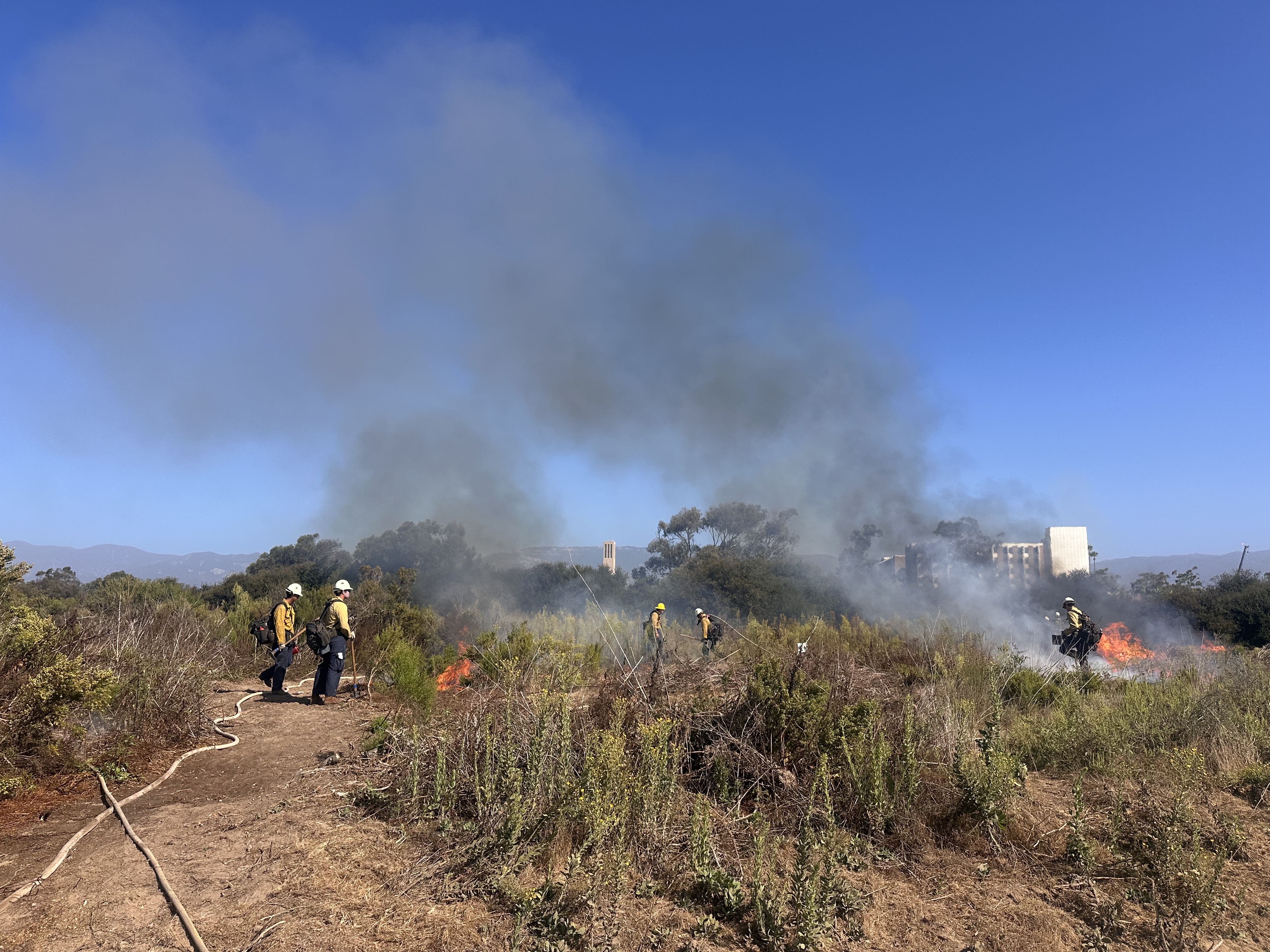
On Monday, Santa Barbara County firefighters burned approximately one acre of grassland and coastal bluff scrub at the UC Santa Barbara Lagoon.
The prescribed burn — a carefully planned and controlled fire — was part of an ongoing effort to control non-native grasses and establish native vegetation around Campus Point and Coal Oil Point Preserve, according to the county’s Air Pollution Control District (APCD). The APCD coordinated with UCSB and County Fire to plan and complete the burn.
The burn was short, starting Monday morning and concluding by 2 p.m., and was scheduled for a day with the best conditions for wind dispersion to reduce air quality impacts, the APCD said.
Smoke was visible from Goleta and the UCSB campus, where fall classes start next week.
The APCD set up a portable device nearby to monitor air quality, according to the agency’s spokesperson Lyz Bantilan. Alongside good wind conditions for smoke dispersal, they also look for a window of time with the least amount of fog to generate enough heat to kill the area’s non-native seed bank.
If weather conditions had been unfavorable, the burn would have been delayed or rescheduled.
Air quality conditions on Monday were good, according to the APCD website, and were forecasted to remain good throughout the week for South County.
According to a notice given to the California Coastal Commission on Friday, September 11, the burn was the first in a scheduled three-part series for the area over a three-to-five-year period to reduce non-native grasses and make room for native species. One burn is planned per year from 2026 to 2028, but dates are flexible due to potentially conflicting weather conditions.
According to the commission’s report, the area is dominated by non-native grasses, which can negatively impact native plant and animal life. Following each prescribed burn, it says, crews will plant native wildflowers in the late fall. All of this, it continues, will increase the site’s long-term biological productivity.