Bikes in Bogotá
The Political Leadership Has Created Extensive Network of Bicycle Paths

A powerful aspect of riding a bike is that public spaces are safer the more they are used. Bikes play a big role in this, but cars don’t. This is certainly true for roads where bikes are ridden because they instantly become safer as more and more people use them. Parks become safer if people ride their bikes and walk in them, but not if cars go by them at 40 miles an hour. Cars are unable to have that kind of positive effect on their environment because they remove humanity from the equation. Bikes put it back in. — Gil Peñalosa, former Commissioner of Parks, Sports and Recreation for City of Bogotá.
It’s seven o’clock on Saturday morning and the beginning of my first full day in Bogotá, Colombia. I’m in a car with Colombian friends, and we’re driving through the still-quiet streets of a city of approximately 8 million people.

We’re on our way to the Parque Nacional Natural Chingaza, one of the country’s many national parks. The parque is a couple of hours outside of Bogotá, by car, but since every route out of the city seems to meander around the maze of streets that make up Bogotá, I’m telling my host, Leo, that I want to know more about the city’s bike culture.
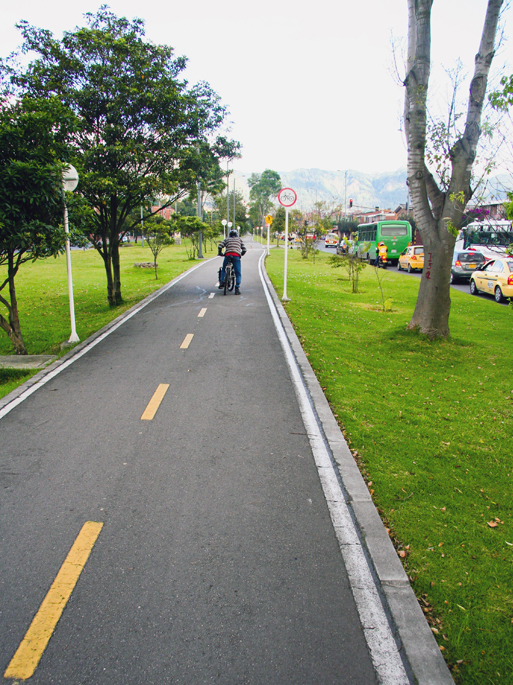
He points out a separated bike path right down the middle of a large boulevard. “I used to ride about 10 miles across the city to go to school,” he tells me. “Unfortunately, that was before these great paths were built, so I rode in the thick traffic. It was hard and dangerous, but I sure was in great shape!” Around me I see a sprinkling of small urban parks where people are walking dogs and kids are playing. There are dozens of people out in sports clothing, walking, running, and — wait! Why, there is a group of recreational riders! And they are on fancy road bikes. Hmmm, I thought. Residents of Bogotá seem to be athletic, and they are riding for exercise.
We started heading up into the mountains that line the eastern edge of the city. It’s a steep, narrow, two-lane highway — a cross between Santa Barbara’s Gibraltar Road (for its steepness) and Highway 154 (for its speed and road quality). I was instantly grateful that Leo was a good driver, one who didn’t take risks passing trucks on blind curves or speeding around cyclists and pedestrians. Wait: cyclists and pedestrians?
Are they heading to work? Hold on, they are fully clad in lycra and riding expensive bikes. They are riding in groups and are hammering up this long, steep grade. The walkers are in pairs or groups, and they are also wearing athletic clothing. This number of riders charging up a serious mountain pass is unlike any I’ve seen in a Latin American big city. Come to think of it, this is something I’ve rarely, if ever, seen in the United States.
The road continued up and up, and there continued to be riders alongside us. The view of the city was breathtaking. “People are up here riding this road every weekend,” Leo tells me. I can see why. For a fleeting minute I wished I could join them. Then I saw yet another huge truck come barreling around a blind curve, about two feet from another pack of riders. The signs along the highway read: “No Más Estrellas,” with a black star under it. “No More Stars.” Leo’s wife Ana tells me it’s part of a national safety campaign to reduce deaths on the highways. When a traffic incident results in death, they paint a black star on the road.
“Pedestrian and bicycle deaths are a big problem here,” Ana continues. “Drivers are so aggressive; pedestrians have to run across the street to avoid being hit by speeding cars. Often people aren’t fast enough.”
It seems the car is still king in Bogotá. I was unprepared for how choked the city streets were with traffic from 7 a.m. until 8 or 9 p.m. each day. Residents who have the luxury of a private vehicle seem to plan their entire schedule around avoiding traffic. The smog during rush hour means that anyone who wants to exercise does so in the early morning, before the air pollution gets too bad.
Except on Sundays.
Ciclovía Every Week: The car may still be king in Bogotá from Monday through Saturday, but each Sunday, Bogotá’s streets are reclaimed by its people. I was like a kid on the first day of summer break when I awoke on Sunday morning and was able to look over the balcony of the apartment where I was staying onto one of the main avenues of the city. Luckily for me, this was one of the main streets of ciclovía and from my vantage point I could see a trickle of runners, bikers, inline skaters, and walkers with dogs. Not hours before, the street had been choked with traffic, the air thick with fumes and polluted also with the noise of horns blaring and cars accelerating. Now, at 7 a.m., with the streets blocked off for miles in every direction, the air was clean, and I could hear birds singing and people talking and enjoying a beautiful Sunday morning.
I’ve already written about ciclovía in Bogotá and the 10-mile block party that is Los Angeles’ CicLAvia, so I won’t go into a lot of the same details in this column.
But here are some highlights of my up-close and personal tour of a small section of the ciclovía.
My friend Viviane and I decided to walk the eight kilometer stretch of Carrera Septima, into the heart of downtown and the Calendaria district, which is famous for its colonial buildings, cobblestone streets, ancient churches, and museums. We had been warned that there was a large stretch of that route that was unsafe during the week, but everything changes on Sundays. Our friends in Bogotá told us that the same is true of many areas of the city — dangerous during the week, perfectly fine during ciclovía. Music to my ears.
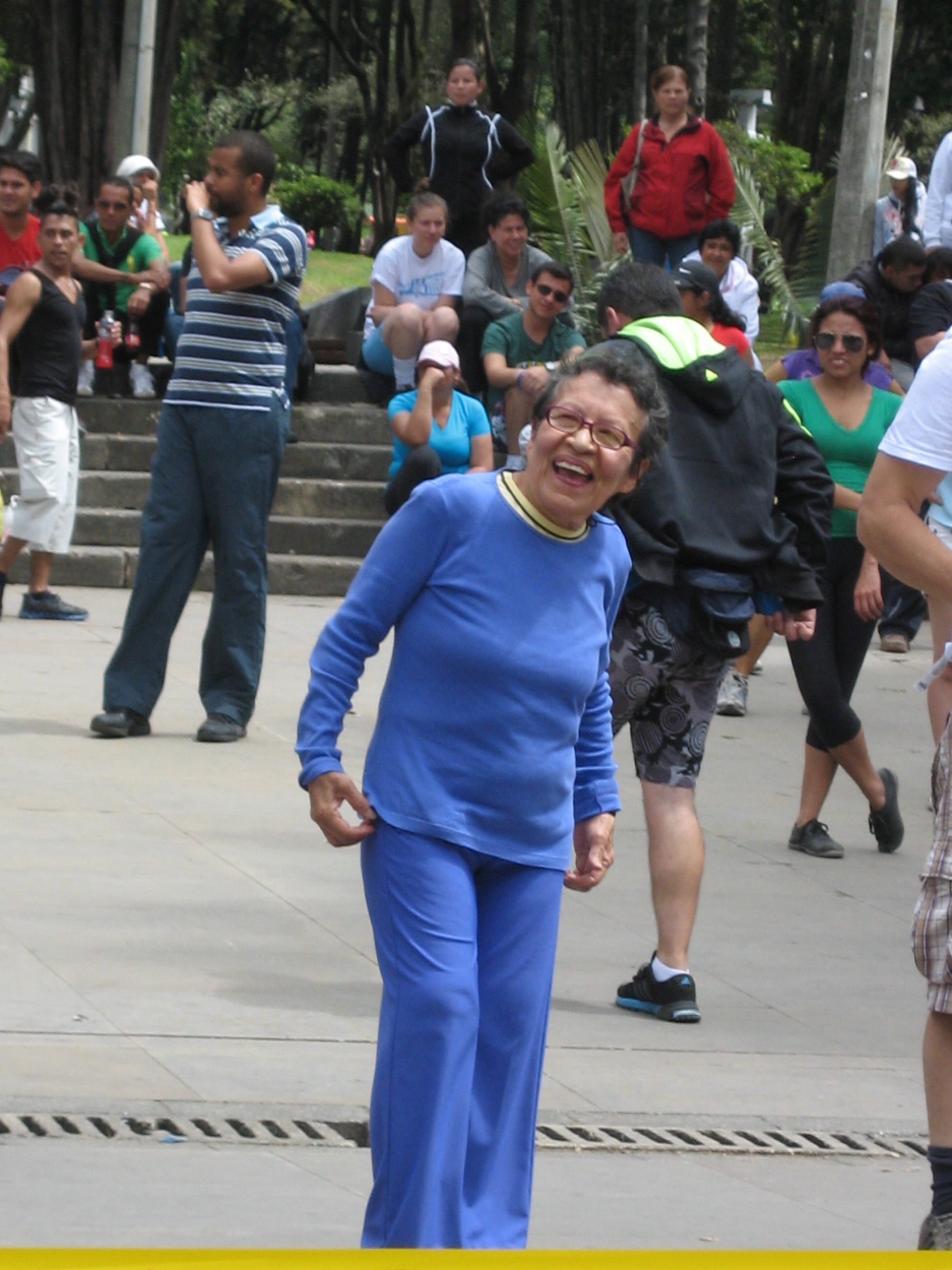
Speaking of music, I’d seen videos and photos of the city’s group-exercise stations, but seeing it in person was something special. A big group of dancers was rocking out, executing a complicated routine led by two people on stage with a good sound system. The music was electronic. The participants clearly had done this before. A large number of spectators were also were also in attendance, enjoying the show. My favorite dancer was an older woman in a blue jogging suit. She was moving slowly, but had a huge smile on her face, and those around her clearly were pleased by her presence.
I loved seeing the mixing of residents, old and young, poor and rich, out enjoying a Sunday. Gil Peñalosa said it best:
In Bogotá, the gap between people is great, but that’s the case in other cities as well. But through the ciclovía, they are in the same place, doing the same thing. These are people who don’t live in the same neighborhoods, their kids don’t attend the same schools, they don’t shop in the same stores, and they don’t eat in the same restaurants. But they are in the ciclovía together. One can have an imported bike that is three thousand dollars, while the other has one that is thirty dollars … so be it. They are both having the same fun with their family, and they stop and chat. It’s a rare activity that can allow this integration to happen. The ciclovía becomes an exercise in social integration; it is much more than cycling, walking and skating.
My cursory research indicates that bicycling culture has been a part of Colombian identity for many decades. Colombians follow professional cycling, and Colombian riders have had some fame in the Tour de France and the international cycling circuit. The Vuelta a Colombia (Tour of Colombia) is a world-famous race held annually since 1951. The political leadership of Bogotá over the past several decades created ciclovía and an extensive bike path network. The greening of the city through parks and bikeways means there are more open spaces for people to get out for exercise.
Bogotá, like many bike cities around the world, faces many social and environmental challenges. It certainly seems that bikes and active lifestyles are helping tackle some of the most daunting of these challenges. No más estrellas. Por favor.