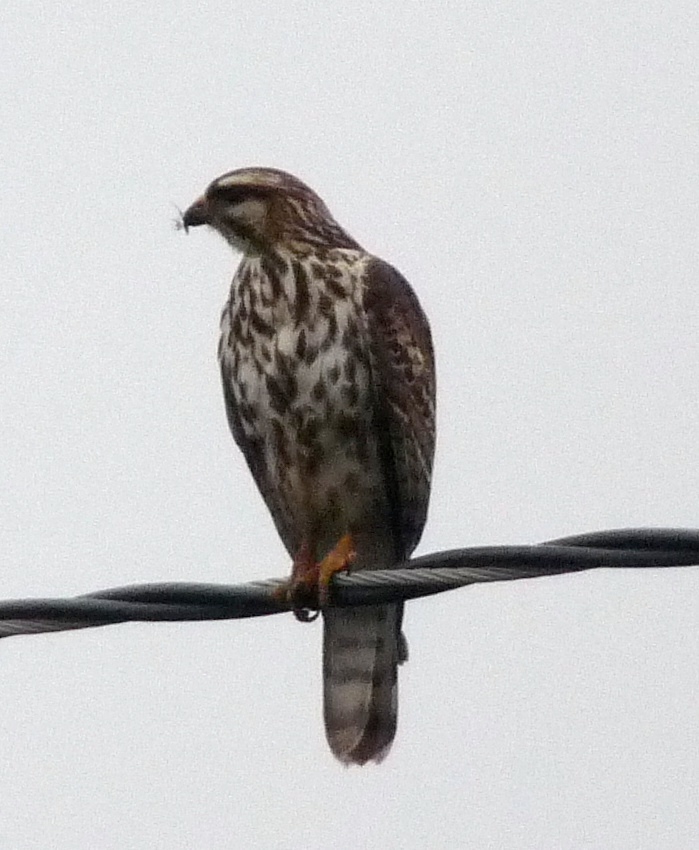
On his drive to see some geese Sunday afternoon, Central Coast birder Eric Culbertson spotted a small raptor he’d never seen before. It was sitting sentry on a power line, scanning the landscape off Via Real in Carpinteria. So Culbertson double-backed, parked, and photographed the young bird of prey, likely the first reported sighting of a gray hawk in California.
At the time, Culberston didn't know what he had. But recognizing it was something special, he sent the images that night to a friend and fellow birder who passed them along to a raptor expert in New Jersey. Soon thereafter, Culbertson — a 25-year-old Carpinteria native and Humbolt University student who's done bird surveying work for the Forest Service — heard back that he had spotted a species never before seen in California. The tropical gray hawk is native to Mexico and Central America and nests in parts of the southwest United States. In their younger years the hawks have dark brown backs and white bellies with brown spots. When mature, they take on a dramatic, solid gray coloring.
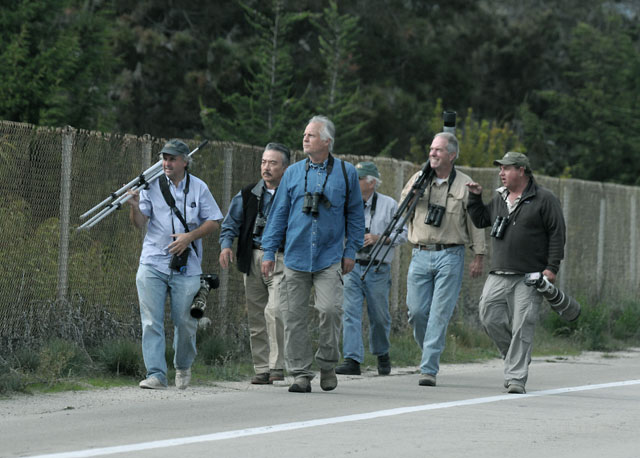
On Monday morning, Culberston made the sighting public by posting the time and location of the encounter on a Yahoo listserv. The posting went “viral” among avian fans near and far, including birding bigwigs like Guy McCaskie and Paul Lehman. Some drove up from San Diego, and others made the trip down from North County. Decked out with binoculars, field guides, and cameras with long lenses, they descended Monday afternoon upon Via Real and watched the bird hunt around the Padaro Lane exit and near Santa Claus Lane.
Culberston explained that the photos and info he and others collected will be submitted to the California Bird Records Committee for official verification. He was credited in late September for spotting the first white ibis in Santa Barbara County and said he counts himself lucky to live in such a rich and well-respected birding community.
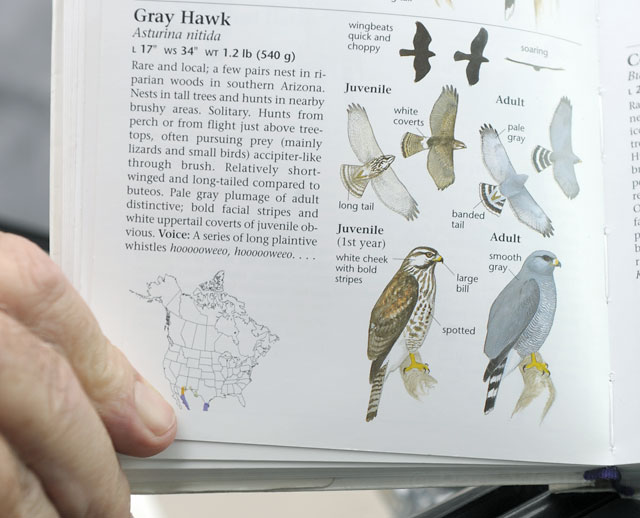
Taking special care to note he's not a gray hawk expert, Culberston theorized that the young bird, which is likely 2 ½ to 3 years old, may be in the midst of a migration stage called “post-breeding dispersal,” or it might have simply lost its way. He said it could stick around town if it thinks it's found a consistent food source, or it may simply move on. Gray hawks are solitary creatures and are not typically long-distance migrators. Their wingspans reach 35 inches when full grown.


Previous Month


Comments
I had seen the exact same species on Venice lane and near Santa Monica going after a bird but missed I was no more than 15 feet away from the incident.
I was trying to figure out what Hawk species it was.
Gerster (anonymous profile)
November 27, 2012 at 2:25 p.m. (Suggest removal)
There was no mention of it, but since this hawk normally ranges within warmer to hot tropical zones, can such a northerly sighting be directly attributable to climate change?
Draxor (anonymous profile)
November 27, 2012 at 3 p.m. (Suggest removal)
Wish I could see this bird. Too lazy to go all the way to Carp.
chilldrinfthenight (anonymous profile)
November 27, 2012 at 3:27 p.m. (Suggest removal)
Draxor hit the nail on the head.
Ken_Volok (anonymous profile)
November 27, 2012 at 4:57 p.m. (Suggest removal)
Yes, clearly one unconfirmed sighting of a bird that nests in Arizona is proof of global warming.
eightdolphins (anonymous profile)
November 27, 2012 at 6:10 p.m. (Suggest removal)
Our aquatic mammalian friend may have been dropping too much domoic acid. How else can we explain his misinterpretation of Draxor's reasonable question?
EastBeach (anonymous profile)
November 27, 2012 at 6:41 p.m. (Suggest removal)
I think photos are reasonable confirmation.
Ken_Volok (anonymous profile)
November 28, 2012 at 1:42 a.m. (Suggest removal)
The appearance of a single gray hawk in California could be evidence for the effects of human-caused climate change. Or it could just be a case of an individual bird that got confused. As with things like the incidence of severe weather events, it isn't valid science to say that individual events constitute proof. Instead, people with relevant expertise need to analyze large-scale effects to distinguish the "signal" of human-caused climate change from the "noise" of scattered individual occurrences.
Unfortunately, when they do that kind of analysis, climate scientists are largely of the view that yes, humans are causing climate change, and its effects are showing up in a multitude of changes, of which tropical species being more likely to show up outside their normal ranges is one.
I was lucky enough to see this bird yesterday morning. For those trying to see it, it's important to give it its space. If excited observers make a point of continuously approaching it closely, it will flush it from its perch, disrupt its hunting, and increase the likelihood that it will move on to another area. So hang back and enjoy the view through binoculars and spotting scope.
Thanks (and congratulations!) to Eric for finding this very exciting bird. I've been lucky enough to go bird watching with Eric several times, and he's an amazingly talented birder.
For anyone who thinks they might be interested in bird watching, the annual Christmas Bird Count is coming up, and is a great opportunity for beginners to go out in the field with experienced birders while making a real contribution to the kind of science I was discussing above. And this year participation is free of charge!
Here are dates and contact information for upcoming Christmas counts:
December 16, 2012: Carpinteria, contact Rob Denholtz, Phone: (805) 684-4060.
January 5, 2013: Santa Barbara, contacts Rebecca Coulter, 805-455-7040, rfcsb@cox.net and Joan Murdoch, (805) 969-5132.
jbc (anonymous profile)
November 28, 2012 at 6:47 a.m. (Suggest removal)
Wake up, folks. We don't need further "proof" that climate change is real...
On another note, I think I have seen a hawk like this around Lake Los Carneros, I wonder if it is just a similar looking hawk...
tammy (anonymous profile)
November 28, 2012 at 8:41 a.m. (Suggest removal)
Penguin swims up on a beach in Peru.
http://news.bbc.co.uk/2/hi/americas/6...
Proof of global cooling.
eightdolphins (anonymous profile)
November 28, 2012 at 12:41 p.m. (Suggest removal)
The fact that eightdolphins appears on the Indy blog after not being seen after so much time confirms global warming.
billclausen (anonymous profile)
November 28, 2012 at 2:02 p.m. (Suggest removal)