Smart Meters Can Be Postponed If Homeowners Act Today
Joining the ‘Delay List’ Temporarily Halts the Switch to a Digital Meter
Saturday, March 3, 2012
Smart meters—automatic, two-way, wireless electrical-energy monitoring and control devices—and the possible effects of their grids have sparked a Goleta City Council protest. Despite being warned by city staff that Southern California Edison would have its way no matter what, the council has unanimously agreed to protest SCE’s installation plan to the California Public Utilities Commission (CPUC).
Citing concern over “health and privacy issues,” the February 22 letter to CPUC President Michael R. Peevey requested the commission provide customers a “no-cost opt-out” from Edison’s plan to switch from the present human-read analog meters to radio-frequency, remote-controlled digital meters.

Vic Cox
While smart meters are scheduled to arrive in March in the City of Goleta, among other jurisdictions, there may still be time to request a delay from Edison and its partner, Corix Utilities, which is actually switching out the old meters. Customers can call (800) 810-2369 (or for Spanish speakers [800] 477-4455) to get on the Delay List; an employee will come to your home and tag the old meter.
Supposedly, customers will be alerted by letter 30 days in advance of the switchover, but don’t bank on it; act now to get on the Delay List. I received my letter about a week before this column was published. The Corix number ([877] 407-2317) on the letter also allows access to the Delay List.
Goleta’s protest joined scores of similar ones from municipalities throughout the state, including the city and county of Santa Barbara. The pushback against the utilities’ plans, which were originally proposed in 2007-08, resulted in the CPUC mandating an opt-out choice for Pacific Gas & Electric’s territory in Northern and Central California. It took effect February 1.
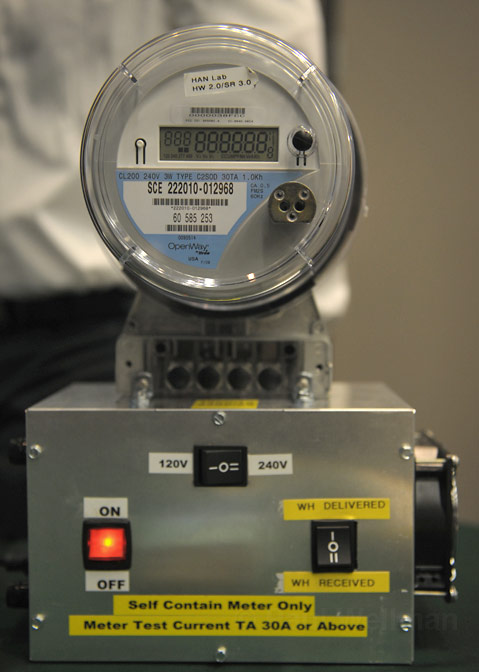
Paul Wellman
Smart meter
Unfortunately, the CPUC, which has paramount authority, also decided it would allow PG&E to charge its customers an initial fee of $75 and an indefinite monthly fee of $10 to continue to use their analog meters. The howls of outrage ignited by this decision were punctuated by threats of class-action lawsuits.
As of this writing, the CPUC has not announced a decision on an opt-out scheme for the southern parts of the state served by SCE and San Diego Gas and Electric. Additionally, Edison’s FAQ Web site states that once the meters are installed “SCE cannot accommodate uninstall requests at this time.”
As a journalist, these are reasons to delay installing a new system that could affect my family’s health and the function of other home electrical devices. Researching the complexities of what smart meters are and do has stirred concerns I want answered.
Despite the reassurances of Edison’s representatives and its Web site, as customers learn more, the controversies increase over the technology’s health impacts, potential invasion of homeowner privacy, and even if the alleged energy savings and efficiencies are real.
Though SCE maintains its Itron meters are “highly accurate” and have been tested “in the field to ensure that our smart meters are safe, accurate and working properly,” no wide scale, real-world test of the meter has been done, according to a November 2011 Sage Associates report. (The Montecito-based environmental consulting firm specializes in analyzing radio frequency projects, such as antennas and smart meters.)
SCE is apparently relying on a 2010 report by a consultant for the industry-financed Electric Power Research Institute (EPRI), which mainly consisted of measurements from two artificial smart-meter test farms in Southern California and South Carolina and a five-minute street test. The EPRI report is filled with qualifiers and limitations regarding the consultant’s conclusions on smart-meter safety.
This hardly seems a basis on which to charge into a long-term experiment on human health and radio waves. Consider the cumulative effects of exposure and it gets worse.
“What is lacking in this and other … reports on smart meters is recognition that many tens or hundreds of thousands of meters are installed at very close proximity to occupied space in homes,” notes the Sage critique. These smart meters “talk” to each other 24/7 as well as send pulses of data to collector cells for relay to the whole network; I’ve seen no measurements on how high the radio-frequency levels are around these special cells.
Perhaps this is a reason why Edison’s Web site does not answer a fundamental question: Do we know enough about the accumulated long-term effects of low-emission radio frequencies on the human body and brain to unleash this technology now on not only Goletans but all Californians?
While thinking about that, note that Southern California Gas Company is planning over the next five years to roll out what they call a “gas advanced meter communication device.” It is claimed to be able to “securely transmit … gas usage data” in a fraction of a second and does not interact with other gas meters or home appliances.
(Disclosure: My wife, Dr. Ingeborg Cox, has testified before the Goleta City Council about possible public health issues associated with these types of exposures.)

Related Links
Comments
Thanks for the article. I do not understand why the meters have to communicate every 10-15 seconds back to Edison. I would think that a radio transmission once a month to report usage and save on meter readers is enough. If someone wants more data, then they can choose to increase their meter reporting rate, but still there is the issue of accumulated exposure to electromagnetic energy and possible hot spots in a neighborhood. Cell phones were found not to cause an increase in brain cancer, but with the caveat that "participants with the highest level of cellphone use had a 40 percent higher risk of glioma, an aggressive type of brain tumor" ( http://well.blogs.nytimes.com/2011/10... ). How do these smart meters compare in frequency range and power output to cell phones? What if your head was just on the other side of the wall from the transmitting meter? I find it hard to trust what the corporations say and it is hard to find reviewers (and politicians) that are not biased by corporate funding. Due to the unknown unknowns, my cell phone is for short periods, using the speakerphone to keep it away from my head. I think the same should apply to smart meters.
sbindyreader (anonymous profile)
March 3, 2012 at 9:43 a.m. (Suggest removal)
This is a sad, misleading bit of fearmongering, Mr. Cox.
And your disclaimer regarding your wife's anti-scientific stand against Smart Meters, should be placed at the front of the article, not after dragging your readers through your barely contained hysteria.
Here are some other things we live with which share the same RF emission as the dreaded Smart Meters:
- cellphones
- baby monitors
- microwave ovens
- wireless laptops
- radios
- televisions
- pagers
- cordless telephones
- garage-door openers
- walkie-talkies.
For the benefit of "sbindyreader," the signal from a SmartMeter typically lasts between 2 and 20 milliseconds. These intermittent signals total, on average, 45 seconds per day. For the other 23 hours and 59 minutes of the day, the meter is not transmitting any RF
And portraying Sage Associates as an "environmental consulting firm specializes in analyzing radio frequency projects" is to overlook the fact that Cynthia Sage makes her living remediating EMF concerns, and and now seemingly wants to exploit people's in-informed concerns over RF exposure (please re-read the list above), and rack up some "consulting fees" while she's at it.
http://www.silcom.com/~sage/emf/index...
A better researched and balanced assessment of the implementation of Smart Meters was published by the California Council on Science and Technology in January 2011, called "Health Impact of Radio Frequency from Smart Meters," which avoids the bombast of Ms.Sage and draws from a broad array of sources.
http://www.ccst.us/publications/2011/...
As to people wanting of 'opt out,' that's fine with me; follow your superstitions where they may lead.
And as you desire special treatment, it seems fair that you should be prepared to pay for the privilege.
binky (anonymous profile)
March 3, 2012 at 1:47 p.m. (Suggest removal)
I wish the health effects were BS but unfortunately they are real. It makes sense for the average american to want to think that there is no problem with radio frequency radiation since we are getting bigger doses of it all the time.
A smoking analogy works here. I can decide to not use a cell phone or wireless connection (smoke) and avoid direct exposure but if I have a little smart meter broadcaster on my bedroom wall I don't have much choice and I am also being constantly exposed to the "second hand smoke" of other meters nearest me.
Unfortunately over 3% of Californians exhibit electrosensitivity so these little devices are bringing on symptoms in over 1,000,000 right now. It could take public health officials a while to identify the cause.
Is your ability to watch your usage on a computer app worth the possible suffering of thousands in your area? That's why a precautionary approach is called for before exposing large populations to an unpiloted technology
inside9 (anonymous profile)
March 3, 2012 at 1:51 p.m. (Suggest removal)
Power Density in Microwatts per square centimeter (µW/cm2):
- Adjacent to a gas SmartMeter(1 foot) -- 0.00166
- Adjacent to an electric SmartMeter(10 feet) -- 0.1
- Adjacent to an electric SmartMeter (1 foot) -- 8.8
- Microwave oven nearby (1 meter) -- 10
- Wi-Fi wireless routers, laptop computers, cyber cafes, etc., maximum (~1 meter for laptops, 2 - 5 meters for access points) -- 10 - 20
- Cell phones (at head) -- 30 - 10,000
- Walkie-Talkies (at head) -- 500 - 42,000
http://www.pge.com/includes/docs/pdfs...
Source: Richard Tell Associates, Inc. (2008)
binky (anonymous profile)
March 3, 2012 at 2:11 p.m. (Suggest removal)
Thanks, binky for some cold, hard facts. Looks like a big fuss about nothing. I had decided to go along with the SmartMeter and will continue to not use a cell phone. Quite a difference, with the cell phone losing.
tabatha (anonymous profile)
March 3, 2012 at 6:46 p.m. (Suggest removal)
I have to agree with Binky, and I'll go along with the majority of sheeple, BUT this reminds me of when I go for my mammogram, dental x-rays and bone density tests.....they all say it's a very small amount of x-ray exposure, but when you add all of it up, doesn't it become a larger amount of x-ray exposure?
And just why do they want to install these more accurate meters? It eliminates jobs, but what else?
topcat (anonymous profile)
March 4, 2012 at 6:19 a.m. (Suggest removal)
topcat, although both are classified as (electromagnetic) radiation, Xrays sit on the opposite end of the spectrum from RF (radio frequency) waves. Between them is Visible Light, also called visible radiation.
So the potentially harmful, concentrated energy from Xrays (a type of ionizing radiation, because it can break-down chemical bonds) is much, much, much, much, much higher than light from our Sun. And much, much, much, much higher than garage door openers, baby monitors, and Smart Meters.
Additionally, these waves of "radiation" in all forms are broken up by environment and obstacles, as cell phone users with dropped calls are painfully aware. The heavy lead blankets they place on you for Xrays are a precaution to protect you from unplanned exposure outside a specific target.
Scientists usually don't call Extremely Low Frequency waves (of the type emitted by our Smart Meters) "radiation," because the coupling between magnetic and electric fields is so weak as to be easily separated and is negligible.
But the anti-Smart Meter crowd, like to call RF "radiation" because it gives us a good scare.
The World Health Organization summed up the results of a large number of studies of Low Frequency Electric and Magnetic Fields over a decade ago:
http://monographs.iarc.fr/ENG/Monogra...
binky (anonymous profile)
March 4, 2012 at 8:24 a.m. (Suggest removal)
Binky is correct - the smart meter hysteria is unfounded. The decision process has not been communicated well to the public, and there are legitimate issues about that, but these meters are not the cancer-causing surveillance devices that many claim them to me.
The link to the health impacts report didn't show up right for me, so here is a different link to the same report: http://www.ccst.us/publications/2011/...
SBneighbor (anonymous profile)
March 4, 2012 at 10:34 a.m. (Suggest removal)
For the benefit of folks coming late to this tempest in a teapot, for at least two decades digital radio frequency technology has been studied, tested, and planned for as a component to modernize our public utilities.
A lot of information is readily available online (and Vic Cox should have done his homework before typing out his vague list of 'concerns,' allegations, and gossip).
For electric Smart Meters (and gas as well), PG&E has some clear, helpful information on all of this:
http://www.pge.com/myhome/customerser...
binky (anonymous profile)
March 4, 2012 at 12:25 p.m. (Suggest removal)
A lot of science and policy information related to smart meters can be found at the web site of the California Council on Science and Technology:
http://www.ccst.us/projects/smart/
SBneighbor (anonymous profile)
March 4, 2012 at 2:38 p.m. (Suggest removal)
The main arguments against boil down to two things:
1. They emit harmful radiation and I'll get cancer.
This radiation is called "EMF", and we have known it for years as plain old radio. We're talking milliwatts with a duty cycle of a few seconds a day. EMF, of course, ranges from power line frequencies through daylight and infrared. Sunlight is EMF. The alternative to EMF exposure is freezing to death in the dark.
2. My electric bill will go up.
Possibly true, but only if you've been getting a free ride. Most mechanical meters are decades old and haven't been calibrated since installed. If the mechanical parts are dirty or worn, the meter will run slow. A new calibrated meter will be more accurate. Old worn-out meterstend to run slow, not fast.
Other arguments...
* They will cost jobs as it will put meter readers out of work.
While possibly true, the meters are made in the USA and they produce manufacturing jobs, software programming jobs, installation jobs, etc. that are higher paying and more skilled.
* The power company will use it to spy on me.
The power company could, if they chose to do so, read your meter every hour or put a recording meter on the pole outside your house. They produce and deliver the power, they're entitled to measure it. As far as spying, they can't tell if you're using the power to watch porn on a big-screen TV or using it to heat baby formula.
* They will use them to remotely control my appliances.
Not true. The meters are measuring devices only. Your appliances aren't capable of being connected to them.
Arguments in favor:
* Those who want to save on their electric bill can actually see what they're using in near-real-time and make adjustments.
* It helps you to determine if you might want to shift to a different rate plan. With a smart meter you can see if you might be better off with time-of-use metering. If you don't use a lot of electricity during the day, it might make sense to go to a time of use plan. And if you choose to switch, your meter is ready for it.
* It saves money and pollution. No more trucks rolling around reading meters.
* It increases privacy. No electric company people wandering through your back yard to read the meter. Also safer, no dog bite lawsuits to worry about.
* It helps reliability and planning for growth. By knowing about usage patterns in a neighborhood on a particular feeder line or transformer, Edison can tell earlier when facilities need to be upgraded.
* When there is an outage, it gets fixed faster. Edison can immediately determine the exact extent of an outage and thus often determine the cause without having to go house-to-house or pole-to-pole.
This hysteria is kind of silly. There was a similar uproar in the telephone industry about going to dial telephones instead of operator exchanges, going to touch-tone instead of dial, and getting rid of exchange names. We survived them all.
bugmenot1 (anonymous profile)
March 5, 2012 at 12:07 a.m. (Suggest removal)
Just do what wveryone else does, find-out what the side effects are, freign those side effects to your Doctor, file a law suit against Mr. Edison in the rich amount of billions of $$$$, the Company will see the cost ineffectiviness and pull the Meters from the area, problem solved and money back in the 99%.
dou4now (anonymous profile)
March 5, 2012 at 7:14 a.m. (Suggest removal)
Don't be fooled by these liars, above. It is extremely obvious that we have a long string of pieces written by 90% utility company shills. No one else would know what the industry's extensive, specific lies are, except them. Daniel Hirsch, California radiation expert and UCSC lecturer on radiation policy, has stated in a report examining the conflicted CCST and Tell claims, that smart meters are actually two orders of magnitude higher than cell phones for microwave radiation exposure. That means up to 160 times HIGHER EXPOSURE than cell phones, and the smart meters are pulsing rf microwave radiation, determined to be a class 2b carcinogen by WHO, 24/7 into your home, if you are unlucky enough to have one. This info may be seen at www.electrosmogprevention.org and www.smartmeterdangers.org. All knowledgeable independent researchers and physicians who do not have a financial pony in the race decry smart meters and exposure to rf microwave radiation. The industry has hired thousands of public relations people to drum up the assurances, whereas we have many decades of research backing up the dangerous health and biological effects that people report when smart meters are installed. In fact, the technology is used in military weapons. Northern Californians were granted an opt-out by the Calif Public Utilities Commission because their 51 municipalities raised so much heck over being irradiated and sickened. We need to do the same in Southern CA. Shills, you have been outed. Begone. Citizens, read up on this topic, join the delay list at SCE, request it in writing so as not to be harassed, and lock up your analog meters so no one can force you to be harmed by high levels of pulsed radiation every few seconds (up to 100,000 daily). More at www.emfnetwork.org and www.stopsmartmeters.org. SAY NO TO SMART METERS AND MEAN IT.
No2SmartMeters (anonymous profile)
March 5, 2012 at 7:47 a.m. (Suggest removal)
Again with the careless tossing around of "radiation!"
You just make yourself look silly, "No2SmartMeters" when you say "smart meters are pulsing rf microwave radiation."
Let's compare these two ranges of the electromagnetic spectrum:
Radio frequency (RF) : :
. . . 3 kilohertz (kHz) - 300 Megahertz (MHz)
- and -
Microwave (MW) radiation
. . . 300 MHz - 300 gigahertz (GHz)
Even a person unfamiliar with these units of measurement can see Microwaves are 100 times greater than RF.
Here's a link to one of many detailed and informative WHO studies which provides pages and pages of EMF information and research:
http://www.who.int/peh-emf/about/What...
binky (anonymous profile)
March 5, 2012 at 8:13 a.m. (Suggest removal)
No to smart meters is a blithering idiot
Riceman (anonymous profile)
March 5, 2012 at 8:41 a.m. (Suggest removal)
The post above by No2SmartMeters is a great example of the hysteria and misinformation this debate engenders.
"Don't be fooled by these liars.... utility company shills" - calling people names instead of rationally addressing the issues. Calling someone a shill is what you resort to when you don't have a factual case. (I wish the utility company were paying me to help my neighbors understand this issue!)
Daniel Hirsch - Every misinformation campaign has some supposed experts, usually with some loose university connection, to add credence to their message. Hirsch has taught a course on nuclear policy at UCSC. Compared to the list of scientists and UC professors (not lecturers) associated with the CCST report, Hirsch's comments are just not credible.The scientific community does not agree with him on this.
"In fact, the technology is used in military weapons." This is misleading on so many levels, I don't know where to start.
"Say no to smart meters, join my cause, etc." - Once people become convinced of something, for whatever reasons, and jump on a bandwagon, it's very difficult for them to reexamine the facts and think through the issue logically. So people with other views must be shills for the opponent.
I do completely agree with one comment of No2SmartMeters: "Citizens, read up on this topic." Just don't limit your reading to one side, and constantly ask yourselves: How trustworthy is this source? How precise are the arguments made and the information presented? Are the claims independently verified?
SBneighbor (anonymous profile)
March 5, 2012 at 8:42 a.m. (Suggest removal)
Thank you binky, helpful actual numbers, with reputable sources noted.
No2SmartMeters' comment does the opposition to these meters no service. I actually felt less concern after reading that comment.
mtndriver (anonymous profile)
March 5, 2012 at 9:51 a.m. (Suggest removal)
binky, do you work for them or what?
santabarbarasand (anonymous profile)
March 5, 2012 at 10 a.m. (Suggest removal)
Please don't cheat your neighbors, be a good citizen and opt in. There is no such thing as a "free opt-out option" your fellow neighbors are paying for your paranoia and free-loading.
sblax2000 (anonymous profile)
March 5, 2012 at 10:27 a.m. (Suggest removal)
Not only is the technology used in nuclear weapons, but dihydrogen monoxide is used as a cleaning solvent in the manufacture of smart meters.
bugmenot1 (anonymous profile)
March 5, 2012 at 11:33 a.m. (Suggest removal)
DIHYDROGEN MONOXIDE!!!
O-o-o-o-o-o-o-o-o-o-o-o-o-o-h N-o-o-o-o-o-o ! ! ! !
.
.
.
.
[Very clever, bugmenot1, but I'm afraid our fellow citizens may not follow, so here's what DHMO is:
http://en.wikipedia.org/wiki/Dihydrog... ]
binky (anonymous profile)
March 5, 2012 at 12:01 p.m. (Suggest removal)
The CCST (CA Commission on Science and Technology) is a partner with US DOE (US Dept of Energy), funder and architect of the current smart grid upgrades, nationally. Hardly an independent source. CCST is pro-wireless.
Shills, you can't fool the public, we are on to your games.
Visit http://www.smartmeterdangers.org/inde... to read what researchers and physicians had to say about the heavily conflicted, cut-and-paste-industry info CCST report. Smart meters ARE dangerous. People ARE getting sick from them. We don't want nor will we allow industry to destroy our health and freedoms. Don't be fooled by these liars.
No2SmartMeters (anonymous profile)
March 5, 2012 at 12:57 p.m. (Suggest removal)
http://monographs.iarc.fr/ENG/Meeting...
WHO/International Agency for Research on Cancer (IARC):
IARC Monographs on the Evaluation of Carcinogenic Risks to Humans
VOLUME 102: NON-IONIZING RADIATION, PART II:
RADIOFREQUENCY ELECTROMAGNETIC FIELDS
[INCLUDES MOBILE TELEPHONES, MICROWAVES AND RADAR]
Lyon, France: 24-31 May 2011
and Press Release on Rf (non-ionizing) radiation as 2b carcinogen http://www.smartmeterdangers.org/inde...
Now, who is right? :) RF radiation includes microwaves
No2SmartMeters (anonymous profile)
March 5, 2012 at 1:02 p.m. (Suggest removal)
Reader comments reacting to this story have focused on the alleged health issues of the Smart Meters, but they have ignored the privacy concerns. There are legitimate concerns about the data that is collected by these meters.... Who has access to it? How is it being used? How is it safeguarded? The mis-use of this information might very well constitute an invasion of privacy. Until these questions are addressed, the public has every right to question -- and oppose -- the use of these devises.
Nockamixon (anonymous profile)
March 5, 2012 at 1:06 p.m. (Suggest removal)
" ... over 3% of Californians exhibit electrosensitivity so these little devices are bringing on symptoms in over 1,000,000 right now...."
-- inside9
Electrosensitivity??? There is no such medically-accepted condition. Wikipedia cites the CDC & WHO and says:
The majority of provocation trials to date have found that self-described sufferers of electromagnetic hypersensitivity are unable to distinguish between exposure to real and fake electromagnetic fields and it is not recognized as a medical condition by the medical or scientific communities.
So inside9, you're talking about a disease that doesn't exist that is being attributed to something where no correlation has been shown.
EastBeach (anonymous profile)
March 5, 2012 at 1:06 p.m. (Suggest removal)
"Don't be fooled by these liars, above. It is extremely obvious that we have a long string of pieces written by 90% utility company shills."
-- No2SmartMeters
The people you're referring to are long-time regular Indy readers.
EastBeach (anonymous profile)
March 5, 2012 at 1:13 p.m. (Suggest removal)
Who has access to it? How is it being used? How is it safeguarded? The mis-use of this information might very well constitute an invasion of privacy.
--Nockamixon
Privacy is indeed an important issue in today's data-driven and internet-dominated world. But I would suggest that your privacy is at a much higher risk, and you have much more to lose, using... the internet, credit cards, online shopping, online banking, etc. Heck, even if you do things without the internet, your privacy is still at risk. If you have a banking relationship, your information is being shared. If you buy/sell a house, all kinds of personal information gets disseminated to third parties. Ad infinitum.
An electric meter sending out information about how much electricity you've been using is the last of your worries ... unless you're growing marijuana :)
EastBeach (anonymous profile)
March 5, 2012 at 1:32 p.m. (Suggest removal)
As far as privacy, telephone bills have been calculated over the network since inception and contain far more detail than just usage.
From a privacy perspective, I would much prefer having the utility measure my usage over the network than have random people wandering into my back yard every month.
Network reading also puts a big dent in residential burglars and other criminals posing as meter readers.
Even if someone were to access the data, so what? There's no gain to a hacker knowing that Bob Smith used 327 kilowatt-hours last month and that 43% of that was in the daytime? Why would you care? On the other hand, if you have a digital cable box or a satellite TV receiver connected to a phone line, those providers are actively mining your viewing habits and selling the information with impunity.
bugmenot1 (anonymous profile)
March 5, 2012 at 1:44 p.m. (Suggest removal)
http://emfsafetynetwork.org/wp-conten...
SEE ATTACHMENT B AT ABOVE LINK, PAGES 9-18 ARE VITAL TO READ
Excerpt from page 11 of 20 :
"Evidence-based Health Risks of EMFs
There is no scientific literature on the health risks of SmartMeters in particular as they are a new technology. However, there is a large body of research on the health risks of EMFs. Much of the data is concentrated on cell phone usage and as SmartMeters occupy the same energy spectrum as cell phones and depending on conditions, can exceed the whole body radiation exposure of cell phones phones (see Attachment B1, Figure 4). In terms of health risks, the causal factor under study is RF radiation whether it be from cell phones,
Wi-Fi routers, cordless phones, or SmartMeters. Therefore all available, peer-reviewed, scientific research data can be extrapolated to apply to SmartMeters, taking into consideration the magnitude and the intensity of the exposure."
------------------
page 13:
"In summary, there is no scientific data to determine if there is a safe RF exposure level regarding its non-thermal effects. The question for governmental agencies is that given the uncertainty of safety, the evidence of existing and potential harm, should we err on the side of safety and take the precautionary avoidance measures? The two unique features of SmartMeter exposure are: 1) universal exposure thus far because of mandatory installation ensuring that virtually every household is exposed; 2) involuntary exposure whether one has a SmartMeter on their home or not due to the already ubiquitous saturation of installation in Santa Cruz County. Governmental agencies for protecting public health and safety should be much more vigilant towards involuntary environmental exposures because governmental agencies are the only defense against such involuntary exposure. Examples of actions that the public might take to limit exposure to electromagnetic radiation can be found in Attachment B2."
(Santa Cruz, CA Health Dept.)
(page 12-13)
Currently, research has demonstrated objective evidence to support the EHS diagnosis, defining pathophysiological mechanisms including immune dysregulation in vitro, with increased production of selected cytokines and disruption and dysregulation of catecholamine physiology (Genuis, 2011). Until recently, the diagnosis of EHS has not received much support from the medical community due to lack of objective evidence. In an effort to determine the legitimacy of
EHS as a neurological disorder, however, a collection of scientists and physicians recently conducted a double-blinded research study that concluded that "EMF hypersensitivity can occur as a bona fide environmentally-inducible neurological syndrome (McCarty et ai',
2011 ). (Santa Cruz County Health Dept., Jan. , 2012)
No2SmartMeters (anonymous profile)
March 5, 2012 at 2:01 p.m. (Suggest removal)
Nockamixon, you're right that privacy concerns should be openly discussed. I would certainly not want a device that spies on me or makes it easy for those with ill intent to learn about my private matters. Your specific questions are important, and I'm not sure why those responsible haven't addressed these issues, and communicated to the public, adequately.
However, the fact is that the technology used for these meters cannot do any of the nefarious things that are being claimed. They just do what the analog meters do, but record the information more frequently and make it available for the energy companies (and for us, the consumers) to view.
If anyone has a pointer to a factual account of the technology that addresses in detail the privacy issues that Nockamixon summarizes, will you please post it here?
EastBeach's comments on this are also quite apropos.
The WHO report that No2SmartMeters refers to is exactly the kind of careful study that we need to inform this debate, although it doesn't make the point the No2SmartMeters seems to think it does. The report is focused on the effects of RF fields emitted by various kinds of devices; it reviews the literature and concludes that there is "limited" evidence of detrimental effect with cell phone usage and "inadequate" evidence for other sources. Their conclusion is essentially "more study is needed." I agree. One can infer from this that sources like smart meters, which provide far less RF exposure to people, are relatively quite safe.
SBneighbor (anonymous profile)
March 5, 2012 at 2:22 p.m. (Suggest removal)
Mr. "No2SmartMeters," I looked up the WHO IARC Monograph you listed above, accessed it via Lancet, and believe you probably willingly overlooked this:
:: "The Working Group concluded that there is “limited evidence in humans” for the carcinogenicity of RF-EMF, based on positive associations between glioma and acoustic neuroma and exposure to RF-EMF from wireless phones. A few members of the Working Group considered the current evidence in humans “inadequate”. In their opinion there was inconsistency between the two case-control studies and a lack of an exposure-response relationship in the INTERPHONE study results; no increase in rates of glioma or acoustic neuroma was seen in the Danish cohort study,4 and up to now, reported time trends in incidence rates of glioma have not shown a parallel to temporal trends in mobile phone use." ::
http://www.thelancet.com/journals/lan...
And those studies concern folks placing cellphones on their ears for extended periods. The report also mentioned the mitigating effect of using hands-free devices, because wave frequency decreases with distance, and avoiding High Energy Rapid frequency waves is what we all should avoid. (Like Xrays and Gamma rays).
Finally, you can't say one part of a spectrum is the same as another: red light is NOT blue light. They are both, of course 'light."
Similarly, Radio Frequencies are not Microwave Frequencies; they both are, of course Electromagnetic Frequencies. In fact, the are called Extremely Low Frequency (ELF) electric and magnetic fields.
This is basic, and if you wish to invent your own description of the world, I can't help you further.
http://imagine.gsfc.nasa.gov/docs/sci...
binky (anonymous profile)
March 5, 2012 at 2:35 p.m. (Suggest removal)
Someday, this whole smartmeter kerfuffle is going to be fodder for a clever sociologist or psychologist.
One of my banking buddies told me about studies in the psychology of finance where investors were found to have asymmetric reactions to gains and losses ... they become conditioned to be insensitive to large gains while even the smallest loss is unacceptable and causes sleepless nights.
I think a similar thing is happening with smartmeters. The vast majority of people find a huge amount of utility (that's a pun) in the use of cell phones, pagers, wifi laptops & routers, and other communications devices that arguably present more of a potential health/privacy threat than a low-powered smartmeter with a dumb microcontroller inside.
But where was the indignation when those handy devices became widely adopted?
The answer, it seems, is those other devices offered too many personal conveniences to bother with any trifles about safety or privacy. That is classic asymmetric thinking.
I'm sure Vic Cox is a nice guy and believes he's doing the right thing. But I'm dissapointed in his column as I feel it is less a piece of journalism (binky has provided more facts) than an expression of asymmetric reasoning. But it is a column, so he's allowed to inject personal opinion.
And don't even get me started about Sage Associates. The more controversy generated on this topic, the more coin they make.
EastBeach (anonymous profile)
March 5, 2012 at 4:01 p.m. (Suggest removal)
If there are any normal people reading this, do protect yourself from smart meters. As a person sick from the smart meter on my home, I don't want others to suffer as I do. Those commentators who are so very familiar with SCE propaganda and twisting of the truth are welcome to experiment on themselves with smart meters. www.electrosmogprevention.org.
No2SmartMeters (anonymous profile)
March 5, 2012 at 4:49 p.m. (Suggest removal)
No2SmartMeters, you claim to be sick from the smart meter on your home. Has this diagnosis been confirmed by a physician? What's the ICD-9 code for that?
bugmenot1 (anonymous profile)
March 5, 2012 at 6:05 p.m. (Suggest removal)
OK, here is an example of outright misrepresentation on the website quoted by N02SmartMeters. At http://www.electrosmogprevention.org/... there is a bold headline "Smart Meters Radiation Exposure Up to 160 Times More Than Cell Phones" and a scary graph with smart meters towering over all of the other sources of radio waves cited.
But, there's a tiny little note under the Smart Meter column, it says "always on".
Of course that's false. Smart meters are not always on. Not by any means, not even close. They transmit 45 seconds per day, a duty cycle of 0.052%. Even if you assume that the rest of the chart is correct, factoring in that duty cycle to the number of 40 yields a number of 0.021 which is LOWER than all of the other sources shown in the graph.
Of course the graph doesn't specify what the units even represent. 40 what? Furlongs per fortnight? Pancakes per gigaflop?
Figures don't lie, but liars do figure.
bugmenot1 (anonymous profile)
March 5, 2012 at 6:57 p.m. (Suggest removal)
According to the technical data filed by the utilities in CA under court order with the CPUC in fall, 2012, the smart meters send and receive signals every few seconds 24/7, and this has also been confirmed many times with rf field meters. I have those reports. Here is one, in Media for this article, one of 22 I have written on the topic, "Revealed: SDG&E Smart Meter Technical Data and Bio-Effects" http://lamesa.patch.com/blog_posts/re.... We have been lied to by the utilities before that document, by omission. They omitted the 90% of the duty cycle that keeps the mesh network up and running. " Biologically speaking, the body will see this as continuous, pulsed RFR, which is demonstrated in many studies to have serious impacts on the functioning and homeostasis of the human body. The nature of these wireless meters is that they spew out not only an intermittent RFR ‘chatter’ to the mesh network, but the mesh network itself creates up to nine-fold more RFR signals to ‘keep the network working and in touch’ and running. These figures come directly from the utilities submitting sworn information to regulators. So, the total number of signals has to include both these pulses, and also unknown but planned addition of RFR pulses from piggybacking signals from the wireless meters of proximate neighbors. If you think of a strobe light or a laser in the eyes, it is intermittent but powerfully disabling if you are forced to endure it. Signals may be very short bursts of RFR (this depends on the meter and how the utilities choose to operate), but to the human body, it is a continual 24/7 battering of the body with cellular insults.
You know perfectly well that ‘lower SAR’ and ‘lower power density’ do not automatically mean ‘lower health impacts’. To say this is to implicitly accept the ‘more is worse’ concept, which you and I and the informed world have seen is simply not true. Without doubt, you know the work of the Lund University team, Bertil Persson, Leif Salford, Henrietta Nittby and the others. Their work on RFR effects from mobile phone frequencies (same as smart meter frequencies) demonstrates in multiple studies that the lower SAR had as much or more adverse effect on pathological leakage of the blood-brain barrier and was still occurring at more than 50 days post-exposure." (http://www.stop-radiation.com/news-1)
No2SmartMeters (anonymous profile)
March 5, 2012 at 9:44 p.m. (Suggest removal)
The issue of privacy is paramount in this siutation. Contrary to the naiive notions that smart meters simply record "that Bob Smith used 327 kilowatt-hours last month" or "they just do what the analog meters do", in fact they do far more than that. They are, after all, "smart".
By having an interactive interface with the power company, the smart meters transmit data constantly. The data collected allows the power companies to not only measure consumption, but also to analyze usage patterns... when you turn on/off appliances, when you are home, when you are asleep, when you are on vacation, etc., etc.
This type of surveilance is an invasion of privacy. And this data can be shared with anyone that the power company wishes to strike a deal with. Worse than that, the data is freely available to anyone who can intercept the radio signal. Police in some jurisdictions are already using this data for surveilance -- without a warrant. Wiretapping is illegal in all 50 states, but there are no laws regulating the use of this data.
Nockamixon (anonymous profile)
March 6, 2012 at 9:47 a.m. (Suggest removal)
Including a long quote from Cindy Sage does not help your argument, Susan - her writings on this are no more informed by scientific findings than yours. She cherry picks results here and there, largely out of context, but does not listen to other scientific results that do not fit into her narrative.
The SDG&E respose to Judge Yip-Kikugawa that you refer to in your article does not make the "large duty cycle" point that you think it does. In fact, the summary of that report says that the radios in these meters (both of them combined, including the network infrastructure) will transmit RF about one minute a day (for a duty cycle of less than 0.07%), and that they are tested and validated to be FCC compliant. Only by misinterpreting this report can it be described as providing "continuous, pulsed RFR."
Anyway, thanks for motivating me to look into the facts and make an informed decision about this. Time for me to move on now.
SBneighbor (anonymous profile)
March 6, 2012 at 10 a.m. (Suggest removal)
The nano-second-like bursts are all day long. Adding them up does not make it safe. These are easily seen on measurements of smart meters on Youtube, also, for those doubting it. You are mistaken and your life and health depends on avoidance of this dangerous device, as does that of your loved ones. Move on to truth, or suffer the consequences of believing falsehoods and misrepresentations by industry, as they alone are the beneficiaries of smart meters.
No2SmartMeters (anonymous profile)
March 6, 2012 at 10:05 a.m. (Suggest removal)
Good digging, SBneighbor.
For those who may not know, "duty cycle" refers to how long something is "on" during a given period.
As an example using lights, if the period under consideration is, say, 24 hours, and your lights are on for a total of 6 hours, the duty cycle is 6/24 or 25%.
EastBeach (anonymous profile)
March 6, 2012 at 12:39 p.m. (Suggest removal)
Those evil smartmeters YouTube videos remind me of an old "All in the Family" episode where a salesman convinces Archie Bunker that he needs to buy new windows because the meter that he uses to check the windows indicates they're leaky, letting air in. Archie is convinced by this evidence. Turns out, the salesman was using a light meter - so naturally it gave high readings near Archie's windows.
The less gullible neighbors weren't fooled.
tmt (anonymous profile)
March 6, 2012 at 1:09 p.m. (Suggest removal)
Nockamixon, measuring consumption indeed allows one to analyze usage patterns. That's true now. Smart meters have much higher granularity, but all they do is measure consumption. This doesn't tell whether you are asleep. You might have an electric blanket. Lights may be on a timer. The meter doesn't tell which appliances or circuits are in use, just the raw numbers.
Compare to telephone bills. Network billed, including numbers dialed, duration, time to answer, etc. In the case of cellular, even location. Cable TV knows what channels you watch and when and actively markets that data. Stop your newspaper and the delivery person knows.
With smart meters you have the same data as now, with more granularity, encrypted and sent to a billing center.
Without them you have utility employees physically visiting your premises who, in addition to electricity metering, also have their five senses to look for vehicles, open windows, mail piled up, presence or absence of a guard dog, etc.
Smart meters clearly enhance privacy.
bugmenot1 (anonymous profile)
March 6, 2012 at 7:45 p.m. (Suggest removal)
Binky: How do you feel about all this?
billclausen (anonymous profile)
March 10, 2012 at 8:36 p.m. (Suggest removal)
http://www.youtube.com/watch?v=FJLAOq...
This poor guy got ambushed by one of these idiots like "nosmartmeters" who like to read an excerpt on some nutjob website or listen to some moron on am talk radio for a few minutes and think they know their facts.
thachaz (anonymous profile)
March 13, 2012 at 11:48 p.m. (Suggest removal)