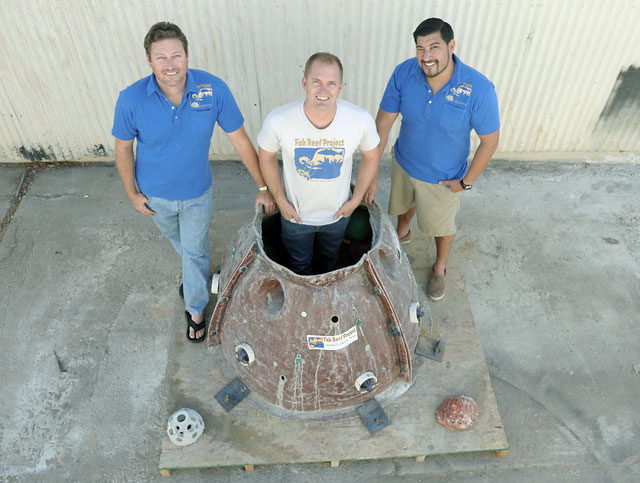
Roughly five weeks ago, with the hope of jump-starting a plan to install a fish — and fishermen — friendly artificial reef offshore of Santa Barbara, Chris Goldblatt, himself a former commercial fisherman and outspoken critic of the recently imposed, state-sanctioned marine protected areas in Southern California, and some colleagues dropped two 1,300-pound hollow concrete igloos into the ocean offshore of Hendry’s Beach.
The custom-made objects, known as reef balls, were deployed with little fanfare and without the direct knowledge of any regulatory agency. As you can imagine, in a community that prides itself on keeping regular tabs on its ocean resources, that relative anonymity has been short-lived. “No doubt [Goldblatt] jumped the gun a bit,” explained the California Coastal Commission’s Cassidy Teufel last week. “At the very least, you definitely need a permit from us to do something like that.”
Premature ball-dropping aside, Goldblatt and his officially named Fish Reef Project are angling to eventually build a large artificial reef, roughly five acres in size, somewhere off the coast between Miramar Beach in Montecito and Loon Point in Summerland. The idea is that by creating a carefully designed hardscape habitat on the ocean floor comprising reef balls (3-by-4-foot rounded hollow shapes with various open portals on them and flat surfaces) and large quarry rocks, marine life will move in, new life will be recruited, and a thriving marine ecosystem will eventually develop in the area and form a space that proponents say will be a boon for both fishermen (recreational and commercial) and researchers alike. “If done right, there is just no downside to this,” opined Goldblatt recently. “Reefs are a rare and precious oasis of life, and we need more of them.”
The concept of an artificial reef is nothing new. In fact, not only did the California Department of Fish and Game have an actual reefing program for much of the second half of the 20th century (it was eventually defunded in 1989), but, as Goldblatt is quick to point out, there are artificial reefs currently off the shores of more than 70 countries, many of which use the reef ball technique. There are also success stories right here in California such as the SONGS (San Onofre Nuclear Generating Station) reef just south of San Clemente, built by Edison as a form of mitigation related to the nearby power plant.
However, despite this, the structures are not without controversy. After all, any time something large and manmade gets put in the ocean, there is always the chance for disaster. As Teufel — who, in his position as an Environmental Scientist for the Coastal Commission’s Ocean Resources Division, has had ample experience with similar projects — puts it, “It is not as simple as just chucking some materials down and getting kelp and fish populations to move in. There is quite a bit of scientific legwork required and a very lengthy permitting process that includes everyone from us to the State Lands Commission to the Army Corps of Engineers to Fish and Game.”
Other concerns held by groups such as the Environmental Defense Center and Santa Barbara Channelkeeper include the potential for an inappropriately sited artificial reef to cause a fish population sink or crash at nearby naturally occurring habitats or the luring of wildlife away from the safe haven of existing marine protected areas to unrestricted waters.
Given these worries, when word spread late last month that Goldblatt had already installed a pair of reef balls without really reaching out to the nearby environmental community or the various regulatory agencies, not only did the collective neckhairs of Santa Barbara’s various ocean watchdog groups stand straight up, but the Coastal Commission’s enforcement wing also opened up an official investigation and has since declared, via a written notice, that the two balls meet the definition of development under the Coastal Act and now must seek after-the-fact approval or be removed.
Adding to the controversy is the fact the balls were deployed as part of an existing aquaculture operation off of Hendry’s owned by Santa Barbara’s Justin Mezey. For his part, Goldblatt explained that the reef balls were technically plopped down, with Mezey’s permission, as anchors for Mezey’s Blue Revolution mussel and oyster aquaculture research business, the idea being that, by getting a few reef balls in local waters, he would be able to document how quickly they recruit life and thus provide some hard — albeit small sample size — evidence of what he hopes to accomplish in the future and boost fundraising efforts.
“It was a way to get a few of them down and see how they work,” said Goldblatt of the violating balls. “We weren’t trying to skirt any permitting; we just thought they were within the scope of the existing aquaculture permit.” Unfortunately, according to Coastal Commission staff, not only are the reef balls in need of permits, but Mezey’s entire operation — around since the mid 1990s under the jurisdiction of the City of Santa Barbara, thanks to the ribbon of Pacific Ocean given to the city to help with annexation of what is now the S.B. airport — also needs a permit from the Commission and, according to their enforcement staffers, has since been deemed to be in violation of the Coastal Act.
Despite the hiccups with the Commission staff, Goldblatt remains upbeat about the prospects for his plans. Saying he is actively working with the agency to get the proper approvals in place, Goldblatt detailed a “very positive” presentation he gave to the Advisory Council for the Channel Islands National Marine Sanctuary last week about the goals of the Fish Reef Project. “It is a form of peer review,” said Goldblatt about going before the Advisory Council. “Basically everyone from our ocean community is represented there. … Obviously, we have to address any concerns [they have] before we move forward.”
In the meantime, however, Goldblatt is most excited about the visit he paid last weekend to the illegal reef balls off Hendry’s. “Already they are just crawling with life,” he beamed. “There were starfish, small barnacles growing, crabs crawling around, and small rockfish swimming by. It was pretty cool to see.”


Print friendly
E-mail story
Tip Us Off
Comments
Share Article
Myspace


Previous Month


Comments
Good for you Chris. If you would have had to wait on the Coastal Commission, we would all be collecting what's left of our social security in 2020. They lost their way a long time ago.
Wasn't their mandate to protect coast lines while maintaining coastal access?
BeachFan (anonymous profile)
July 26, 2012 at 8:37 a.m. (Suggest removal)
"they were concerned with luring fish from the safety of the sanctuaries"??
How out of touch are these scientists!!
Go Chris!!
dadof3 (anonymous profile)
July 26, 2012 at 9:27 a.m. (Suggest removal)
Go Chris!! Yipee!! Thanks to you, any dipchit will think he can dump concrete rubble and crap in the ocean and claim it is an artificial reef.
.
BUSS-TEDD!!
John_Adams (anonymous profile)
July 26, 2012 at 8:27 p.m. (Suggest removal)
I certainly hope that this scheme turns out to be beneficial. However I strongly disagree with Beach Fan. The Coastal Commission staff are doing a tremendous job with sadly limited resources and have no evil axe to grind to impede good things. I hope the Mr. Goldblatt is pure in his motivation and he is not rushing into this for some sort of financial gain. It is my understanding that he has been invited by the local Santa Barbara chapter of Surfrider Foundation to give a brief presentation on his proposal at the Watershed resource Center at Hendry's beach Thursday evening August 16th. Anyone interested in hearing more, asking questions and perhaps hearing some pros and cons should plan to attend.
www.sbsurfrider.org
Noletaman (anonymous profile)
July 26, 2012 at 9:44 p.m. (Suggest removal)
Wow, this is like needing a permit to feed the homeless.
Hopefully they will overlook and encourage this project without giving them undue burdens.
loonpt (anonymous profile)
July 27, 2012 at 11:05 a.m. (Suggest removal)
Will the discussion at the Surfrider meeting include the "pros" of dumping in the ocean without a permit?
John_Adams (anonymous profile)
July 27, 2012 at 12:56 p.m. (Suggest removal)
These comments, for the most part, read like someone called all his pals and told them to have his back on this travesty. How arrogant do you have to be to do something like this and then expect to get the go ahead later?
For shame.
chilldrinfthenight (anonymous profile)
July 28, 2012 at 4:39 a.m. (Suggest removal)
The reality is the Fish Reef Project’s dedicated volunteers have donated thousands hours to help create new life in the sea that everyone benefits from. Historically Aquaculture operations were not forced in obtaining additional coastal commission permits to simply put down anchors- however once it became clear that the commission is requiring such permits we have complied fully, submitted applications and paid huge fees- we are a small grass roots nonprofit working to making the ocean healthy, offset overfishing, reduce greenhouse gases, ocean acidification and unite the ocean community after the great MPA fight as we can do more good as unified group that we can scratching each other eyes out- so I ask anyone who truly cares about the health of our ocean to join us in this cutting edge effort to help ocean life thrive-yes even you Mr. Adams are welcomed to be part this-
The Hendry's site is only a test for the future projects and the balls make no more of a footprint than lobster trap and certainly far less than the six tone anchors deployed by the cruise ships and navy when they call at SB. The Aquaculture lease holder were generous in letting us provide them with life giving anchors-think of it as urban gardening- it’s making the best use of space while giving back to the ecosystem.
There will be 12 Billion of us soon and reefs are one of the best way to make the ocean strong enough to offset human impacts.
Oh- and NOBODY not even me draws a salary for the countless hours we put in to make this happen. We are doing this for love of the ocean and nothing more.
Chris Goldblatt
Fish Reef Project
ChrisGoldblatt (anonymous profile)
July 28, 2012 at 10:50 a.m. (Suggest removal)
The SB oil derricks are great fishing locations. But so are the aircraft, and oil derricks they dump off in the Atlantic and the Gulf. But i certainly prefer these smaller "more natural" systems. Especially if they are made from recycled materials that cant get a second use somewhere and dont pollute. I see a need for permits for navigation reasons or to keep from hitting a pipeline or oil cap. But this is one of many approaches that we need to do to restore and improve fishing.
passagerider (anonymous profile)
July 29, 2012 at 2:48 p.m. (Suggest removal)
I dropped out of Surfrider long ago because they seem unable to understand both sides of any discussion and have become as myopic and hysterical as the EDC.
JohnLocke (anonymous profile)
July 30, 2012 at 2:41 p.m. (Suggest removal)
Keep up the good work Chris! We got your back! and most of us who can actually look at an issue and analyze it realize that artificial reefs are a good thing especially ones as eco friendly as the reef ball! I remember telling you a while back that channel keepers could be allied on this as they have worked to plant kelp and make habitats in the past. Boy was i wrong! Apparently it is ok for them to plant kelp but to put in something for the kelp to grow on is just out of the question to them. Organizations like surf rider and channel keepers have their hearts in the right place but they need to look at the end outcome not the steps to get there. We want the same things. This should be a bi partisan effort.
cmetzenberg (anonymous profile)
August 2, 2012 at 2:17 p.m. (Suggest removal)
I have free dove the Caribbean tourist ocean wastelands, where old engine blocks serve as mooring anchors for the swimming nets, to keep Jet Ski out of swim zones. The dual unintended luxury of those engine blocks is housing for exotic rare fish. In the early morning hours you can see some of the rarest of the Caribbean fish hiding in the cylinder blocks of these engines. If you swim the yellow nylon buoy line following the engine blocks you discover the quantity and quality of fishes living and hiding among them is amazing. Therefore, it would be hard to argue against these benign cement reefs.
A permit in California, no doubt a slothful way to go about something such as this and unfortunate that volunteers and private funds were used. The lesson for researchers, the state, the feds, and environmentalists is not to spend public money investigating this as a crime, rather to emulate this agriculture on a larger scale. People that spend time under water, classically trained or expert from time spend paying attention should be heard. This is a simple, inexpensive and sturdy small reef. The reef ball, bell, honeycomb, labyrinth is what small fish and octopus look for in nature. The problem is the permit? The Federal Government has allowed first timers a pass.
The next project I am looking to follow over the years is the Ocean Meadows Golf Course being dug up to allow water in to reestablish a wetland. In synchronicity to that they are trying to save Goleta Beach. I don’t think that we have a whole approach to viewing our coastal issues geologically, meteorologically or from the stand point of oceanography. If we did maybe we would better be able to understand the marine biology issues. The planning in this county is very poor because the denial factors are so high in the top three mentioned sciences.
Special interest groups have zero influence over geology, meteorology and oceanography. So they shift focus to under water development. They speak very little about El Nino and La Nina. The life and death of the kelp forest, the mover of fish, the drought breaker and flood maker. What a great diversion from science and basic ocean habit. We ask ranchers to leave small branches from fallen trees to create habitat for birds and small mammals. They get to take the rest of the fallen tree.
Check the materials used by these guys on the (2) prototypes. That an enormous amount of study needs to be done is untrue. There are plenty of documented underwater models to look at. This is a benign experiment. Too bad that these young men did not have mentor; like UCSB to help them, even now. However, because someone without a PhD didn’t figure it out, slim chance on that happening now.
jw (anonymous profile)
August 4, 2012 at 12:44 p.m. (Suggest removal)
No good deed goes unpunished.
Ken_Volok (anonymous profile)
August 4, 2012 at 1:23 p.m. (Suggest removal)
JW!! for the win
dadof3 (anonymous profile)
August 9, 2012 at 8:19 a.m. (Suggest removal)