
Robert A. Huttenback was born in Frankfurt, Germany, on March 8, 1928. His family emigrated to the United States in 1939. He attended UCLA, where he earned 13 varsity letters and a BA in history. Following two years of Army service, he returned to UCLA and received a PhD in history in 1959. He then went on to Caltech, where he coached soccer, taught history, became dean of students, and established a graduate program in social sciences. He is the author of a number of books on racism and imperialism. In 1977 he became the third chancellor of UCSB. On June 10, 2012, he passed away at his home in Camarillo, California. This In Memoriam reflects memories of our interaction with Chancellor Huttenback during the establishment of the NSF Institute of Physics at UCSB.
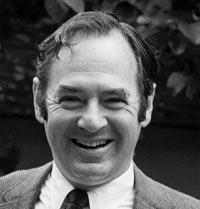
Robert Huttenback played a key role in the decision by the National Science Foundation (NSF) to establish the Institute for Theoretical Physics (ITP) at UCSB. In early 1976, the NSF solicited proposals to establish a new institute that “would bring together physicists from different locations and age groups to stimulate the continued flow of new ideas.”
The announcement created great excitement in the physics community, and over 30 universities throughout the United States submitted proposals. Huttenback, who was still at Caltech, had heard about the proposed institute from a Nobel Laureate colleague in the Caltech Physics Department. Caltech was submitting a proposal, and this colleague noted that UCSB, where Huttenback was headed, wouldn’t have a chance in this competition.
As the competition evolved, Caltech, the University of Illinois, a Cornell-Yale consortium, UC Santa Cruz, and UCSB were selected as finalists and invited to present their proposals to a peer-review panel in Washington, D.C., in the fall of 1977. At this meeting, the UCSB group announced a new key element to their proposal: three new faculty positions for physicists who would work at the NSF Institute, providing continuity for its postdoctoral fellows as well as the institute as a whole.
This idea was well received by members of the review panel, but they questioned whether the UCSB proponents could guarantee the newly proposed faculty positions. Indeed, the Caltech group knew that Dr. Huttenback had not yet arrived at UCSB to take up his new position. So, the UCSB physicists phoned Huttenback in Pasadena, introduced themselves, and described the situation.
His response was immediate: “So they want to play hardball. Tell them that I will guarantee the three positions and do everything I can to see that the Institute for Theoretical Physics becomes world renowned. By the way, give my best to my Caltech colleagues.” He was as good as his word, not only backing previous commitments, but playing an important role in securing the institute grant through direct interactions with the NSF over critical issues, such as space, while protecting campus interests.
Huttenback was a great friend and supporter of the ITP and the UCSB Physics Department. His enthusiasm and his vision were instrumental in recruiting the first ITP director, Walter Kohn; the first ITP faculty appointment, Frank Wilczek; and physics department members J. Robert Schrieffer and Alan Heeger. While Schrieffer was a Nobel Laureate when he arrived at UCSB, the others were awarded the prize after coming to UCSB.
An example of Huttenback’s recruiting style occurred when Schrieffer was considering an offer from the Physics Department. He arrived at LAX from the East Coast, intending to travel from there to Santa Barbara on his own to visit the campus. However, Huttenback insisted on meeting him at LAX, and he drove up beautiful Highway 1, while extolling the virtues of the campus and his vision for its future.
Shortly thereafter, Schrieffer accepted our offer.
There is no doubt that Huttenback’s strong support for the ITP stemmed from his devotion to intellectual quality across all disciplines. He realized that an internationally renowned institute or department in one area could help to foster excellence across the campus. The ITP was the first of several major initiatives he promoted. For example, his leadership played a major role in the evolution of the College of Engineering into the highly distinguished institution it is today. Clearly, UCSB’s standing as a leading research university is due to the efforts of many individuals. Robert Huttenback played a leadership role in the critical early days of this development.