Who was Davy Brown?
Marksman Makes Home Near Figueroa Mountain

Davy Brown Campground, located just to the northeast of Figueroa Mountain, is named for William S. (Davy) Brown, who lived in this area in a wooden cabin in the late 1800s. Brown remains a mysterious figure to this day. He was not one to readily share stories of his early life; so much of what we “know” about him is more a matter of speculation.
According to his death certificate, Brown was born in Ireland in 1800. The period between the year of his birth and his arrival in California in the late 1840s is shrouded in uncertainty. Reportedly, he served on a British privateer during the War of 1812 and at some point may have been involved in the slave trade between Africa and Cuba.
How he came to settle in the U.S is yet another mystery. One story has him captured by the U.S. Navy, and then released. Stories have also circulated about Brown getting in trouble with the law, perhaps even committing murder, but none of these has ever been verified. He also reportedly hooked up with famed hunter and guide Kit Carson for a time.
In 1883, the Santa Barbara Daily Independent published an account of a visit by a group of hunters with Brown, and it is probably one of the more reliable sources of information. Apparently, Brown made his way to California in 1848 or 1849. Unlike the thousands of fortune seekers who made their way to the gold rush fields, Brown put his superb marksmanship to work by becoming a deer hunter to supply meat for miners’ tables. He also worked in Calaveras County as a bear hunter, and Brown related a story to his group of visiting hunters of how he bagged 10 grizzlies in one week.
By 1872, Brown was living in San Francisco. His unquenchable thirst for liquor resulted in a serious illness, and doctors pronounced him near death. Brown fooled his physicians, however, and made a full recovery. He then moved to the wilds of the San Mateo hills. A few years later, by now in his mid seventies, Brown drifted southward and bought some acreage near Guadalupe to farm.
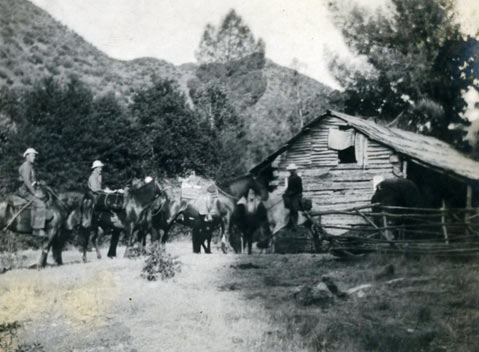
The call of the wilderness was too strong, and about 1883, Brown took off again, this time to a site near what is today Davy Brown Creek. Reportedly, he lived in a hollow sycamore tree upon his arrival. He then built a cabin of rough-hewn logs with a roof of oak shakes. Brown used this main building only for storage. Living quarters consisted of two lean-tos, each open on two sides. The wall of one lean-to consisted of a huge fireplace, about six feet high and four or five feet deep. Brown used his two mules, Tommy and Captain Jinks, to haul large logs to the lean-to and right into the fireplace. Brown would set one end of the log aflame and skid it forward into the fireplace as it burned down.
Brown developed quite a successful farm at his new home. The nearby creek was full of trout, and Brown semi-domesticated a doe that he used as a decoy to lure bucks within range of his rifle. In the late 1890s, Brown moved back to the Guadalupe area. There he died in 1898.
Brown’s abandoned cabin became a popular shelter for hikers, hunters, and fishers. The cabin was torn down in the early 1930s and the large fireplace demolished. A pile of dirt and rocks at one end of Davy Brown Camp sits as testimony to the hunter’s backcountry home.