Where Do the Homeless Heal?
A Special Report on What Happens to Santa Barbara’s Homeless After Hospital Visits
On a sweltering Wednesday afternoon last month, a tall, mild-mannered homeless man was walking up State Street when he became dizzy and short of breath. He sat down on a bench in front of Chipotle Mexican Grill and, within minutes, became unconscious. Forty-one-year-old William Richardson did not know he was a diabetic or that his blood sugar level was soaring past 764. (Normal is 120 and below.) His body was shifting into the deadly state of ketoacidosis.
Coincidentally, Richardson’s mother was walking up State Street, too, and saw her son just before he collapsed. She informed a Paseo Nuevo security guard, who called paramedics. Richardson was taken by ambulance to Cottage Hospital’s emergency room and then admitted to the intensive care unit. After two days of medical intervention, his condition stabilized, and nurses began teaching him how to inject himself with insulin — something he will need to do four times a day from now on. A little later, doctors said he was ready for discharge. And that’s when a whole new set of problems arose: Richardson had nowhere to go.
Being discharged from the hospital is ordinarily a relief for patients, but for the majority of Santa Barbara’s homeless, it’s when life gets even more complicated. There are only two reliable facilities to which homeless hospital and emergency room patients can be transferred: WillBridge, a small residence for the homeless mentally ill, and Casa Esperanza Homeless Center.
Skilled nursing facilities would be appropriate for some homeless patients, but as they require that patients be covered by Medi-Cal insurance and have a physician overseeing their care, they’re rarely a viable option. And because WillBridge is small and has no nurses on staff, the majority of homeless patients who don’t want to return to the streets upon discharge are usually sent, via taxi, to Casa Esperanza.
Patient Dumping
Since the late 1970s, when it first became common to see people sleeping on park benches and in doorways in the nation’s urban centers, hospital discharge planners, shelter operators, and social-service providers have wrestled with how to care for homeless patients who are no longer sick enough for hospital care, but are too sick to live on the streets. Compounding the problem is that hospital stays have shortened due to managed care, and patients are often sicker when discharged than before.
In 2006, the issue became national news when a video camera outside a Los Angeles homeless shelter captured an elderly patient in a hospital gown looking confused and lost as she stepped out of a taxi following her discharge from a Kaiser Permanente hospital. After investigating over 40 separate cases of alleged “patient dumping” by 10 different hospitals, only Kaiser was charged with criminal false imprisonment and dependent-care endangerment.
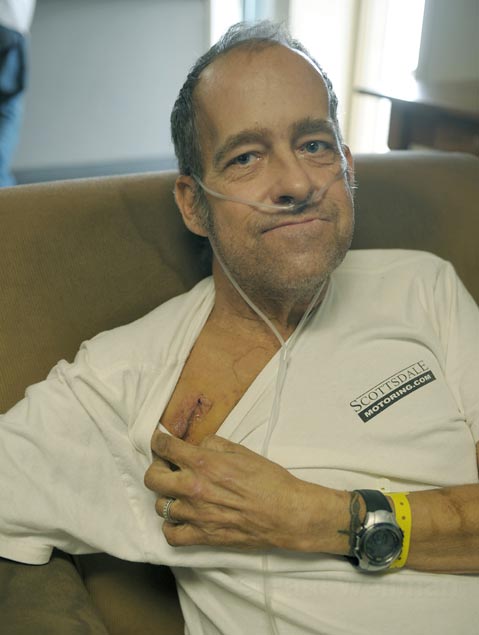
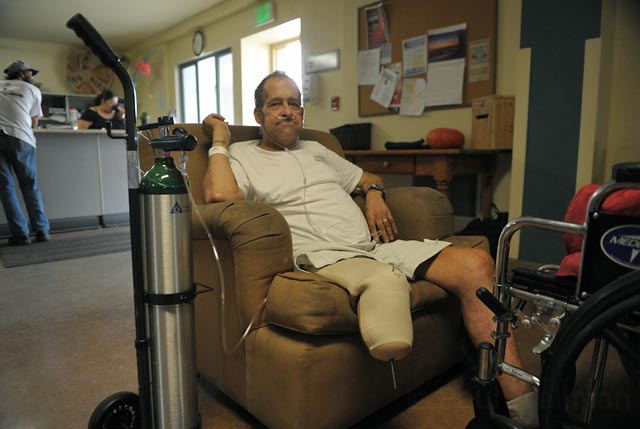
As part of an Online Community Building and Health Fellowship offered by the USC Annenberg School for Communication & Journalism, HomelessInSB.org, my Santa Barbara homeless blog, has been examining what happens to homeless patients after they are discharged from hospitals in southern Santa Barbara County. I’ve tracked four homeless people who have recently received care at Cottage Hospital. The three men and one woman have unique stories and struggles, but each one is homeless, broke (or close to it), and without family nearby who can take them in. Their stories illustrate the most common outcomes for homeless patients here and suggest ways in which the discharge system could be improved. I also visited two other California cities, San Jose and Los Angeles, to learn how they are managing the needs of recuperating homeless patients.
Circuitous System
There hasn’t been any patient dumping in Santa Barbara, as far as I can tell. Homeless patients are never discharged without some planning for their aftercare; everyone is offered, at minimum, a bed at Casa Esperanza, where they will be given one week of unlimited bed rest and access to nursing care. Sometimes, a bed at the smaller, quieter WillBridge is available, where there is case management but no nursing staff. Cottage Hospital’s discharge planners and the staff of Casa Esperanza and WillBridge are all doing their best within this system.
Unfortunately, the system is uncoordinated and underfunded. Todd Cook, Cottage’s director of quality control, said the hospital is almost always able to provide a safe place to discharge people. “We wouldn’t let them just go without having a safe handoff and feeling comfortable that the next level of care they’re going to get will be sufficient to meet the needs of whatever conditions they’re working through,” said Cook.
Even so, it’s not uncommon for Casa’s staff to send a discharged patient back to Cottage because he is too weak to perform basic daily functions, like getting himself to the bathroom. And it is also not uncommon for patients to arrive at Casa without their prescribed medicines or with the wrong medicine. The inefficiencies inherent in this system, including readmissions, are likely costing Cottage Hospital and the community more than it would cost to run a 24-hour medical respite center for recuperating homeless people. Research has established the cost savings of these programs, which are sprouting up throughout the country.
Between January and September, Cottage’s Emergency Department discharged 267 homeless patients to the street, almost always at their request. The hospital doesn’t keep data for inpatient discharges. But Casa Esperanza received 306 Cottage patients between January and September; WillBridge received 15. The hospital gives money to both programs to accept their homeless patients. Casa received its largest grant ever from the hospital this year: $125,000. Casa’s executive director, Mike Foley, said the shelter bills the hospital $39 for every medical bed night a patient spends there, up to $125,000. After that, the beds are provided free. According to Lynnelle Williams, WillBridge’s executive director, her program received $20,000 from Cottage Hospital for its respite bed nights in 2011. But as of October 14, those funds are depleted.
A 1998 New England Journal of Medicine study found homeless patients stay an average of four additional days in hospitals than “housed” patients suffering the same conditions. Cottage spokesperson Janet O’Neill said it costs $1,200 to simply keep a patient overnight there, without even providing medical care. As few homeless patients have insurance, this cost is almost always borne by the hospital.
Sick and Dizzy
Though William Richardson’s discharge from Cottage was discussed and planned, it was hardly smooth. WillBridge had a bed for him. His mother accompanied him there with his medication. But when intake manager Nick Ferrara completed the paperwork, he decided that Richardson’s condition, with the special diet and his being unsure about giving himself daily injections, was too fragile. So Ferrara let Richardson spend the night, but took him back to Cottage the next morning. At the ER, Richardson was given his shots and more training in insulin injections. He was sent to Casa Esperanza around 5 p.m. At Casa, Richardson objected to having a top bunk, and began feeling dizzy again. He went back to the ER.
Once again, Richardson, who has a learning disability, was given his shots, more training, and sent back to Casa, where nursing staff let him sleep downstairs in the lobby. The next day, when he went to give himself his injection, he discovered the hospital had given him insulin pins, not the vials and syringes he had been trained to use. He’d never seen the pins before, plus he was feeling dizzy again. The shelter nurse sent him back to the ER in an ambulance, where nurses there taught him how to use the pins.
Gradually, Richardson is adjusting to having diabetes and to living in the chaotic surroundings of Casa. He has been to the ER two more times since that first bumpy weekend and described the whole experience as scary. “At first I didn’t want to come [here] because I knew there were a lot of people and a lot of drama,” he said. He was happier when he found out he was going to WillBridge. “I guess it was a misunderstanding.”
Stay tuned for future reports on Independent.com and HomelessinSB.org.