Frank Lloyd Wright
Santa Barbara Is Home to One of the Architect’s Designs

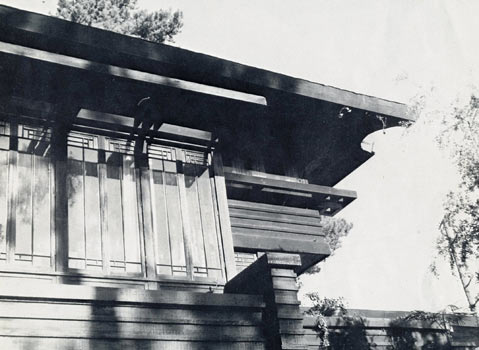
Frank Lloyd Wright designed 24 residences in California. His commission from George C. Stewart for a home near the intersection of Hot Springs and Summit roads in Montecito was his first in the state and the only one on the South Coast. The Stewart house is an outstanding example of Wright’s work in the prairie style.
In 1909, Stewart, a Seattle accountant, was casting about for an architect to design a getaway home for his family. Reportedly, it was Mrs. Stewart who first approached Wright. The architect drew up plans not only for a main house but also for a gardener’s cottage, stables, and a work shed, all of which were built but for the cottage. The house was completed in 1910.
There were a number of unusual features about the construction process. Wright often took very much of a hands-on approach in regard to construction, not all that uncommon for architects of the period. Additionally, clients would engage his firm to design furniture, wallpaper, and even china for a new home. Stories abound of Wright becoming enraged when owners dared to override or ignore his design ideas.
This close supervision did not occur with the Stewart house. Late in 1909, Wright left his family and business for a year-long stay in Europe with his mistress. Also, by this time he was losing interest in the prairie style. These two factors explain much about his lack of supervision of the Montecito project.
Still, the house is a gem. Homes in the prairie style generally presented low, horizontal silhouettes. Wright wanted to establish a natural flow between interiors and outside surroundings. With the Stewart house, he achieved this through the placement of more than 360 windows, in effect inviting the outdoors in. In addition, redwood siding was used to blend the house further into its wooded site. Originally, there was a notch in the eaves to allow room for a large eucalyptus tree, which eventually died.
The Stewarts did tinker with Wright’s original plans. An open-air porch on the first floor was enclosed in glass and the servants’ rooms were enlarged. Wright often designed fairly small rooms in his homes and sacrificed his clients’ creature comforts to fulfill his artistic vision. In 1930, the Stewarts enlarged two of the bedrooms and added a half bath.
The Stewarts owned the home until 1942, when Greta Blickenstaff bought it, signing the papers less than one hour after she first toured the house. She owned the home for 42 years. By the time she sold it, the house had fallen somewhat into disrepair. After the brief tenure of a third owner, Jerald Peterson bought the home in 1986 and undertook a restoration project. The grounds, badly overgrown, were cleaned up, the house repainted, and a new roof put on. Dry rot under the home’s flooring was addressed.
In 1985, the nonprofit Stewart House Foundation was founded with the intent of eventually purchasing the house, opening it for tours, and utilizing it as a cultural center. Rising real estate prices foiled this vision, and, in 1993, writer T. Coraghessan Boyle bought the house. Like Blickenstaff, he too made a quick decision, buying the home the same day he saw it for the first time. In 2009, Boyle came out with The Women, a novel about Frank Lloyd Wright.
The Santa Barbara area is home to any number of architectural treasures. The George C. Stewart house, architect Frank Lloyd Wright, must certainly be numbered among them.