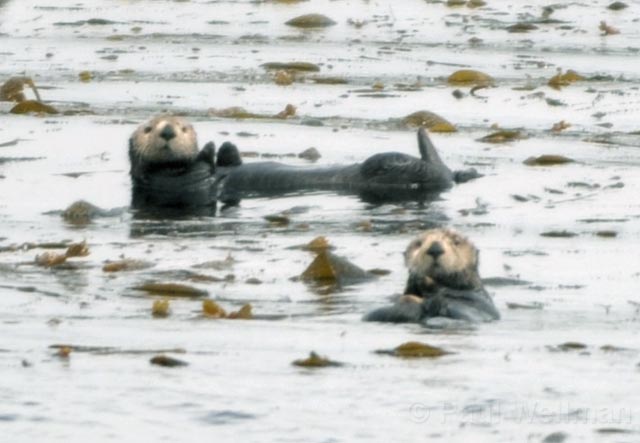
Not even the most politically savvy sea otter activist tries to deny it: If the endangered species is once again allowed to swim in Southern California waters as is currently being proposed by the U.S. Fish & Wildlife Service, the commercial shellfisheries along the mainland coast from Point Conception to Carpinteria — namely spiny lobster, sea urchin, crab, and sea cucumber — are likely to be decimated within a decade. “It’s like introducing Godzilla to Southern California,” claimed fisherman Jerome Betts of Santa Maria, one of more than 25 speakers who talked before about 100 attendees during Tuesday night’s hearing at the Santa Barbara Museum of Natural History. But that’s a small price to pay for saving a species from extinction, argue scientists such as Chris Harrold with the Monterey Bay Aquarium. “The science is crystal clear,” said Harrold, explaining that the evidence repeatedly shows that otters turn coastal zones into healthy kelp forest ecosystems that support an astounding diversity of life. “[The otters] need all the help they can get.”
The hearing was to gather public comments on Fish & Wildlife’s plan to end the 24-year-old translocation program, which sought to establish another population on San Nicolas Island in the event of the oil spill or other disaster on the Central Coast, where the otters have persisted for millennia; the program — which moved any otter that ventured south of Point Conception to San Nicolas — was also a tradeoff for Santa Barbara Channel fishermen, who successfully argued for their cause in the 1980s when the special rule to enable the program was passed. But the program never met its goals — otters died, migrated, and disappeared from San Nic, although it’s still home to a steady population — and the feds stopped touching otters that disobeyed the invisible line in the sea long ago.
On Tuesday, the crowd was divided between fishermen — including those that use gill and trammel nets to catch halibut and sea bass, as they may have to move further from the coast if otters return — and otter advocates, from kayakers and UCSB students to professional conservationists. The fishermen threw out a number of arguments: the program is not actually a failure due to technicalities, otters are more threatened by pollution, otters will starve themselves and kill fisheries, otters will decimate endangered abalone species, and there’s no compromise on incidental take. “An alternative should be developed to allow the protection of the commercial fishing industry,” said Chris Voss, head of the California Abalone Association That, who explained that was done in the past. “Now there’s this ridiculous move to not do that…We’ve got to strike a balance.”
Otter fans, meanwhile, expressed openness to discussing rules about incidental take, so long as it didn’t delay the official end of a program that hasn’t been in effect for years anyway. And though shellfish populations may slowly dwindle below commercially acceptable levels, “it’s not going to happen overnight,” said Brian Segee, of the Environmental Defense Center, whose lawsuit against the government for The Otter Project is what led to the proposed change. “We still have fisheries north of here. We still have fisheries in Alaska….I’m confident we can have both otters and a fishing industry in Southern California.”
Related Links
- Taking Sides in Otter Showdown [ September 30, 2011 ]


Print friendly
E-mail story
Tip Us Off
Comments
Share Article
Myspace


Previous Month


Comments
Matt, Matt, Matt... you should be reprimanded for publishing false information.
Otters are NOT an endangered species.
The no otter zone was a compromise after the "otter fans" and the USFWS violated the marine mammal protection act by unilaterally translocating otters to San Nic. This only happened cause they got caught.
The USFWS has not kept the obligation of following the law for the last 20 yrs.
The otters original range can no longer support their need for food.
Otters are dying from pollution & starvation.
All this from some folks who don't care about the ecosystem or other species... they want otters cause they make a lot of money off of them(expoitation). And, being a "THREATENED" species, they keep fishermen away.
There is no other animal that earns more money/grants in California.
I have one word for this bias article...."Myopic."
JeffCrumley (anonymous profile)
October 6, 2011 at 12:02 p.m. (Suggest removal)
Mr. Crumley is certainly splitting hairs here. The southern sea otter is listed as "threatened" under the Endangered Species Act. In ordinary vernacular, any ESA listed species is generally referred to as endangered. But whatever, there are around 2700 southern sea otters where there were between 12,000 and 15,000 according to the best available science.
Otters die from a variety of causes including disease (that is by far #1), boat strike, gunshot, shark bite, and research. Very few otters are found emaciated - an indication of starvation.
I do strongly disagree with Mr. Kettman on his opening point. Otters will not decimate shellfish fisheries within the decade -- there just aren't hundreds of otters lined up at the line ready to swim south. It took 80 years for the sea otter range to expand from Big Sur to Point Conception; it will perhaps take as long for the otter's range to expand from Pt. Conception to the Mexican Border and throughout the Islands. Commercial fisheries will very likely adapt during that time from shellfish to finfish -- as they have done up and down the coast within the sea otter's current range.
SteveShimek (anonymous profile)
October 6, 2011 at 1:49 p.m. (Suggest removal)
To Jeff:
Sorry for the misinfo on the status. Threatened is different than endangered, and I've made the mistake a couple times, it seems. Otherwise, however, I think the article is quite fair, some might say overly so, to the fishermen who will be impacted by the plan.
To Steve:
Sorry you disagree with my assessment, but no one at the hearing even attempted to discount the information about commercial shellfisheries that was published as part of the notice in the Federal Register.
It reads: "Selected fisheries, both commercial (sea urchin, crab, lobster, and sea cucumber) and recreational (lobster), would likely be eliminated in mainland coastline areas predicted to be re-occupied by sea otters over the next 10 years: Point Conception to Carpinteria (lower bound) or Oxnard (upper bound)."
Everyone can see for themselves here: http://www.gpo.gov/fdsys/pkg/FR-2011-...
Matt (Matt Kettmann)
October 6, 2011 at 3:39 p.m. (Suggest removal)
Not spitting hair at all, Mr. Shimeck. In fact you can't produce any taxonomy that shows the "southern sea otter" is any different from the otters in Alaska. These otters in Big Sur "dicovered" back in the 30's were translocated from Alaska to make room for a military firing range. Funny how they landed in Margaret Ownings "back yard." They were listed as threatened as a favor to Margaret by some Gov. big wigs that her husband designed for as an architect.
What's more, your idea that otters should inhabit their entire range is insane at best. The ecosystem is nowhere near what it was 100 yrs ago and the prospect of otters having a sustainable food supply is a step beyond reality. To have otters in So Cal is akin to putting my kids goldfish in a jobsite port-a-potty and expecting it to thrive. Read "Otters in a Dirty Ocean" - Jessup 2007 (co-authored By Melisa Miller) You can't even keep the ones alive in "pristine" conditions of Central Cal.
As for how long it takes to decimate other species...you say it will take a decade? HA! First off, it is incredible that you would accept the demise of even one other specie so you can exploit otters.
The Cojo Anchorage in northern SB County was eliminated in less than 2 years by100 to 200 sea otters in 1998/99. This would have been avoided but for USFWS.
This same thing happened at Pt. Buchon between Port San Luis and Morro Bay in an
approximate 2 year period between 1973-1975 as published by the California
Department of Fish and Game in Diablo Canyon Nuclear Power Plant Baseline
Studies, 1983/84. And to the Pismo clam fisheries at Morro Bay and Pismo Beach.
To top that off, otters were found dead from infections and having abscessed teeth from broken mussel shells they ate from severe hunger; after eating/destroying pismo clams at Pismi Pier.
Go ahead and continue this with me here Steve buddy!! I'll break out the file cabinet and show your fans proof of your deceit and miss-information.
I know all about you, Julie and your sea otter lies.
Standing By.... over...
JeffCrumley (anonymous profile)
October 6, 2011 at 8:46 p.m. (Suggest removal)
The USFWS has not removed an otter from the southern waters in 20 years, right? My questions are:
Is there any evidence that doing away with the unenforced "Otter free zone" will increase otter population or range?
What is the evidence that the unenforced "line in the water" has been a detriment to sea otters?
ijmarsh (anonymous profile)
October 7, 2011 at 7:03 a.m. (Suggest removal)