OCD Spawns Creativity
Designer, Author, and Illustrator Stefan Bucher to Speak During TEDx Conference

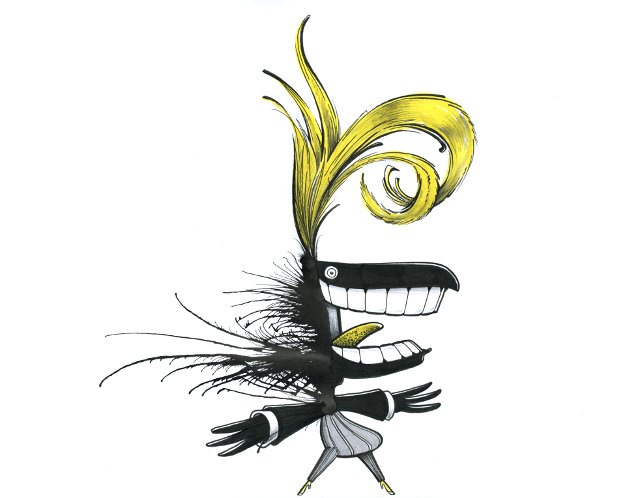
Stefan Bucher describes himself the same way he defines the monsters he draws: “neurotic, somewhat befuddled, occasionally exasperated, but generally friendly.” After interviewing him, I’d say that’s accurate but would add articulate and talented to his list of traits.
This Friday, Bucher will join an accomplished block of speakers for the second annual TEDxAmericanRiviera conference — a spin-off of the celebrated TED (Technology, Entertainment, Design) gatherings that opened in Monterey County in 1990. For his talk — titled Watch Your Head: Tales from the OCD Frontier — Bucher will tell how he funnels his compulsion for order and perfection into a successful career as a designer and illustrator. (Check out his ongoing critter-creating project at dailymonster.com.)
The following is an email exchange I had with Bucher about his life, work, and eccentricities.
Tell me a little bit about yourself. I was born and raised in the north of Germany and came to California for college back in 1993. I got my degree at Art Center College of Design in 1996 and have been working ever since. I still live in the L.A. area.
Have you been officially diagnosed with OCD? If so, how do you treat it? My OCD is of the self- and friend-diagnosed variety — more eccentricity than serious affliction, particularly as I can channel a lot of my need for order into my work. Being a designer, illustrator, and writer, my entire career is about shaping little parts of the world to my exact specifications. That said, all my pictures are hung in a precise grid, I often adjust restaurant tables to align all elements on it at right angles, and I tip waiters to achieve a palindromic total. But I’m not a clinically diagnosed sufferer. It’s a major difference, and I don’t intend to make light of a serious condition.
How did you learn to focus the extra energy or anxiety that is often symptomatic with OCD? Oh, none of it is much of a choice. I’ve been making things since I was a little kid. It truly is compulsive. I feel the need, and I’m lucky enough to have a career that lets me act on that need whenever it strikes. As for the anxiety, it’s always there to some degree, but when I get immersed in my work, it’s hardly noticeable. I don’t want to give you the impression that I’m in Rain Man territory. I’m not a control freak; I’m a control enthusiast. I can quit anytime I want. And don’t look at me like that! :^)
Do the monsters you draw reflect your “disorder” or personality? New viewers sometimes complain that the Monsters aren’t scary. They aren’t, because I’m not. Like me, the Monsters are neurotic, somewhat befuddled, occasionally exasperated, but generally friendly. Also, they’re sharp dressers.
How would you describe your style? Who do you count as your inspirations or influences? Do you think they had OCD? I’d describe my technique as needlessly ambitious and generally painstaking. There are artists who make it all look easy. I’m not that person. I work hard, and I make sure you can tell. One of my great artistic inspirations is the German artist Hans-Georg Rauch. Did he have OCD? One suspects. I’m heavily inspired by musicians of all stripes. The recording studio is a hotbed of obsessive-compulsive behavior. I just love anybody who cares openly about the importance of details.

Where did the idea of creating a daily monster come from? Why monsters? Why the marrying of clear lines and shading with unpredictable and “messy” blown ink? Working with blown ink was a conscious decision to introduce an element of chaos. My natural inclination is to keep everything very controlled, and that was getting a little stifling. I wanted elements that are more complex than what I could build consciously. Basing the Monsters on ink blots also gets me around the fear of the blank page. Thanks to the ink blot, I don’t have to start drawings; I just have to finish them.
The specific idea for the Monsters came to me in a vision as I was driving. I’m not a vision kind of guy, but there you have it. A monster appeared on my arm. I knew I had to draw him, and I understood right away how I had to do it.
Does your OCD come out in your personal life? Does it affect your ability to work with other people? When most of your waking life is dedicated to shaping things, it’s hard to switch it off at will. It takes a bit of effort to abstain from art-directing my friends. I’ve learned not to offer my advice unless it’s requested. I like collaborating with people who work as hard as I do. There are people who have healthy boundaries and keep a balance between work and their private life. I have a hard time understanding those people. It’s much more fun to be with fellow maniacs.
What do you hope listeners take away from your TEDx talk? You’ll have to come see the talk! :^)
4•1•1
The TEDxAmericanRiviera conference takes place Friday, November 11, at the Music Academy of the West and features presentations by experts on food, music, relationships, business, technology, and more. An application to attend can be found at tedxamericanriviera.com.