Separation Anxiety
Helping Your Dog Cope When You Leave Him Alone
It’s that time of year again. Teachers and students are back in school, while some pets are wondering what happened to their best buddy they played with all summer. Unfortunately, this scenario can sometimes lead dogs to bark obsessively, chew incessantly, soil the house, and even carry out self-destructive behaviors. These are all signs that a dog is experiencing separation anxiety.
While most dogs will adjust without any issues when routines change in the fall, some pets may not. Certain dogs are more prone to experience separation anxiety than others. According to Jacque Lynn Schultz, director of Companion Animal Services at the American Society for the Prevention of Cruelty to Animals (ASPCA), “The canines most likely to fall victim are second-hand dogs. Whether from a shelter, rescue group, or greyhound-track adoption program, dogs re-homed in adolescence or older are at greater risk of suffering separation anxiety than puppies. This is probably because it is more difficult for these dogs to accept changes in their routine and environment. They cling to their new pack leader and panic when that leader leaves home to go about his or her daily business.” I want to emphasize that just because you have a rescue dog, it does NOT mean the dog will experience separation anxiety.
Before you lose any sleep, or your sanity, over this issue, there are tricks to help deal with separation anxiety. Here are some tips to help your dog adjust more easily:
• Make sure your dog is vigorously exercised before you leave the house. This ensures your dog is at least physically exhausted.
• A few minutes before you depart, divert your dog’s attention with an interactive toy. One toy that seems to work well is a Kong. They can be filled with dry kibble and sealed with peanut butter and should take your dog 10-15 minutes to consume. Since the worst of a dog’s panic is typically during the first half-hour after departure, this will keep your pet occupied during this critical period and help him get past his usual frenzy.
• Try not to make a big deal when you come and go. Leave the house quietly and without your dog noticing if possible. When you return, don’t speak or pet your dog for the first 10-15 minutes. If you remain low-key in both circumstances, your dog is more likely to remain calm as well.
• Some dogs begin their anxious behavior the minute departure activities begin. If this is the case with your dog, try desensitizing him to your normal departure rituals by performing them without leaving. For example, grab your keys, but instead of heading for the door, sit down for a few minutes. Then grab your purse or wallet and don’t leave right away. You can also give your dog a treat while performing these tasks. Do this repeatedly until your dog is desensitized to your departure behavior.
What Won’t Help
• Your first instinct may be to adopt another pet. Unfortunately, this doesn’t always work. Most separation anxiety is due to separation from the owner, not as a result of being left alone.
• Punishment is never an effective way to correct a problem behavior. In the case of separation anxiety, it may actually increase the negative behavior.
• Crating a dog with severe separation anxiety may cause him to become injured. Dogs in this state will still engage in their frenzied behaviors inside their crate and may even attempt to escape.
Most experts think separation anxiety is an issue of owners over-bonding with their dogs. To prevent this, try to encourage independence with your dog and don’t allow him to follow you everywhere you go. Make sure different members of the family are participating in dog duties. One person shouldn’t be the only one who dispenses the food, plays with the dog, and takes him on walks everyday; these activities should be shared.
There’s a product on the market that mimics the properties of the natural pheromone of a lactating female dog. A mother dog releases this pheromone to give her puppies a sense of well being. It’s called “Dog Appeasing Pheromone,” (DAP). DAP comes in a collar form, a spray and an electric diffuser that dispenses the pheromone (which we cannot detect). The theory is that your dog will feel that same reassurance he felt as a pup when he smells the pheromone. I can’t say I’ve ever tried this, but I have tried the feline pheromone with some success in shelter environments.
If your dog has severe separation anxiety, it is possible that the tips listed above may not work. In those circumstances, you might want to talk to your veterinarian about drug therapy. I have friends who had to resort to drugs and although giving medication isn’t fun, if it comes down to getting rid of the dog or putting him on medication, I’d choose the medication.
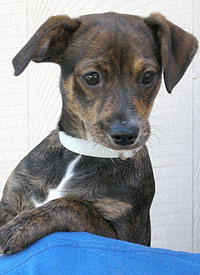
Adoptable Pet of the Week
Fizz is a wonderful four-month-old Chihuahua mix who weighs only 9 pounds! He is a mellow, adorable young boy. He likes other dogs and would do well with kids who are 10 years or older. Since he is just a puppy, he’ll need guidance, positive reinforcement training, and lots of socialization.
Visit Fizz at K-9 PALS, 5473 Overpass Rd., 681-4369 or online at k-9pals.org.