Where the Wild Things Are
Max Records and Catherine Keener Star in a Film Written by Dave Eggers and Spike Jonze, Based Upon the Book by Maurice Sendak, and Directed by Jonze

Some of us cringed and possibly cried upon hearing that Maurice Sendak’s beloved children’s book, Where the Wild Things Are, was being brought to the big screen. Sendak’s masterpiece is compact and complete, an ideal marriage of text, image, and subtle story just common enough and just fantastical enough to stake a special claim in our collective unconscious. And now Hollywood was going to get its mitts on the thing? It seemed like blasphemy from the get-go.
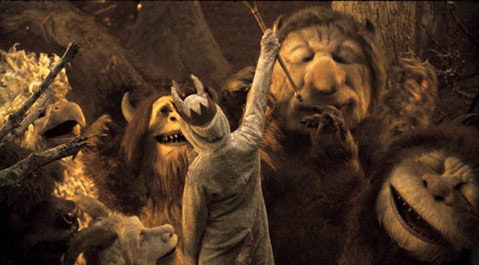
Of course, the shock was mediated by the fact that respected fiction guru Dave Eggers was brought in to write a screenplay with creatively elastic director Spike Jonze (Being John Malkovich, Adaptation). Wild Things, according to Jonze, is fleshed out-too fleshed out-in terms of imposing modern-day backstory on little Max, as well as his work-addled mother (Catherine Keener). The wild things themselves have necessarily become more three-dimensional, verging on four-dimensional thanks to the mixing of costumed live action actors and elaborate post-production CGI. From a narrative perspective, the “things” are also craftily imbued with human emotions and elements of assorted dysfunctional personality traits.
In its moments of joyous abandon, the film’s forest sequences feel like the best kind of wild rumpus, with gravity-defying and injury-defying leaping about, and dog piles that yield to cozy sleep heaps. But in Jonze’s party-pooping scenario, realities of the emotional, social, and metaphorical sort keep turning the story dark and murky, and the fantasy ends in a mild grumpus state. Into the monster party come angst and neuroses, not to mention the huge letdown of realizing that their pint-sized leader is bogus (a nod to religious and political disillusionment in the “real” world).
It’s possible to have a double-layered response to Jonze’s creation, enjoying the invention for what it is, while still harboring a nagging feeling that this thing should not even exist in the first place. Jonze and Eggers have come up with a fascinating, distinctive looking and feeling piece of cinema, it must be said. Still, forgetting the fact that Sendak approved, encouraged, and helped in the creative process, something feels inherently wrong with this picture.