Underwater Invasion
Asian Seaweed Threatens Channel Islands
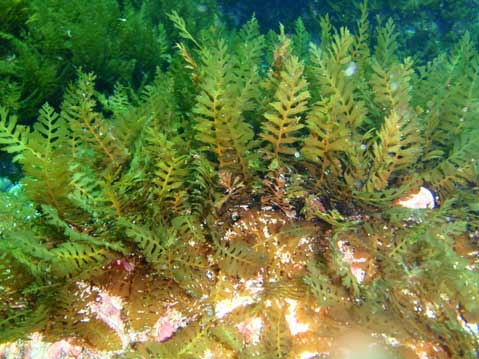
The waters west of Anacapa Island are under attack and, according to the experts, the war may already be lost. Divers from Santa Barbara Channelkeepers confirmed last week what had been feared since early April: An aggressive, nonnative seaweed from Asia that has wreaked havoc around Catalina and San Clemente islands in recent years has indeed arrived in local waters. Speaking about her discovery of large swaths of the interloping brown seaweed and the potentially dire impact it could have on the underwater ecosystem, Channelkeepers Science Director Jessie Alstatt said last week, “It is too early to know what exactly is going to happen, but it is probably impossible to stop it from spreading, and it is definitely going to compete for space with native species.”
Known officially as the Sargassum filicinum, the seaweed, which originates in Northeast Asia, first showed up in California in 2003 around Long Beach Harbor-most likely hitching a ride on the hull or in the bilge pumps of a large shipping vessel-before it spread to the leeward side of Catalina in 2006. In the time since, the seaweed has proliferated around Catalina and taken hold at San Clemente Island, as well as in some areas of San Diego. According to the UCSB Marine Science Institute’s Dr. Jack Engle, who has been one of the few people studying the weed, the trouble with controlling Sargassum filicinum is that not only does it grow rapidly and benefit from being buoyant during its reproductive stage (allowing it to ride currents from spot to spot), but it also has both male and female parts on each individual plant, thus greatly increasing its odds of survival if only one strand makes it to an empty stretch of water. “The only realistic chance to eliminate a species like this is to get it at the very earliest signs of its arrival. It is already too late at Anacapa, and maybe Santa Cruz, too,” opined Engle.
The seaweed itself is a benign algae but, when taken in the context of a native ecosystem, there is a fear that the aggressive, fast-reproducing species will outcompete and supplant native kelps without providing the same nutritious benefits for the fish and invertebrate species that rely on indigenous seaweeds to survive. “It basically creates vast monocultures of itself,” explained Alstatt, “so it seems that it will be displacing something. We just don’t know yet what that will be.” Based on what he has seen at Catalina, Engle concurs. “It has clearly taken over a lot of space [from the native species], but unfortunately, we haven’t yet done a lot of studies on its ecological impact.”
In April, a sport diver reported that he had found samples of Sargassum on the south side of Anacapa’s west end, but efforts by National Park researchers and divers from Channelkeeper to confirm the sighting proved fruitless until recently. Taking a break from seasonal eelgrass checkups, Alstatt came across the rumored invader while diving on the north side of the island’s west end. “At first, it was only one. But then we moved the boat a bit and we found thousands of them,” recalls Alstatt. Even worse, the specimens were growing in a particularly current-heavy area of the coast that typically flows westward and toward the rest of the Channel Islands. According to National Park officials, the plan is to further assess the situation in the coming weeks, to try to get a better understanding of where exactly the seaweed has moved in, and then conduct a more in-depth study of ecological impacts. “Once that is done, we will determine if there is anything we can do,” said spokesperson Yvonne Menard.