Grad Student Maps County Lagoons
Efforts May Help Endangered Steelhead
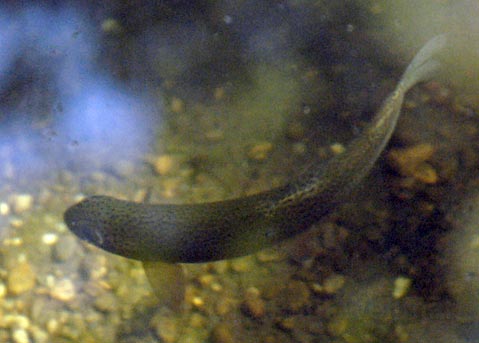
The endangered steelhead trout may stand to benefit from new research on lagoons by UCSB graduate student Andrew Rich, who claims that these bodies of water help the species survive. If the future size of lagoons can be predicted – and Rich says he’s found a way to do that – then biologists and others who protect and rehabilitate steelhead habitats would have another tool in promoting steelhead survival.
Rich explained that work done in Santa Cruz indicated that steelhead grow more when they stay in lagoons during their journey from the creeks and rivers where they were spawned to the sea. “When you have fish that are bigger, they are less likely to die in the ocean and therefore more likely to pass on their genetics and help the species survive,” Rich said. Those working to restore estuaries could potentially use Rich’s research to make a given body of water a better spot in which steelhead can reach maturity.
“We know very little about these systems at all, especially in Southern California. We’re trying to fill that gap,” Rich said of lagoons, which he defines as a coastal body of water that receives both sediment and water from the ocean and from terrestrial sources. Rich – a grad student in UCSB’s Earth Science department who studies geomorphology and hydrology – took a close look at 23 lagoons in Santa Barbara County, including those in Gaviota State Park, and along Rincon Creek, Mission Creek, Arroyo Burro, and Carpinteria Creek. (The study excluded Goleta Slough and the Carpinteria Slough. “They’re a different kind of estuary,” Rich explained.) Taking a small boat out into the water, Rich used a Global Positioning System (GPS) to map the lagoons’ depth, volume, total area, and average width.
According to Rich, one can predict the future of lagoons when viewing these measurements in the context of the amount of water flowing in. For this, Rich looked at average rainfall at each, as well as the slope of streams connecting to them. (If a stream has a higher slope, water in it will move faster and have a higher capacity to erode what it’s flowing through.) Rich’s work should give those studying the steelhead more information about environments optimal for the growth of the species as well as individual fish.
In addition, the information may be of value to those studying sea level increases. “These levels are predicted to rise about 70 centimeters in the next 100 years, so as they do that, the lagoons are going to be one of the first things to be affected by that,” Rich said. “They will somehow change. Probably what will happen is that the sand barrier that separates the lagoon from the ocean will move toward land, [causing] the whole lagoon to move toward land.”