Within the Syuxtun Story Circle
Collaborative Chumash Mosaic Brings Community Together at West Beach

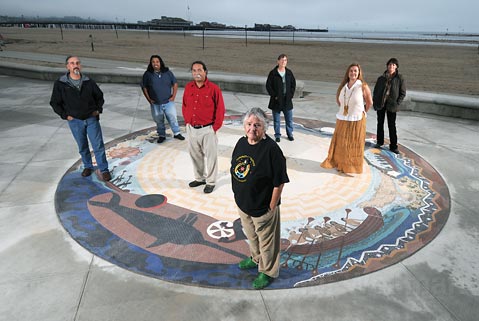
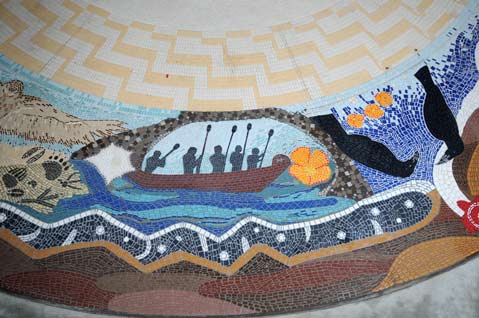
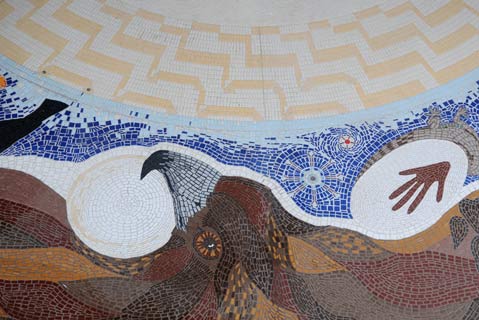
Right now, steps away from the sand at West Beach, the upper-, middle-, and under-worlds are swirling together in beautiful harmony on the Cabrillo Boulevard sidewalk. Wrapped in the gentle brown wings of a giant eagle and spread out around a centrally placed sand dollar, a lizard sneaks past Coyote to grant people hands rather than paws, a red-tufted woodpecker carries an acorn away from the Great Flood, and two ravens stand in a ravine full of golden poppies waiting for human souls to pass by. But age-old legends aren’t the only stories on display here-there’s also a once-thriving seaside village from the 1700s coming back to life, its thatch-roof huts serving as the backdrop for a team of paddlers returning from the ocean with a plank canoe full of fish, and, even more contemporary, a scene from the 1970s of modern-day paddlers, returning to the sea in their abalone-adorned tomol like the generations of ancestors before them.
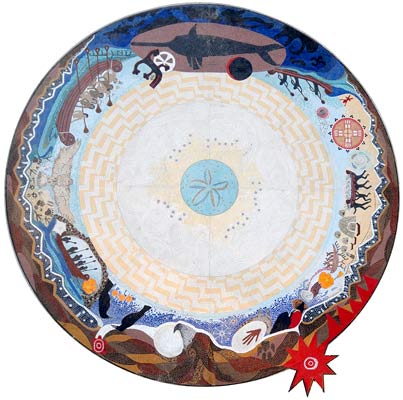
Welcome to the Syuxtun Story Circle, the new, 20-foot-wide mosaic that sits upon the very location of the village of the same name, which was once the largest settlement in all of Chumash country, from the shores of San Simeon to the mountains of Malibu. Comprised of about 200,000 unglazed ceramic tiles and the product of more than 5,000 collective hours of intense work by more than 100 people from a variety of backgrounds, the Syuxtun Story Circle now stands as Santa Barbara’s most prominent ode to the area’s first inhabitants and shall serve as a steady reminder that the Chumash people never died, and that their culture persists and continues to grow in this corner of California. Even more promising is that the mosaic represents the first time in anyone’s collective memory that the six organized Chumash tribal groups came together to wholeheartedly support a unified vision and collaborate on telling their own stories, a reality that all involved hope will lead to much more cooperation and mutual understanding in the future.
“What we are creating is a circle of inclusiveness and equality within our community,” said Ray Ward, a longtime tomol paddler who is one of the project’s visionaries. “And not only the Chumash community, but the community at large. This is all of ours.”
The unique collaboration was sparked in November 2008, when Ward, Stephen Franco Jr., Carmen Sandoval, Chuck Franco, and Lori Ann David all attended a meeting held by the City of Santa Barbara’s Arts Advisory and Visual Art in Public Places committees, which were seeking proposals for a display to decorate the to-be-renovated sidewalk along Cabrillo Boulevard as part of the ongoing West Beach Improvement Project. They’d come independently, but found themselves discussing a similar vision for the site. “It was obvious we wanted to create something great for the space,” said artist Lori Ann David, who’s been making outdoor mosaics, sculptures, and more in Santa Barbara since 1984, “and I wanted to help them have their story told in the most permanent, amazing way.”
The specifics of that story were then hashed out by cultural historian Franco Jr., who wove together a number of oral traditions about creation, cosmology, and ancient history with recorded events starting from the time of European contact and running until the present day. The original design was scribbled upon a now nearly mythical paper plate, later enhanced into a drafted illustration by Ward’s wife, artist Sue Nakao, and then shared with the various tribal communities. Throughout time, the story’s narrative became more complicated and encompassing, and was influenced by everything from the memories of elders and 30-year-old photographs to the recent dreams of today’s Chumash.
“Like every good story, it draws you in, gives you an emotional response, and takes you on a journey,” said Franco Jr. “It’s definitely been a journey, and, into the future, I think it’s going to continue being a journey for all of us.”
Much of that journey took place in the foothills above Santa Barbara, beneath the baking sun and sporadic shade of majestic oak trees in the outdoor studio of Lori Ann David. Though her home up San Roque Canyon burned to the ground during May’s Jesusita Fire-which also destroyed the wooden platform that had been built to hold the mosaic-the team was able to recover the work space quickly. By the beginning of July, they’d built a new platform and were hard at work outlining the 20-foot-wide dial on 21 separate panels. Then came the detailed task of organizing, splitting, arranging, laying, and gluing in place the more than 200,000 tiles, which were later grouted together with epoxy. In early October, the 21 panels, which each weighed about 60 pounds, were trucked down to the mosaic’s new home on Cabrillo Boulevard, just across the street from the green grass rectangle of Ambassador Park, and then the crew spent another few days connecting the panels and applying the final weather-proof glaze.
Altogether, the hands-on mosaic-building process took from July until October and eventually involved a seemingly endless stream of individuals, including numerous Chumash artisans and non-artists, students from the Open Alternative School, and even one lucky journalist. “People would show up out of curiosity, not knowing what to expect, and then get inspired to be involved,” recalled Lori Ann David, who co-managed the Syuxtun team with Ward and Franco Jr. “It was three-plus months of solid, everyday working as a group. At times, it definitely was challenging. It was really a collaborative process, which isn’t easy in art.”
This spirit of teamwork and togetherness became a central theme to the Syuxtun Story Circle, as cooperation has not always been a reliable part of the relationship between the six organized Chumash tribes in San Luis Obispo, Santa Barbara, Ventura, Bakersfield, and the Santa Ynez Valley. But this time it was different. “When it comes to the project, there’s been no separation-we’re all working together,” said Franco Jr.
And that makes the elders proud, said Carmen Sandoval. “It’s wonderful to have certain elders come out and say, ‘This is about time,'” she explained. “They get so emotional.” Echoed Ward, who said that some Chumash folks in their eighties and nineties had participated, “We’re showing the elders that we can work and play together.”
Best of all, the impossible-to-miss mosaic will stand as a constant reminder to both locals and tourists that a proud people-arguably one of the strongest, most socio-culturally advanced tribes in the so-called New World-once ruled this land, and that they are very much still a piece of the fabric that binds Santa Barbara. “It’s a wonderful education tool,” said Sandoval. “It shows the beauty and serenity of our culture and the fact that we’re still here. We know that, but not everybody does.”
As such, the Syuxtun Story Circle, while based on stories from a millennia-old oral tradition and specific events of the past, is full of messages for the present and a symbol of hope for the future. “This isn’t stopping here,” explained Lori Ann David. “This isn’t static. This is alive.”
Chumash elder John Moreno agreed. “These stories need to be told,” he said. “They are alive. We are alive. As beautiful as the mosaic is, it is beyond the beauty the eyes can see-it touches the heart, our senses. It is very important to us. It stands for our past, our present, and our future.”
The Mosaic’s Message
A Detailed Guide to Understanding the Syuxtun Story Circle
Growing up, I was taught that storytelling is transferred by direct experience and oral teachings from one person to another, that the oral history of our Chumash culture is sacred, and that it should be deeply respected, appreciated, and shared. These stories, passed down through generations, reflected the Chumash people’s supreme understanding of cosmology, their firm grasp of the natural world, and the importance of family unity to society. But I also was told that, because our oral traditions weren’t valued and were even feared by those who came from distant lands, many of the stories were put to sleep. After generations, these stories finally are starting to wake up and be told again, and some have found a home within the Syuxtun Story Circle.

In the very center of the circle, we see a green-blue sand dollar, which is said to be the resting place for the Sun as he journeys from East to West during the Winter Solstice. Surrounding the sand dollar is a basket design, as the Chumash were regarded as some of the finest basket makers in the world, their woven fibers a centerpiece of daily life. The yellow pattern is based on a 200-year-old basket that was found in the hills above Santa Barbara. Within the design are representations of tomols, which commemorate the many channel crossings to Santa Cruz Island we have completed in modern times.

Toward the outer rim of the Syuxtun Story Circle are the three worlds that comprise the Chumash universe: the World Above, the Middle World, and the World Below. The World Above is home to the sky people. The Sun, Kaqunupmawa, takes his torch around the world and warms us. Slo’w, the great eagle, sustains the upper world with his wings. Below the beak of Slo’w is the Moon, Alahtin, who shines her purifying light on the Earth and the woodpecker, Maqutikok, who was the sole survivor of the Great Flood and holds an acorn while being warmed and fed by his uncle, the Sun. There is also a coyote paw floating above a white table with a red hand impressed upon it that is part of the sacred creation story. The paw represents Å nilemun, the benevolent Sky Coyote, who announced after the Great Flood that there would now be people and that they would have his hands, for his hands were the finest of all. After much debate, the sky people agreed-all except for Onokok, the lizard, who did not voice his opposition. Rather, just before Å nilemun could press his paw into the stone table, Onokok pressed his hand down, giving people hands much more like the lizard’s. The two ravens posed above the poppies are the upper-world beings we encounter when we die as our soul journeys to the West.

The Middle World is home to the Chumash. The two giant serpents who make their way up on either side of the mosaic are Ma’aqsiq’ita’Å¡up, those who hold up the Middle World from below. When they are tired, they move, and cause earthquakes. As we travel counterclockwise around the circle, we encounter the four Channel Islands off our coast: a closed poppy depicts ‘Anyapax (Anacapa), the poppy in bloom is Limuw (Santa Cruz), the red driftwood next to it is Wima (Santa Rosa), and the abalone shell is Tuqan (San Miguel). On the shores of Syuxtun, there stands a woman whose abalone necklace sparkles in the sun, and she represents the powerful female chief who is said to have ruled in 1542. Along the same shore, we see the flourishing village life reported from 1769, where men carry a tomol out of the ocean.
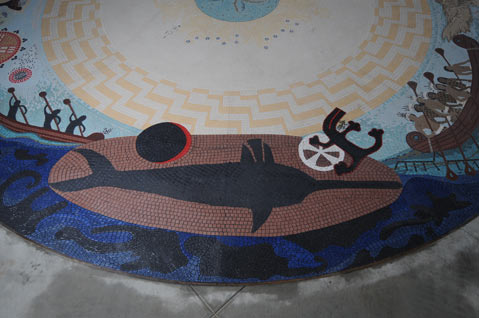
The adjacent image shows the rose window from the Santa Barbara Mission, which reflects the scattering of the Chumash people, since the mission system forever altered the indigenous lifestyle. Next to the rose window is a vibrant comet, and, below that, a woman who’s raising her arms to receive a vision that warned of the impending destruction of her culture, two events that led to the Chumash revolt of 1824. The next image is Palatino’s tomol traveling across turbulent water, symbolizing the time when the tomol teachings were put to sleep. The solar eclipse that follows reveals the arrival of the Americans and their influence on the Chumash.
Directly below the eclipse is a replication of Swordfish Cave and next to that, a representation of the Earth Coyote. Together, these images recall the oral history of Earth Coyote rescuing Xelex, the falcon, from the bottom of the ocean where the swordfish people reside. We liken this tale to Fernando Librado, the Chumash man who brought the tomol out of slumber when, from 1913-1915, he built the first one since Palatino’s. That tradition carries on in the next image of Tomol Xelex and her crew from the Quabajai Brotherhood of the Tomol, which undertook an 11-day circumnavigation of the Channel Islands in 1976, the first time a tomol was back in the channel since the 1800s. Next to the tomol are animal tracks, indicating the importance of relationships between humans and beasts.

In 2001, the launch of the Tomol ‘Elye’wun (Chumash for “swordfish”) and her crew marked the first time Chumash families returned to Santa Cruz Island as a community, now an annual tradition every autumn. The peregrine image between Xelex and ‘Elye’wun is in honor of the falcon that is the spiritual captain of all tomols.
As we journey back down the circle we find the World Below. This underworld is home to the nunaÅ¡iÂiÅ¡, beings that come out after dark to travel mysteriously into the Middle World. These malevolent creatures are dangerous and often a nuisance to the Chumash people.
We believe that the Syuxtun Story Circle truly is a gift to the entire community. Speaking on behalf of the seven artists who allowed this design to manifest through us, we feel that our participation in its creation is our way of continuing the work of our elders and preserving these stories so they can be shared with the community and the world. – Stephen Franco Jr.