How to Handle Aphids and Their Friends
Sucking Insects

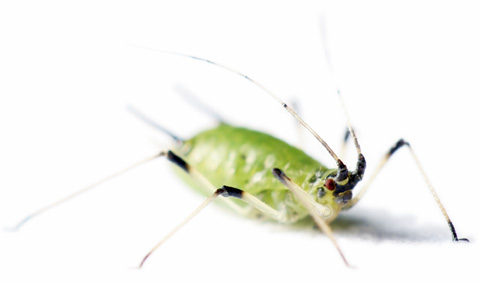
They are among the most prolific and destructive pests in any garden. Aphids, mealybugs scale, and thrips all belong to different branches of the insect family tree, but have some attributes in common. They are visible, but tiny enough to go unnoticed until their populations are large and the damage may be already severe. Vigilance is required to catch them early, but knowing a little bit about their lifecycles may help in the battle to curb their numbers.
There are more than 400 species of aphids and many have names reflecting their favorite foods, such as green peach aphids and blackberry aphids. Even in the ornamental garden, there may be several species of interest to the watchful gardener. All of them have mouth parts that consist of a piercing tube that allows them to suck out plant sap. Recall that this sap is rich in sugars and carbohydrates, a meal fit for any aphid. While the aphid does do some sucking, once the aphid has pierced the phloem (food transport system in the plant), the pressure of the movement of sap within the plant actually helps force sap into the insect. Because the aphid may not be able to utilize all of the sugary liquid, excess is emitted from the anus. Known as honeydew, it coats the leaves of infested plants and may foster the growth of fungus, called sooty mold, which discolors the plant and may even interfere with photosynthesis. Ants are attracted to this energy-rich exudate and will even “herd” the aphids, carrying them around the plant and harvesting the honeydew, which is why just ridding the affected plant of aphids may not be enough to stem the damage. The ants must also be controlled to break the cycle. Ants may even nurture aphid eggs during the winter in their burrows and return them to the garden in spring.
Aphids also have the ability to hatch several generations of offspring through parthenogenesis, the development of an egg without fertilization. Wingless, unfertilized females produce a number of new female aphids each. Some generations will have wings and fly off to infest new plants, while others will be wingless and continue to reproduce without fertilization. Late in the season, winged males hatch out to mate with females that then lay the eggs that will lie dormant during the winter. It’s easy to see how aphids can multiply so quickly.
Mealybugs are a little more visible, but no less damaging than aphids. Most species of mealybugs look like little pieces of white or gray fluff. Their bodies are coated with waxy threads, probably foiling some predators. They and their close relatives the scale insects also produce honeydew and the same problem of ants keeping them and harvesting their excess applies to them. Scale is so named because the soft bodies of the female insects are sequestered under a hard waxy shell that literally is glued to the plant. Once under cover, the female loses her legs and most of her internal organs and just lays eggs. Males are puny things that never feed, living only to copulate and dying soon after the act. Just like aphids, unfertilized females can produce more females, while fertilized ones produce both males and females. Scale is best controlled when the young insects are still crawling around on the plant prior to hiding under their shell. Once the shells are in place, it may take physically scraping off the scales to reduce the numbers enough to achieve a measure of control.
The last of the common sucking insects is thrips. Yes, thrips, which sounds like it should be plural, is really the singular name for a group of tiny insects that can pack a big punch. Nearly invisible, you may see damage before you find the insects themselves. Foliage of affected plants will look sort of silvery and desiccated. Plants under stress are particularly vulnerable to attack, so keeping plants healthy can alleviate much of the problem. Thrips is also more prevalent during dry summer weather. Keeping plants well watered, and even increasing humidity by misting, should be standard practice if thrips becomes a problem. While thrips do fly between plants, it is rather weak and rarely move very far, so isolating and treating affected plants is a good practice to prevent further infestations. Remove infected leaves and dispose of them promptly. Thrips will feed on just about anything, so even if you’ve gotten on top of the outbreak in the garden, those weeds at the edge of the property may be harboring a new generation. Cleanliness is key with this pest.
Luckily for your favorite garden subjects, all of these pests can be controlled with a few key practices. Knowing that they all feed on sweet plant juices, it is not hard to believe that each of them has more than one predator that hungers to enjoy a sweet meal at their expense. Some of the more generalized predators such as lady bugs and lace wings will happily help with this task. Each of them also has some more species-specific predators. Some are parasitic wasps, such as the various chalcid wasps that parasitize scale insects by laying their eggs inside the pest.
One famous parasite of mealybugs is Cryptolaemus montrouzieri. The interesting thing about this predator is that it looks almost identical to its host. It is usually just a little larger and many a gardener has panicked at the sight of it. On closer inspection, it is clear that this fuzzy-looking insect is actively attacking the mealybugs and in short order getting them under control. There actually are lots of predator insects feeding on aphids, which is good, because they are among the most common pest. Lady bugs, lacewings, soldier bugs, damsel bugs, big-eyed bugs, pirate bugs, spiders, assassin bugs, and syrphid flies all find aphids to their liking. The key to encouraging predators is to tolerate some of the pests until the predators have time to find them. Mechanical treatments like blasting pests off with water and using more-or-less benign sprays of horticultural oil or garlic-and-pepper spray are options for extreme outbreaks. These may be needed to keep plants healthy until the army of predators can arrive and go to work.