‘What buildings did architect Russel Ray design in Santa Barbara?’
History 101

Question submitted by John Mandle
For 20 years, Russel Ray was one of Santa Barbara’s most significant architects, gracing the local landscape with a variety of homes, both stately and modest, as well as commercial buildings, schools, and churches. Ray was never wedded to a single architectural style and his work often incorporated different styles in intriguing mixes.
Ray was born in New Jersey in 1878, but soon moved with his family to Chicago, where he received his schooling. He entered Harvard University in 1904 and, after graduation, moved to New York where he began his architectural practice. He soon made his way to California, and, after spending a short period in Los Angeles, he arrived in Santa Barbara in spring 1908. He first became associated with the firm of Augustus B. Higginson, a fellow Harvard graduate, who had received his training at the cole des Beaux-Arts in Paris. Upon Higginson’s retirement, Ray bought the practice and soon received his first important commission-a redesign of Arcady.
George Owen Knapp’s 70-acre Arcady was one of Montecito’s most magnificent estates. Knapp wanted to redo the estate with a Spanish Colonial theme. Ray added a tower to the original house and designed a number of new buildings for the grounds. Knapp and Ray became close friends. They traveled together and socialized often. Enjoying the endorsement of one of the most influential members of Montecito’s social set certainly did not hurt Ray’s burgeoning career, and he soon received a number of other Montecito commissions.
Ray’s first significant assignment for a non-residence was a design of the new quarters for Cottage Hospital, constructed in 1913. The three-story hospital of concrete and steel would survive the 1925 earthquake and received patients from other area hospitals. Cottage would eventually outgrow this building as well. It is interesting to note that one of the biggest boosters of Cottage Hospital was Ray’s good friend, George Owen Knapp.
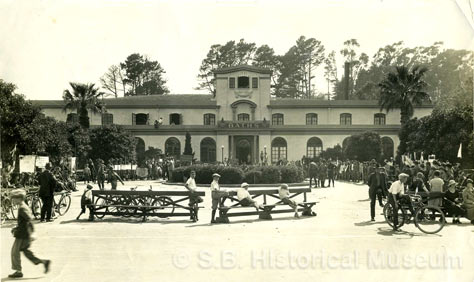
In 1914, Ray received the commission to design the second Los Ba±os del Mar bathhouse, replacing the one that had burned the previous year. Ray also was instrumental in convincing the Southern California Edison Company to pay for the $70,000 structure. The new bathhouse opened in 1915 and was a major attraction until damaged in the 1925 earthquake. It was replaced by the present Los Ba±os in the 1930s.
About 1913, Ray teamed with another prominent architect, Winsor Soule. Together they designed buildings for Cate School in Carpinteria, as well as homes on the upper Eastside, one of which was for artist Reginald Vaughn at 316 East Los Olivos Street. Their largest commission was the YMCA building at 110 West Carrillo Street, an interesting mix of Mission Revival and Italian styles. This building was torn down in 1986.
Ray joined the military during World War I and did not return to Santa Barbara until 1926, but it was not long before commissions were again rolling in. He designed a Swiss chalet on Las Tunas Road, and in 1930 drew up plans for El Montecito Presbyterian Church. One of his most distinctive designs was for the electrical substation at 11 West Mission Street with its blend of Spanish Colonial Revival and Moderne elements. In 1931, he redesigned the Hopkins house at 1900 Garden Street, one of the most distinctive homes in the city, using Spanish Colonial motifs.
Ray left Santa Barbara for good in about 1935, eventually settling near San Diego, where he continued his career well into the 1940s. What he left behind was a rich and varied body of work-leaving his stamp on the urban landscape of Santa Barbara.