Be Democratic and Eat Less Meat
Frances Moore Lappe to Lecture about the Value of Plant-Centered Diets, Food Dependency, and More

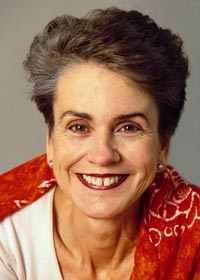
Frances Moore Lappe has been lauded so much that an article about her could burst with such a list. To pick just three items: Her paradigm-shaking book Diet for a Small Planet, published in 1971, has turned hundreds of thousands to vegetarianism. In 1987, she received the Right Livelihood Award, aka the Alternative Nobel Prize. And just last year, Gourmet magazine put her in a line of 25 people-including Thomas Jefferson, Upton Sinclair, and Julia Child-who radically influenced the way America eats.
Lappe will give a free lecture on Wednesday, February 25, fittingly presented by the Nuclear Age Peace Foundation and La Casa de Maria. I spoke to her on the phone recently about her hopes and fears given both the crashing economy and the ascension of Obama.
In your latest book, Getting a Grip, you create the phrase “thin democracy.” Can you give a description of what it means? Thin democracy is behaving as if all we need for a livable society is the market and a democratic government. We can maybe vote and certainly shop, and we have to serve on a jury and obey traffic laws. It’s behaving as if democracy is simply a structure that we inherited and there’s nothing left to create.
Your talk in Santa Barbara is titled Living Democracy, Feeding Hope. Clearly there are many kinds of food : My adulthood began when I stopped trying to save the world. I’ve made a conscious choice not to be forced into random acts of charity. We [the Small Planet Institute] are acting to reverse causal patterns that create suffering. It makes no sense that somehow the brightest species of all hasn’t figured out how to do that most primal act: Feed everyone. Yet we see the Earth’s great abundance and that approximately a billion people worldwide go hungry. We are ruining our topsoil and groundwater, killing our capacity to feed ourselves. What species would destroy its food supply?
This Sunday, I was preparing this talk and looked at what Joe Collins and I wrote in 1977 in Food First: Beyond the Myth of Scarcity and I started to weep. It sounds melodramatic, but we said the most obvious things and no one has countered it. Nobody’s free if their very survival is dependent on imports. Yet we have pushed and coerced developing world countries into food dependency since then. It certainly doesn’t feel good to say “I told you so,” and yet we haven’t really awakened. We produce 20 percent more food since 1980, but we have much more hunger since the 1970s. Why don’t we learn?
We have to go deeper, to fundamental assumptions. This current economic disaster comes directly from all these problems, but there’s the saying that in a storm, when a big tree falls, you can see the roots. Here’s hoping people can see the roots. We have to focus on the nature of human relationships and bring power in balance.
How does the election of Barack Obama make you feel? On one hand, I’m elated, but on the other hand, I’m filled with fear. Are people going to think, “Now that we have Obama in the White House, our problems are solved”? He’s not the sufficient condition, only a necessary one. While food prices were going up, agribusiness said, “Let’s divert good land to grow ethanol.” That’s prima facie evidence of a lack of democracy. Now our work has begun moving the country to a living democracy.
Does the Slow Food Movement connect with your idea of a living democracy? The main thing I love about the Slow Food Movement is it focuses on relationships and gets away from thinking of food in quantities and numbers. It makes us think about the people who produce our food. It shifts us from production quotas and instead we’re building relationships that can help reinstate independent family farms. It’s actually the opposite of elitist. Putting out of sight and mind the people who provide us with our cheap goods is elitist. Instead we see our place in the ecology of eating.
What one thing could people do today that would begin to change the world? Wow. One thing? It so depends upon who you are. If you don’t know anything, I know this sounds self-serving, but, I think of the book I worked on with my daughter [Anna Lappe] and would suggest reading Hope’s Edge. It’s very personal about a journey we took, so it’s a travelogue, but it has recipes, and it’s an idea book. But if you are aware, I believe in the buddy system-don’t feel so isolated. Sure, it would be great to eat less meat and shift to a plant-centered diet. But that’s easier to do with even one other person. Change comes when you have other people equally excited about change.
4•1•1
Frances Moore Lappe’s free talk Living Democracy, Feeding Hope is the 8th Annual Frank K. Kelly Lecture on Humanity’s Future, and takes place on Wednesday, February 25, at 7 p.m. at La Casa de Maria (800 El Bosque Rd.). Space is limited to 140 people, so get there early. Call 969-5031.