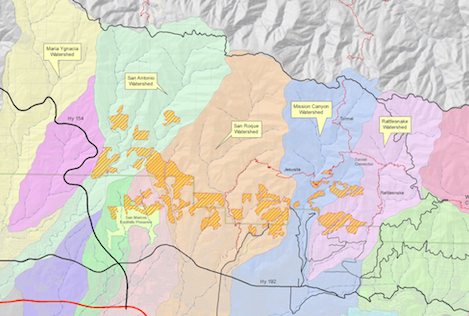
According to officials, nearly 1,250 acres of the Jesusita burn area will be covered with hydromulch - which helps strengthen soils and foster new plant growth - perhaps as early as September 15. Of this, approximately 1,000 of the acres will be contracted by the County of Santa Barbara with the remaining 250 acres by the U.S. Forest Service.
Thanks to $4.6 million in emergency funding provided by the Natural Resources Conservation Service (NRCS), the county is only on the hook for $100,000 with the City of Santa Barbara kicking in an additional $50,000.
Aware of criticism that last year’s hydromulching of the nearly 10,000-acre Gap Fire area included plastics, metal fragments, and other undesirable litter, county officials are promising that this round of hydromulching will be certified “100 percent plastic-free,” explained Tom Fayram, the county’s deputy director of Public Works. “We are aware of the problem,” he said, “and we will be monitoring the mulching extremely carefully.”
NRCS has mandated that the mulching be done no later than mid-October, so the county is scrambling to get the program moving by September 15. Residents in the to-be-sprayed areas should expect “soft closures,” meaning that roads in the affected areas will be open to residents only during the operation.
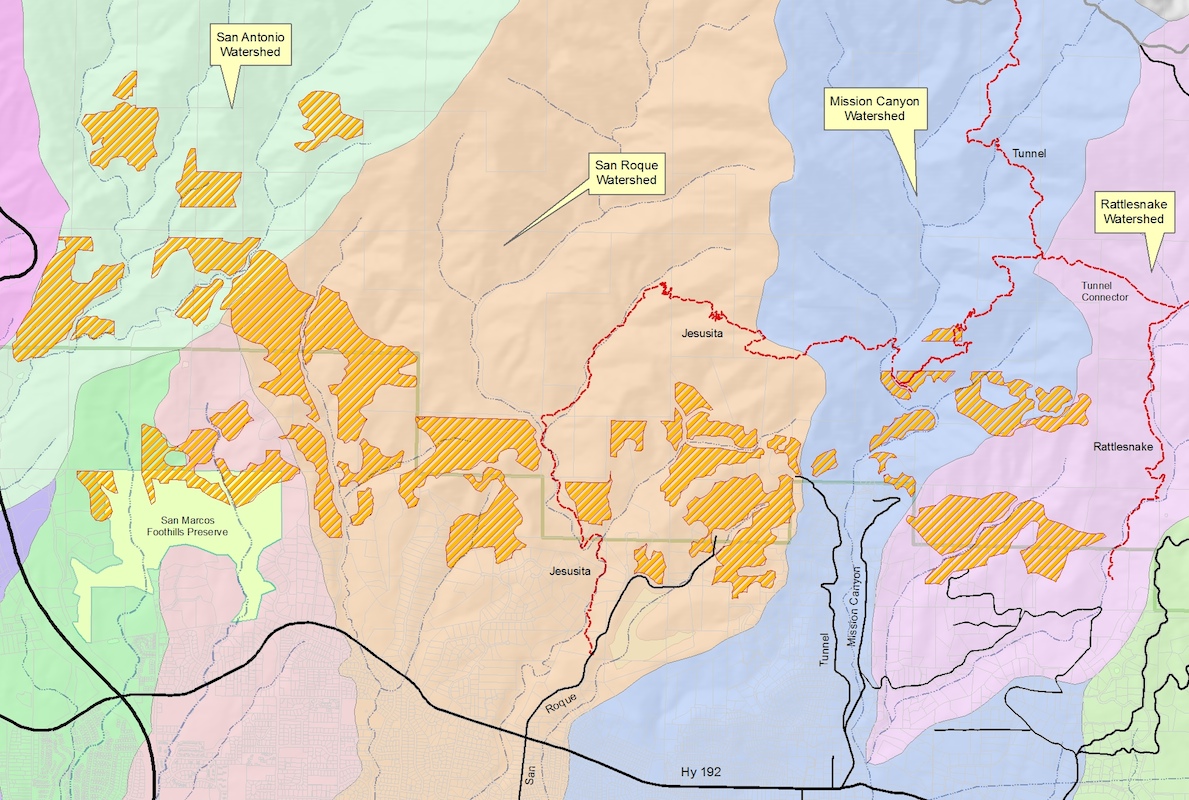
Map Designed by Ray Ford
Closer up view of the hydromulch areas (there are 39 separate areas recommended for spraying) shows proximity of the mulch areas to the front country trails.
Hikers may be affected as well, as the Jesusita Trail goes through an area slated for spraying. That and other trail access issues are on the agenda of the upcoming September 2 Multi-Jurisdictional Task Force meeting.
The word I’m hearing is that the recently re-opened parts of Jesusita Trail could be closed again as the hydromulch will be applied on both east and west sides of the trail and that Mission Canyon, including Tunnel Trail, Seven Falls, and the route to Inspiration Point will be closed as well through at least the winter rainy season.

Print friendly
E-mail story
Tip Us Off
Comments
Share Article
Myspace


Previous Month


Comments
Is the hydromulch to be used certified weed-free? Is it certified to contain only appropriate native plants?
My experience is that, even with both of these, hydromulching can and not infrequently does introduce weeds and non-native plants, as well as 'native' plants not actually appropriate for the area into which they are being introduced.
Bela (anonymous profile)
August 27, 2009 at 8:06 a.m. (Suggest removal)
The product for this project is just mulch, not a seed mix. When aerial coverage includes seed it is usually called "hydro-seeding." Since the 1980s and 90s, Agencies have been moving away from hydro-seeding for exactly the reasons mentioned.
norminSB (anonymous profile)
August 27, 2009 at 8:23 a.m. (Suggest removal)
There are dozens of great articles on Hydroseeding in Erosion Control Magazine. Check them out for free. www.erosioncontrol.com and search on "hydroseeding".
Also, check out www.santabarbaraerosioncontrol.com for local solutions
freshpavement (anonymous profile)
August 27, 2009 at 8:50 a.m. (Suggest removal)
Please let this be HydroMULCH, not containing trash, as was reported after the Gap Fire burn area recovery program
http://www.independent.com/news/2009/...
Those brave pilots flew their planes hundreds of times, at risky low altitudes, trying to save Goleta from flooding before it started raining. How unfortunate that some doofus filled their tanks with scraps of plastic, rubber, candy bar wrappers and waxed paper instead.
green_helmet (anonymous profile)
August 27, 2009 at 5:12 p.m. (Suggest removal)
There is evidence that "hydromulching" actually inhibits the natural re-growth of native vegetation that occurs after a fire.
Jesusita (anonymous profile)
August 28, 2009 at 7:11 a.m. (Suggest removal)
Whatever happened to the use of the wood mulch listed in the BAER assessment?
Great website at www.woodstraw.com
mcp0917 (anonymous profile)
August 28, 2009 at 8:42 a.m. (Suggest removal)
In addition to concerns about weed and non-native seeds and plant matter that could later sprout (bermuda stolons, anyone?) what about plant diseases, fungi, etc? I've heard gardeners complain about diseases in the free county mulch--don't know if that is accurate, but many gardeners won't use it. (My neighbor just dumped six blighted tomato plants into the green waste, destined to be turned into mulch.)
After spreading a lot of the free county mulch on my property I've had problems with convovulus (morning-glory), vinca, and fan palms sprouting from it. So far no eucalyptus, but the seeds are there in the mulch. I can pull or dig those things out, but no one's going to do that in the chaparral. What guarantee do we have that the mulch they're planning to use is cleaner than what we get from the county?
Has anyone knowledgeable about the ecology of the chapparal been consulted about this?
mtndriver (anonymous profile)
August 28, 2009 at 9:38 a.m. (Suggest removal)