• CREATE AN ACCOUNT
  • LOG.IN
  • CONTENTS
  • CLASSIFIEDS
  • ARCHIVE
  • INFO | ADVERTISING | CONTACT US

  • Home
  • News
    • News Main Page
    • NewsFlash
  • A&E
    • A&E Main Page
    • Movie Times
    • TV Listings
    • A&E Blog
    • Art Galleries
    • Best Bets
  • Opinion
    • Opinion Main Page
    • Endorsements
    • Blogs
    • Columns
    • Voices
    • Letters
    • In Memoriam
    • Obituaries
  • Events
    • Today
    • Search
    • Submit
    • Best Bets
  • Living
    • Living Main Page
    • Outdoors
    • Travel
    • Sports
    • Peeps
  • Food & Drink
    • Food & Drink Main Page
    • All Restaurants
    • Delivery
    • All Bars & Clubs
    • Drink Specials
    • Open Now
  • Sports
  • Outdoors
    • Outdoors Main Page
    • Outside Insider
    • Spotlight On
    • Features
  • Classifieds
    • Real Estate
    • Jobs
    • Autos
  • Obits

    Ray Ford

    Fire pushes towards the Sierra Madre ridge and eventually spot fires push it down into Moon Canyon.


    La Brea Fire Tops 20,000 acres, Jumps Sierra Madre Ridge

    Like the Zaca Fire, It May Consume Lots of Acres But Perhaps Not Homes


    Tuesday, August 11, 2009
    By Ray Ford (Contact)
    Article Tools
    Print friendly
    E-mail story
    Tip Us Off
    iPod friendly
    Comments
    Bookmark This
    del.icio.us. del.icio.us.
    Digg! Digg!
    furl furl
    google google
    newsvine newsvine
    reddit reddit
    technorati technorati
    Facebook Facebook
    Yahoo! My Web 2.0 Yahoo!

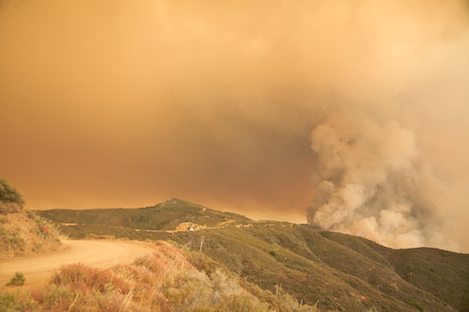
    From my perch near Timber Peak on Sunday night I could see the La Brea flames creating a thunderous column of smoke as it worked its way toward the Sierra Madre crest. “It’s already over the ridge,” one fire fighter said but it turned out he was wrong.

    Last Monday night, despite the efforts of engine crews to backfire along the ridge, the fire jumped the Sierra Madres about five miles east of my position and began to work its way down into Moon Canyon. It turns out that the heaviest pressure on the ridgetop was quite a bit further to the east. In response, Los Padres Forest officials began closing down portions of the ranchland on the Cuyama side of the Sierra Madres, a mandatory order that will affect some 14 ranch owners as well as the La Brea Canyon area.

    Brush in this area last burned in 1922. North of the ridge, most of the area burned less than ten years ago in the Spanish Fire. This could help fire fighters control any slopovers.
    Click to enlarge photo

    Ray Ford

    Brush in this area last burned in 1922. North of the ridge, most of the area burned less than ten years ago in the Spanish Fire. This could help fire fighters control any slopovers.

    Despite the rapidity in which the fire increased in size, jumping from 1300 hundred acres to more than 15 times that size in just 48 hours, the La Brea Fire is still primarily a wilderness fire that is consuming acres mostly along the upper slopes of the sun facing side of the Sierra Madres. The heaviest pressure the crews are facing are along the Sierra Madre ridge but despite this
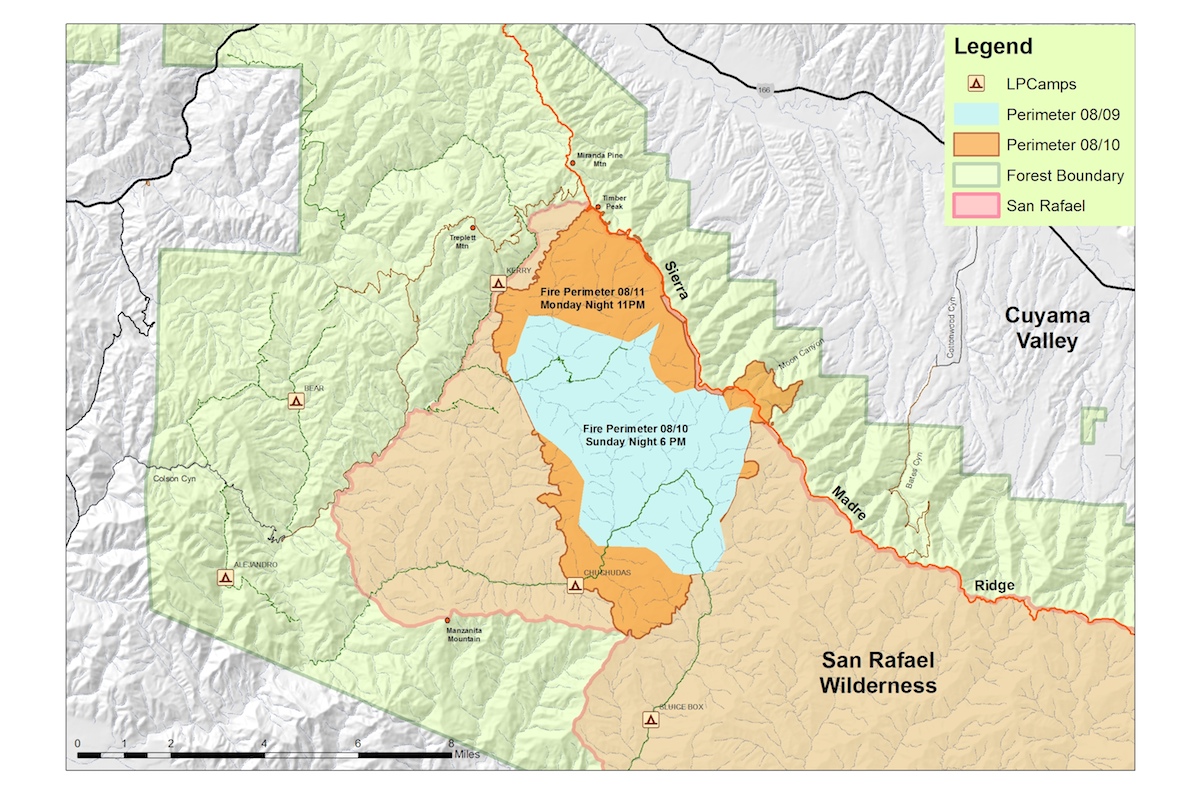
    Sunday's and Monday's fire perimeters are overlayed showing the main expansion is towards the Sierra Madres.
    Click to enlarge photo

    GIS Map by Ray Ford

    Sunday's and Monday's fire perimeters are overlayed showing the main expansion is towards the Sierra Madres.

    Overlaying the fire perimeter maps from Sunday and Monday night, the fire appears to be expanding south a bit and has turned east from the Cuchadas Camp area and jumped over the ridge into Horse Canyon. However, to the north it doesn’t appear the fire is making a major push to the east, which is good news at this point.

    On the west side of the fire, flames that I could see burning up out of the South Fork of La Brea Canyon on Sunday night have crossed over into Kerry Canyon and there is a potential for the fire to continue moving towards Treplett Peak. The good news is that fire crews do have more access to establishing a perimeter on this side of the fire than along the south or east sides.

    What everyone has on the mind is how long this one will last, how big will it get and how much will it cost (both in property, dollars and possibly lives). It is not a difficult stretch to think that the La Brea Fire could be one of the county’s “Big Ten” — chewing up 50,000 acres or more before it is out.
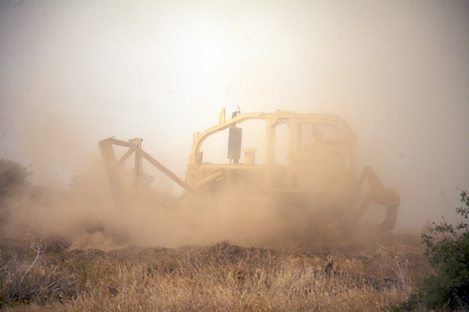
    Dozer operators are not always appreciated in the back country until a fire break needs clearing as the flames approach.
    Click to enlarge photo

    Ray Ford

    Dozer operators are not always appreciated in the back country until a fire break needs clearing as the flames approach.

    Here’s the good news. The fire is currently working its way through thick brush last torched in a 1922 fire that burned 114,728 acres. So there’s good reason why the fire has exploded like it has the past few days. The worst, however, could be behind us once this 80-90 year-old fuel is gone. Across the Sierra Madres immediately in the path of where the fire is heading is the footprint of the 22,000 acre Spanish Fire that burned in 1999. In fuel terms, this is still pretty young brush and will help slow down the fire.
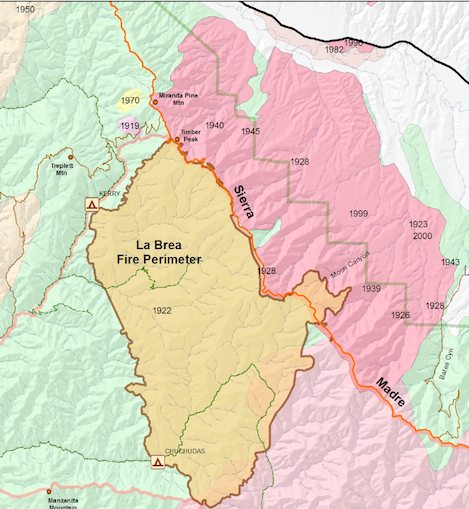
    GIS Map by Ray Ford

    Fire History map shows age of the brush. The fire is currently burning in brush that has not seen a wildfire since 1922.

    Then there’s the bad. Along the southeastern flank, the fire is bumping up against the 1966 Wellman Fire boundary. A close look at this area in the map above shows that La Brea fire is moving across and into wilderness territory that hasn’t burned in 43 years. There’s almost 45,000 acres of brush located east of the current fire perimeter that could be almost impossible for fire fighters to do anything about given the nature of the country.

    “Another Zaca,” a hot shot from the Casitas Pass Fire Station commented as his glance swept over the smoke-filled skies. Perhaps, to an extent. If the La Brea Fire were to follow the flanks of the Sierra Madres up the Sisquoc like the Zaca did up the Manzana two summers ago, there’s ten miles and as much as another 50,000 acres that could go up in smoke.

    Ray Ford

    Isolated fires burn inside the San Rafael Wilderness in a number of locations. Though destructive, they will more-than-likely not pose a long-term threat.

    This time fire fighters are holding a better hand of cards. The Zaca Fire burned out most everything to the south and further to the east so eventually it’ll burn itself out if it heads in that direction.

    The key in the next few days will be in establishing a perimeter around the Moon Canyon slopover and in holding the Sierra Madre Ridge, which fire fighters should be able to do. If that scenario works itself out then the only real question is how much of the hillsides in the Sisquoc drainage will burn before the fire is contained.

    Related Links

    • More La Brea Fire coverage
    Story Help (Click-ability)
    Double-clicking on any word or phrase in this story will open a reference window with definitions and links to other reference material.

    Comments

    Discussion Guidelines

    Good coverage, but rarely is it mentioned that the chaparral and related ecosystems are fire-dependent. Fire cleanses, renews, cycles biomass, triggers seed germination, and in the long run is absolutely necessary for the health of the system. These fires are just part of the natural world doing its thing. A fire is no more a tragedy than rain, drought, wind, or any other natural event. Wildfires only become problematic when they threaten manmade structures and communities. It always pains me to see the natural world left out of the discussion. Might we at least acknowledge that we are not the only species on the planet?

    Readers say: Thumbs Up: 1 of 2 • Thumbs Down: 1 of 2

    OwenDell (anonymous profile)
    August 11, 2009 at 7:36 p.m. (Suggest removal)

    Good to get the story behind the numbers. Thanks.

    Wildfires become problematic when they are repeated too often to allow full regeneration. Frequent fires in the same area result in type conversion mostly to alien vegetation. Thereafter natural ecosystems are destroyed. Chaparral is fire-adapted, I believe, but not necessarily fire-dependent. There is always more then one route to regeneration.

    Readers say: Thumbs Up: 1 of 1 • Thumbs Down: 0 of 1

    tabatha (anonymous profile)
    August 11, 2009 at 7:47 p.m. (Suggest removal)

    Oh goodie Santa Barbara will get another dusting of ashes!

    My question is how much is it going to cost to fight this fire and can the county (not that there is a choice) afford to pay for it? The fire fighters must be so tired of this year after year. I would pay higher taxes to pay them and get the equipment we need to keep in this county.

    Readers say: Thumbs Up: 1 of 2 • Thumbs Down: 1 of 2

    spnsb2008 (anonymous profile)
    August 11, 2009 at 8:40 p.m. (Suggest removal)

    Would I pay more in taxes? Of course I would. You get what you pay for in this world. I'm tired of people saying we just have to live without vital services and/or borrow and spend, to waste money on interest as well as to pass our bills on to the next generation. We got lucky with Jesusita. Do you feel lucky? Are we going to send the tea partiers out to fire; maybe they can pour their teacups over it? ;) I only wish that the magic fairy would come along and wave a wand and fight fires without costing us anything, but if anyone starts talking about that we know it's not tea they're drinking ! Someone please take the red pencil out of Arnie's hand and fund that DC-10. Or anything else our firefighters need. I trust their judgement over a bunch of politicians'.

    Readers say: Thumbs Up: 0 of 1 • Thumbs Down: 1 of 1

    Beep (anonymous profile)
    August 11, 2009 at 9:38 p.m. (Suggest removal)

    I'm afraid the usually well-informed Owen Dell (and others) are perpetuating a common misconception about the chaparral which surrounds us in SoCal. As Robert Muller mentioned in an article we ran last year:

    "Several myths have been perpetuated about this vegetation that we know to be untrue, such as: It is a fire-cycle vegetation and is dependent upon fire for its survival; if it does not burn it will senesce and become a vestige of its former glory; the natural fire cycle is approximately every 25 years. The weight of scientific evidence strongly suggests otherwise."

    You all may be interested in hearing what Muller reveals about our native landscape and its relationship with fire.
    http://www.independent.com/news/2008/dec...

    webadmin (Indy Staff)
    August 11, 2009 at 10:57 p.m. (Suggest removal)

    Exactly. If it supposed to "senesce", how did it sustain vigorous growth for 90+ years.

    Here is another link on myths:
    http://www.californiachaparral.com/chapa...

    Readers say: Thumbs Up: 0 of 1 • Thumbs Down: 1 of 1

    tabatha (anonymous profile)
    August 12, 2009 at 9:11 a.m. (Suggest removal)

    Dear Indy Staff,

    I think that the spirit of Owen's comment is absolutely correct, and concurs with most if not all of Robert Muller's article. The argument over whether indeed chaparral is fire "dependent", or simply well adapted to repeated burning over time is largely semantic. The fact remains that fire is a natural occurrence in the chaparral, grassland, oak woodland, and even riparian areas of the coastal desert we live in. (I hiked through a totally burned riparian area to my family's property immediately following the Jesusita fire - the creek was still running while the ground smoldered!)

    To blame fire for the increase in non-native species is misguided. The European invasion of this continent was (is) 100% responsible for this. What would be valuable to explore and adjust would be the methods we use to manage fire now that we have the problems of non-native invasion. How about re-seeding burned areas with native bunch grasses and annuals instead of dumping trash ("hydromulch") or european grasses all over the landscape?

    Thank you Owen, for your frequent and well-informed points of view. Please continue!

    Readers say: Thumbs Up: 0 of 0 • Thumbs Down: 0 of 0

    nonni (anonymous profile)
    August 12, 2009 at 9:48 a.m. (Suggest removal)

    Thank you for the link, Tabatha!

    Myth #6 is particularly pertinent to this discussion:

    Can fire "sterilize" the soil and if it can, does it really matter? A hot fire can certainly kill biological life on the soil surface. But unless there are burning logs that maintain continuous amounts of heat over long periods of time, the amount of "soil sterilization" is relatively minor. Since trees and logs are not part of the chaparral ecosystem, chaparral fires are generally quite fast and the residence time for any heat on the surface is relatively short. In fact, hot fires actually serve an important purpose in shrubland ecosystems by destroying the seeds of invasive species. One sign of a healthy, chaparral ecosystem that is recovering from a fire are large areas of blackened ground (punctuated with resprouting shrubs and tiny shrub seedlings) remaining long after the first rainy season. Hot fires are a natural part of the chaparral. Contrary to popular opinion, we don't need to rush in and cover the ground with mulch or seed. A healthy ecosystem will recover quite well without our help.

    Readers say: Thumbs Up: 0 of 0 • Thumbs Down: 0 of 0

    nonni (anonymous profile)
    August 12, 2009 at 10:04 a.m. (Suggest removal)

    Repeated fires in the same area WILL result in the increase of non-native species. This is because native chaparral takes a longer time to recover - as much as 15-20 years - whereas invaders by their very nature are fast colonizers.

    There is more information about that on http://www.californiachaparral.com. There are articles about this in the Special Issue: CHAPARRAL. Fall 2007 issue of the California Native Plant Society's quarterly journal Fremontia.

    Historically, native Americans repeatedly burned certain areas over and over again, to where the original ecosystems were destroyed, and those areas were ripe for the infestation of non-native vegetation when Europeans arrived. If native vegetation was so "strong" why is over 99% of grass in California non-native, even in areas that were not burned or turned into farmland?

    I think any mulch applications after fires have been to halt mud slides, not to prevent alien vegetation growth.

    Readers say: Thumbs Up: 0 of 0 • Thumbs Down: 0 of 0

    tabatha (anonymous profile)
    August 12, 2009 at 10:43 a.m. (Suggest removal)

    Dr. Muller states in the Indy article referenced that, "...fire in chaparral is not a regular occurrence with a set periodicity." That is not the same as saying that fire does not play an important role in chaparral ecosystems but merely clarifies that the idea of a recurring 25-year or any other cycle is a myth. It may be that chaparral vegetation does not senesce at the rate we once thought it did, but that still doesn't make the role of fire a negative or unnecessary one. This is a very complex subject that is certainly open to new information based on good science. It is of course also the case that well-informed professionals often disagree (vehemently at times) about even the fundamentals of their area of expertise. Still, I don't think you will find a single well-informed botanist or ecologist, including Dr. Muller, who would say that fire is not a key element in the system.

    But that's not what my comment was really driving at. The main point I wanted to make was that the original article is entirely anthropocentric and makes not one nod to wildness. It as if the only information that matters is how the "battle" is going and how many manmade things are at risk. I appreciate Ray Ford's coverage, but I would like to see him include the kind of ecological breadth that these very interesting comments have given it. Perhaps others will comment on that aspect of the discussion.

    Readers say: Thumbs Up: 0 of 0 • Thumbs Down: 0 of 0

    OwenDell (anonymous profile)
    August 12, 2009 at 4:44 p.m. (Suggest removal)

    Post a comment

    Username:
    Password: (Forgotten your password?)

    Comment:

    EVENT CALENDAR

    Previous Month | Next Month

    Today's Events Best Bets Submit an Event

    Local Weather

    Currently:
    Clear Sky
    Temperature:
    50.0°
    Wind:
    3 NW

    Surf Report
    • Specials
    • InPrint
    • Top Emails
    • Best Of 2009
    • 2009 Election Coverage
    • Wedding Guide 2009
    • Blue Green Guide 2009
    • SBIFF 2009
    • Tea Fire 2008
    • Local Heroes 2008
    • Calendar of Fundraisers
    • Local Bands
    • High Noon in the Garden of Controversy
    • CAMA Presents the Shanghai Symphony
    • Elings Park Expansion Shot Down
    • Before I Be Your Dog …
    • Flobots Return with New Record, New Vision
    • Autism Attacked Alternatively
    1. Eating Animals
    2. Montecito Pet Shop to Sell Only Rescued Dogs
    3. Producer Must Pay Landscaper
    4. Nothing to Hide Anymore
    5. High Noon in the Garden of Controversy
    6. Teacher in Trouble
    • CREATE AN ACCOUNT
    • LOG.IN
    • CONTENTS
    • CLASSIFIEDS
    • ARCHIVE
    • INFO | ADVERTISING | CONTACT US
    Google
     
    Independent.com Web
    Copyright ©2009 Santa Barbara Independent, Inc. Reproduction of material from any Independent.com pages without written permission is strictly prohibited. If you believe an Independent.com user or any material appearing on Independent.com is copyrighted material used without proper permission, please click here.
    This is our Privacy Policy.