Harvesting Rainwater for the Future
Catching Raindrops

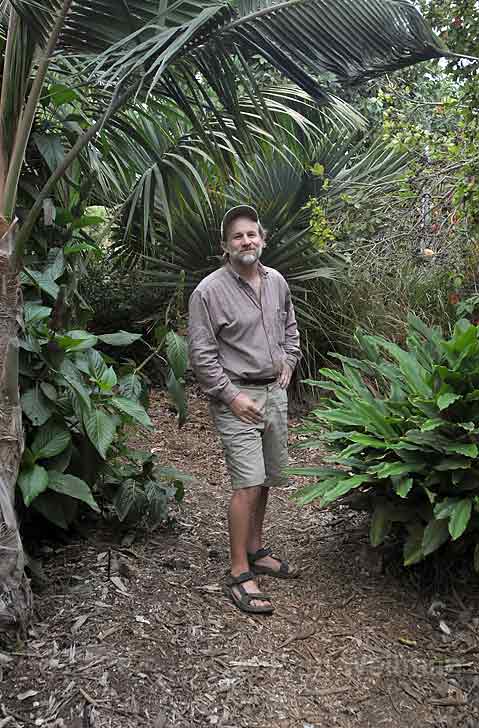
In this drought-stricken land, we are almost allegorically shortsighted. As we struggle with dry-season scarcity and rationing of life’s most basic necessity, water comes falling from the sky every winter, and we let it drain uselessly into the sea. Ecological landscape designer Art Ludwig put the matter in exceptionally clear light: “The rain that falls on the average roof in Santa Barbara from November to March is roughly what is used inside the house throughout the year.”
Ludwig owns and manages Oasis Design, a Santa Barbara-based sustainability consulting and landscaping firm, and he is well-versed in the virtues of harvesting rain. Most water resources that land within the city go careening across the pavement, into storm drains, and onward to the beaches, he explained. The wet season’s first rain, or “first flush,” is even quite toxic, carrying with it all the industrial and automotive poisons accumulated through rainless months of exhaust, smog, dust, and sun. Yet this water won’t hurt most yard and garden plants, and when homeowners divert such water onto their property it slowly percolates through the earth. As it goes, subterranean biosystems break down the street toxins in the water-even petroleum products-and effectively purify the water before it drains into the sea. Much water, though, remains in the soil and within the onsite plants. In fact, the soil becomes so saturated that irrigating one’s garden may be unnecessary for as long as weeks or months following the winter’s last rain.
Ludwig committed a mere half-day carving a groove in the paved surface just upslope of his yard. Now as much as 50,000 gallons of runoff during the winter is directed into his garden and small grove of fruit trees. “This kind of storage is literally dirt cheap,” Ludwig quipped. “Sure, it leaks out the bottom and you can only pump the water out with plant roots, but the price is right.”
In many developing nations, the need for water and the lack of public supplies has forced the population to capture rainwater and save it for use throughout the year, both for irrigating and for drinking. In Australia and Germany, too, policies require that new urban development include rainwater harvesting systems. Incredibly, some states in America prohibit such resourcefulness. Colorado, for one, allots legal ownership of water before it even hits the ground to industries downstream on the Colorado River. In Santa Barbara, the rain is public domain, yet few harvest this resource.
“I’m always astonished at what we haven’t yet done,” said Adam Green, professor of environmental studies at Santa Barbara City College. “In a place like Santa Barbara that is drought-prone, it makes complete sense to develop rain harvesting infrastructure. The city is talking about putting $70 million into the desal plant, but putting rain catchment systems on our roofs is so much cheaper. It’s just silly not to use the water falling from the sky and allow it instead to become a source of pollution. It’s too valuable a resource here, and [installing a catchment system] is just too easy to do.”
Yet all this discussion only speaks to diverting rainfall toward one’s garden. Storing rainwater as an indoor faucet supply, especially for drinking, is an entirely different matter and requires sanitary tactic as well as huge storage capacity. The average indoor use of water for a family of four totals 25,000 gallons annually. With careful rationing, that figure may drop by half, said Ludwig, but cisterns totaling 15,000 gallons of capacity are not feasible on most urban properties.
Brad Lancaster is aiming for water independence by winter of 2009. As author of the two-volume series Rainwater Harvesting, Lancaster is a self-taught expert in the field and has steadily modified his one-eighth acre property in Tucson, Arizona, to optimize the use of falling winter rain. Currently, a diversion system directs more than 100,000 gallons of water per year into his yard of vegetables and fruit trees. “We access the water through vegetation in food plants, windbreak, and shade,” he said.
Once his four-person household’s washing, sewage, and irrigation needs are taken completely off the water grid, Lancaster intends to boost his tank storage capacity to carry enough drinking water to last through the year. Currently he has a 1,200-gallon storage vessel, but by late next fall Lancaster hopes to have installed capacity for more than 3,000 gallons plus-a total that could be suitable for a highly rationed water use lifestyle. Lancaster believes that 10 years from now much of Tucson will have done the same. In fact, city officials have predicted that, at the current rate of local population growth, the city will run out of water in about a decade. Plans to treat sewage water and render it safe for drinking are in motion. Lancaster sees rainwater as a simpler solution, and the level of local interest is sky high, he said.
Santa Barbara has seen rainwater harvesting development at a lesser rate, said Daniel Wilson, environmental design consultant and teacher of irrigation technology at City College. “A good, sizeable handful of people have tried their hands at simple systems, but only a few that I know of are more sophisticated, with systems that filter out mosquitoes and vermin and make it safe for drinking.”
At his own home, Wilson harvests rainwater passively, directing it into his garden via a system much like Ludwig’s. Wilson grows drought-tolerant plants, too, and has no irrigated lawn. “I think that more important than harvesting rainwater is just not wasting water to begin with,” he said.
Anyone, Wilson said, can build a system of efficiently using rainwater to irrigate soil. All they need is some basic know-how and a shovel. Diverting soapy gray water for watering the yard in the dry season may also cut a household’s water use by 30 percent or more and is another simple concept, though it entails some human safety issues and experts are best consulted for such a project.
Beginning Friday, September 12, Santa Barbara City College will host a three-day session of talks, lectures, and demonstrations on the practical applications of harvesting water straight from the sky. Lancaster will deliver a talk on September 12 at 7:30 p.m. at the west campus (721 Cliff Dr.). On Saturday and Sunday, Ludwig and Lancaster will direct a two-day public course on sustainable development, water conservation, utilizing gray water, and other means of lessening the city’s impact on the water table.
4•1•1
For consultation and advice on rainwater and gray water harvesting, visit the Web at WELDesign.net or oasisdesign.net.