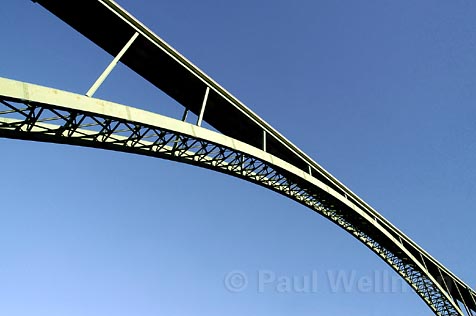
No sooner was the draft Environmental Impact Report (EIR) out for a barrier intended to prevent suicide jumpers from taking flight off Cold Spring Bridge than opponents were attacking it and the barrier concept in general. Marc McGinnes, a retired UCSB professor who has led the charge against the proposed barrier-a steel fence at least six feet high curving inward at the top-said the draft EIR would be challenged. “We’re counting on you not to allow our tax dollars to be wasted in this way,” McGinnes told the SBCAG (Santa Barbara County Association of Governments) board on May 15. “This is a boondoggle, a lavishly funded project in search of a purpose.” If Caltrans gets to the point of certifying its EIR, McGinnes plans to file a lawsuit.
Caltrans District 5 Director Rich Krumholz indicated the controversial project will continue to go forward, a decision that sits squarely on his shoulders. The director’s May 15 report to the SBCAG board was more of a courtesy call and status update. The board, which voted in support of the project in June 2006, really has no say at this point, and even if it did, many of its members seemed sympathetic to the cause. Second District Supervisor Janet Wolf said she was “so glad this project is being looked at and going forward.” Guadalupe Mayor Lupe Alvarez said it appeared a bridge barrier would be built despite the feelings of the board, a situation that irritated Lompoc Mayor Dick DeWees. “What’s the point of going through the public process when the decision has already been made?” DeWees asked.
The historic bridge, providing a breathtaking view 400 feet above Cold Spring Canyon along Highway 154, has been the site of 43 suicides from the time it first opened to traffic in 1963, according to Caltrans. No one has ever survived a jump from the bridge. Sheriff Bill Brown, whose department responds to calls from the bridge, is a proponent of the project. The department has responded to roughly 160 incidents in the last eight years. “The railing is the right thing to do for the right reason,” said Sheriff’s Commander Dominick Palera.
“The same qualities that make [the bridge] so magnificent, and its setting, constitute a tremendous intrinsic value,” Krumholz said. “But it also attracts this disturbing phenomenon of suicides.” Lisa Firestone, director of education and research for Glendon Association, a group dedicated to suicide prevention, claimed research shows that if people are prevented from committing suicide in one location they often change their minds. “People who take their own lives are ambivalent,” she said. “Part of their life wants to die; part of the life wants to live.” Restricting someone’s means while a person is on the negative side of the ambivalence offers more time for intervention, she said. But McGinnes, citing research by UCSB Professor Garrett Glasgow, suggested otherwise. “Barriers divert people, they do not save lives,” McGinnes claimed. Call boxes have proven to be effective in other parts of the country, he said.
The cost of the barrier would be paid with funding from the State Highway Operation and Protection Program and wouldn’t use any county funds. The project isn’t competing with others for funding, but rather is prioritized in a Caltrans database in terms of fatalities occurring in certain highway locations. While initial Caltrans estimates put the cost at only $605,000, the total cost is now expected to be $3.2 million.
Caltrans is now considering only two options: grid-patterned mesh fencing or metal bars. A safety-netting barrier below the bridge was rejected. Not only would it make it more difficult for law enforcement to rescue survivors, Krumholz said, but jumpers could then just jump again off the netting into the canyon below. The no-build alternative was also rejected because, Krumholz said, it “just simply doesn’t address the serious safety situation we have at that location.”
4•1•1
Forums to take input on the barrier will be held Monday, June 9, at the S.B. Public Library, and Tuesday, June 10, at the Solvang Veterans Memorial Building, from 5:30-8:30 p.m.
Print friendly
E-mail story
Tip Us Off
Comments
Share Article
Myspace


Previous Month


Comments
Chris, your info on the costs is not quite complete. The $605,000 was the capital expenditure, and that has risen to about $1 million. The figure near $3 million was *always* known and available, and the additional $2 million consists of all the costs of Caltrans staff assignable tot he project, which will be expended whether the barrier is built or not; however, their salaries etc would be attributed to different projects if this one does not go through.
There is a lot of discussion in the DEIR that addresses the points raised by McGinnes and Glasgow, but you decided not to balance your article by including that DEIR information in your article.
sevendolphins (anonymous profile)
May 22, 2008 at 7:29 a.m. (Suggest removal)
What the headline portrays as "some opposition" is, in fact, very widespread and rapidly increasing public opposition. The barriers project is opposed by numerous community organizations representing thousands of local citizens and taxpayers, including the Santa Barbara County Taxpayers Association, Santa Barbara County Action Network, Santa Barbara Trust for Historic Preservation, Los Padres Chapter of the Sierra Club, Womens Environmental Watch, Citizens Planning Association South County Land Use Committee, Santa Ynez Valley Alliance, Pearl Chase Society, Los Padres ForestWatch, and Friends of the Bridge.
While there continues to be "some support" for the proposal, the momentum of public opinion is clearly moving to opposition in light of evidence that is coming to light about its deeply flawed justification, excessive cost, and failure to adequately consider a superior no-barriers alternative plan based on the recommendations of a leading expert on addressing suicidal behavior on bridges. So the story is far, far from over, and the tide is turning against barriers proposal.
Three important public meetings are on the immediate horizon and provide citizens with excellent opportunities to become better informed and to express their views about the barriers proposal and the more effective, less costly and less damaging "human connections" alternative to it:
Monday, June 2:
Free public program Monday June 2 6:30-8:30pm at the Faulkner Gallery of the Santa Barbara Public Library, 40 E. Anapamu. Invited speakers Dr. Lisa Firestone of the Glendon Association and Dr. Garrett Glasgow of UCSB will address the question "Do Suicide Barriers on Bridges Save Lives? Considering the Evidence in Evaluating the Cold Spring Bridge Barriers Proposal." Co-sponsored by Friends of the Bridge and Pacifica Graduate Institute.
Monday, June 9 and Tuesday June 10:
Public hearings in both Santa Barbara and Solvang addressing the questions about the purpose of the proposal and the adequacy of the analysis of its impacts in the community:
Santa Barbara (June 9, 5:30-8:30 at the Faulkner Gallery of
the Santa Barbara Public Library, 40 E. Anapamu) and
Solvang (June 10, 5:30-8:30 at the Veterans Memorial Bldg, 1745 Mission Dr.)
For further information please contact bridgefriends@hotmail.com
marcmcginnes (anonymous profile)
May 22, 2008 at 10:21 a.m. (Suggest removal)
Actually sevendolphins, that $3 million figure was not publicly available until Marc McGinnes requested internal Caltrans documents under the California Public Records Act a couple of months ago. Caltrans was compelled at that point to release the true budget for the project to the public.
Until then, Caltrans was telling the public the cost of the barrier was $605,000 -- no mention of the actual cost was made public. For instance, in their public presentation on the project last July the only cost figure mentioned was $605,000. Check out the Caltrans powerpoint presentation:
http://www.dot.ca.gov/dist05/projects...
Further, other barrier supporters were also telling the public the cost was $605,000. Here is Lisa Firestone repeating that figure in the press, claiming the barrier would cost less than a stoplight:
http://sbdailysound.blogspot.com/2007...
I'm assuming that the Glendon Association was not deliberately trying to mislead the public, but was as in the dark as the rest of us about the true cost of the barrier.
GarrettGlasgow (anonymous profile)
May 22, 2008 at 12:06 p.m. (Suggest removal)
Public accounting generally distinguishes capital expenditures and staff salary, benefits, etc. The original $605,000 was the capital expenditure of a modest, architecturally plain barrier. The escalation to $1,000,000 in the capital expenditures occurred because there was a lot of protest for a more aestethically pleasing project.
http://www.dot.ca.gov/dist05/projects...
Pretty clearly says the `Project Construction Cost'... that is generally understood to be capital expenditure... was $605,000.
If one compares to a stoplight, then all staff/salary costs should be included too, and that will drive the stoplight cost up above the simple capital expenditures.
Staff salary etc would have been spent whether or not this project or any project or no project got done; State Employees aren't laid off easily.
Any representation that costs got out of control and escalated from $605,000 to $3 million is inaccurate. That is not an apples-to-apples comparison; there is simply diffrerent account used.
sevendolphins (anonymous profile)
May 22, 2008 at 3:14 p.m. (Suggest removal)
If the barrier is canceled that $2 million in staff salary will likely be spent in a different CalTrans district, which explains why the CalTrans folks in this district are fighting like hell for this stupid idea. They have a clear financial incentive to build the barrier.
Kratatoa (anonymous profile)
May 22, 2008 at 11:46 p.m. (Suggest removal)
Thank you Marc McGinnis for continuing to be our environmental conscience.
This kind of project, which has come into favor among frustrated bridge bureaucrats, has no scientific basis; it is purely emotional. Barriers do not stop suicides they merely shift them to other locations. CEQA requires an EIR to make findings based upon science not emotional arguments, taming even the most obstinate and unresponsive of agencies like CALTRANS. Lucky for us, we have citizen attorneys like Marc who will courageously fight the good fight to enforce CEQA.
In the meantime, cherished landmarks including bridges from Cold Springs to the Golden Gate get defaced with these chain link prisons, removing some of the joy we take for granted.
We need to care about the reasons people choose to commit suicide and address them as a society. But any truly spectacular place becomes a magnet for jumpers. I for one don't think the solution is to destroy the beauty. Natural vistas and aesthetics in our natural world have value in and of themselves.They have become a precious and diminishing quality in our harried urbanized world.
TerryLeftgoff (anonymous profile)
May 24, 2008 at 4:51 p.m. (Suggest removal)
As a employee of the county and seeing funding restraints on the ADMHS by both state and county level brings the question. Why is a single project funded when funds are cut which can help a vast more number of citizens with the same issues at hand?
SSolano (anonymous profile)
May 28, 2008 at 8:02 a.m. (Suggest removal)
It seems people are more interested in having a great view and saving money than perhaps saving a life.Are you putting a monetary value on life. It might be that the time it takes prospective suicide jumpers have from jumping off the bridge to figure out another place to do the act will be the time they decide NOT to do it. As Dr. Lisa Firestone says it is a "moment in time" for people to change their minds about doing something so permanent. It gives them a chance to make another choice.
islandgirl (anonymous profile)
May 28, 2008 at 8:08 a.m. (Suggest removal)
SSolano... $41 million a year is spent on mental health services by Santa Barbara County... the barrier, if accounted for at $3 million (which is questionable) over 30 years amounts to $100,000 a year, which is a tiny compared to mental health services.
And most of the $3 million is Caltrans staff costs, which would under no circumstances be transferable to County mental health. Only $1 million is `new money', which amounts to about $30,000 a year, less than 1/1000 of the amount spent on County mental health services.
sevendolphins (anonymous profile)
May 28, 2008 at 4:45 p.m. (Suggest removal)