Question: ‘I’m interested in one of the early families in Carpinteria, the Olmstead family.’
-Victor Walton

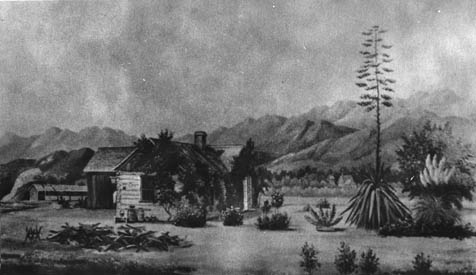
Stephen H. Olmstead was among the first American settlers in the Carpinteria Valley, arriving in the early 1860s. Highly adaptable, he was willing to try any number of enterprises in the quest for success. He enjoyed prosperity as a farmer in the Carpinteria Valley, and his home became a focal point for the fledgling Yankee settlement.
Olmstead was born into a family of farmers in New York state in 1829. Even as a young man, however, he demonstrated an interest in fields beyond farming. He attended the Delaware Literary Institution in Franklin, New York, and became an ardent naturalist.
Like countless others, Olmstead was lured to California by the promise of striking it rich in the gold fields. In 1852, he boarded a ship bound for Central America, a trip that rendered him, as he later put it, “sick as a fool.” After crossing the Isthmus of Panama, he embarked on a ship headed for Acapulco, but the ship foundered off Mazatlan, stranding the passengers. Olmstead and a companion engaged a man with a mule to guide them to Acapulco through terrain so rugged they at times had to hold on to the mule’s tail to negotiate the steep inclines. They then had great difficulty booking passage to California, such were the numbers traveling northward. When they finally did so, it took more than two months to get to San Francisco; supplies ran desperately short, and a number of the passengers succumbed to disease.
Olmstead spent a few years in the gold fields, where he was not only a miner but also ran a general store and a lumber mill. He then returned east, but wanderlust soon overtook him again and he made his way to Illinois, where he farmed, clerked, and worked for the circuit court of Cook County. Yet he never really did get California out of his system.
In 1857 he once more headed west, this time by wagon train. Poisoned water in Nevada’s Humboldt Sink killed the horses, and Olmstead and his friend Charlie Fish (who also eventually settled in Carpinteria) walked the last 70-plus miles to Reno. After a few years in Northern California, Olmstead decided to move south to farm. Upon arriving in Santa Barbara in 1861, he was told that the Carpinteria area had good soil. He walked down to take a look and eventually settled there.
Olmstead tried a variety of crops on his farm, including almonds, lima beans, potatoes, and barley. Additionally, he owned some asphaltum beds on the beachfront, which he leased. One of his friends was the famed landscape painter Henry Chapman Ford, who stayed with the Olmsteads when he arrived in 1875. Eventually, Ford built a home in the valley, purchasing the land from Olmstead by giving him five paintings. The two men shared a number of interests, especially in horticulture. Ford served as president of the Santa Barbara Natural History Society for several years.
In 1863, Olmstead’s sister-in-law, Alice Brown, came to live with the family. She taught for a time in Carpinteria and then opened one of the first schools in Montecito. At about this same time, Olmstead’s brother, Seth, moved to the valley.
Farming could be an uncertain business. Prices fluctuated widely, and in 1876 Olmstead was badly hurt in a financial panic and depression that gripped the entire nation. In 1879, Olmstead once again pulled up stakes, this time moving to Los Angeles, where he remained until around the turn of the century. He then returned to Carpinteria to live the rest of his life.