Pruning Deciduous Fruit Trees
Floral Restructuring

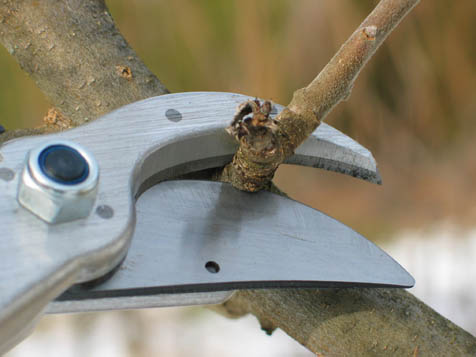
Winter has some unique pleasures in the garden, including that of seeing the structure of deciduous trees and shrubs revealed after their leaves have fallen. It also affords an opportunity to improve on that structure while the plants are dormant. Cuts made to branches during this season direct the growth that begins again in spring. This is the time to shape fruit trees for health and productivity.
The general goals are to open up the tree for good light penetration and encourage a strong branch structure to support the fruit without breaking. There are two main types of structure to choose from when starting with a young tree, a central leader type or a vase-like structure. Some fruits respond better to one than the other. Apples, cherries, and pears are successful if pruned to a central leader, while peaches and nectarines do best as vase shapes. Plums and apricots can go either way.
Trees with a central leader resemble the classic Christmas tree shape. A single central trunk supports ranks of radiating branches. In the first year, the whip is cut down by about one third. It will then form several sets of branches below that cut. The next year, choose the central leader by removing one or more of the branches at the top, leaving just the single, upright one. In subsequent years, thin the ranks so that they are evenly spaced around the central leader and alternating above each other. It’s helpful to remember that you are attempting to let the maximum light strike all the branches as you visualize this.
To encourage a vase shape, the central leader is removed and lower branches encouraged, providing what is known as the scaffold. You may purchase a tree that has already been encouraged to branch in this way. If not, cut the whip to 30 to 42 inches above the soil level at planting. During the next years, the three to five scaffold branches will be developed by thinning the side branches these scaffold branches produce. The result is a vase or basket of several strong radiating limbs with a network of smaller, fruit-bearing wood.
Once the basic shape of the tree has been developed, the work of pruning each year is fairly simple. The first task is to find and remove any dead wood. Then look for any branches that cross each other. Remove or head them back so that they produce growth toward the outside of the tree. Future branching comes from dormant buds below the growing tip of the branch, so make cuts above buds that are on the outside, or bottom, of the branch. These will then grow in the next season in the desired direction.
That’s the general idea. Here are some specific tips:
Some apples and pears tend to grow very upright branches. More fruit will develop and branches will be stronger if they can be made to spread out from the tree. When the branches are young, spread them apart with small pieces of lath or other wood. Fruit develops on short spurs in most varieties, so cut long whips to encourage the short side branches. Pears usually need little pruning, and too much may induce production of lots of weak shoots.
Peaches and nectarines produce fruit on one-year-old wood, so prune out more than you would other fruit trees to assure that there is always plenty of new growth. Keep the tops thinned out so that light can enter the center. The scaffold branches also respond to shortening if you want to keep the tree at a reasonable height.
Plums tend to produce long suckers or whips if pruned heavily. Lightly thin the trees out to promote shorter spurs. Apricots definitely need annual pruning to keep the tree open. They, too, need to have plenty of new growth for fruit production.
Do remember that small mistakes in pruning can be corrected in future years. Healthy trees respond with renewed vigor when carefully trained and pruned. If this all seems a little overwhelming, there are some good guides to buy or check out of the library. Many have great diagrams to illustrate their points.
For hands-on help, check listings for pruning workshops. Lotusland is hosting one on Saturday, January 26, from 9:30 to 11:30 a.m. Karen Christman of Arbor Services and Lotusland staff members will offer personalized instruction in the techniques used to prune different types of fruit trees. Reservations are required. Call 969-9990 to register.