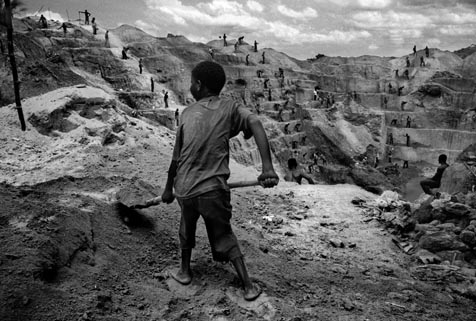
Africa has long been scarred by strife, but in these early days of the 21st century, the continent’s chaos seems to be exponentially exploding. Few journalists have dedicated as much time to documenting the past African decade as photographer Marcus Bleasdale, a former investment banker who has spent the last eight years jumping from the Democratic Republic of Congo (DRC) to Chad, Uganda, the Sudan, Somalia, and beyond. Bleasdale rose to international fame when his book One Hundred Years of Darkness, which features dozens of haunting black-and-white images from the DRC, was declared one of the best photojournalism works of 2002. He has since shot for Time, Newsweek, National Geographic, and the New Yorker.
In anticipation of his visit to UCSB on March 3, Bleasdale spoke to me on the phone from his home in Norway.
You’re a mix of old and new worlds, using multimedia but also shooting mainly in black-and-white. Why black-and-white? For me, it’s a medium that allows every confusing aspect of an image to be taken away, and you’re left with what that image is trying to tell you-the emotion, the statement that the image has, whether in the face of the subject or in what is exactly happening. : You’re left with the pure message.
You’re also a proponent of multimedia, with your photo podcasts. Why? It allows us to extend our audience significantly, not just dealing in terms of numbers, but with the sort of viewers, too. We’ve got youngsters now who don’t buy newspapers or magazines. They source all the information they need electronically. We have to work with that. They’re the next generation of the concerned, and if we’re not feeding them with the right information, it’s a generation that could pass by.
Do you think that many of the problems in Africa persist because people don’t read about them? These problems persist because someone is making money out of them. Every conflict you can strip down and find out there’s a financial reason it is happening, whether it’s natural resources, whether it’s power, whether it’s oil, whether it’s land, whether it’s water. There’s always an economic reason.
Do you think your work will help fix these situations? I don’t think that the situation will be fixed by the images. I think what we can do as journalists and photographers is provide ammunition for the people who can fix the problem. I don’t hold on to the view that I can save the world, but there are other people out there with a lot more power and a lot more influence who can do that. So I give them the ammunition to do that. I give them the same sort of information that angers me.
Do you recall your first experience seeing a dead body? Yes, it was in the Balkans.
Was that a powerful experience? Yes. It’s one thing to see a relative laid out in a coffin or to see death in that kind of fashion. But I think I speak for a lot of journalists by saying that when death presents itself not as an image, but as a smell, that’s something you don’t get rid of for a long time.
Do you find yourself growing more callous to death now? No, not at all. I try not to build up any barriers. I think the more sensitive you are to a certain situation, the more chance you have of reflecting that in your images. If you’re desensitized to it, your images become colder and less emotional, your indifference to the situation comes out.
Have you ever been scared? Very. Different situations present themselves with different kinds of fear. Getting shot at is one thing, and that’s happened to me more times than I want to remember. But the most fearful moment was documenting Ebola in Uganda. You don’t know where it is. With a bullet, you kind of know where it’s coming from. But working in the Ebola ward for two weeks, hoping that there would be no transmission, that was a scary moment, and the months waiting afterward.
Lots of people go to Africa, see what a mess it is, and proclaim that the freedom and democracy we have in the West won’t work there. What do you think? We can enforce democracy on a country, but whether it becomes embraced by the politicians and the people is another matter. We’ve forced a democratic solution on the DRC, but there’s no way anyone would say it’s fair, free, and democratic-there’s no political opposition and they are imprisoned if there is. You can’t go from a military state to a democracy overnight. It takes a huge amount of trust between people and politicians. It takes years and years and years for generations of people to change the way they think. They have to have hope for enhanced democracy, hope for enhanced wealth. That’s when democracy starts to work. African states are at different stages in that process. Corruption is obviously a huge problem, and is limiting the ability to evolve.
4•1•1
Marcus Bleasdale comes to UCSB’s Campbell Hall for a free slideshow and talk on Monday, March 3, at 8 p.m. For more information, call 893-3535 or visit marcusbleasdale.com.