What’s Your Dog’s Real Age?

The old standard in determining a dog’s age was to multiply their age in calendar years by seven. This is somewhat accurate, but it is a very rough estimate. To be more precise, you need to take into account your dog’s size. For instance, a 20-pound dog who is six years old is equivalent to 40 human years, yet a 90-pound dog of the same age is closer to 50 human years. See the conversion chart for more specific information.
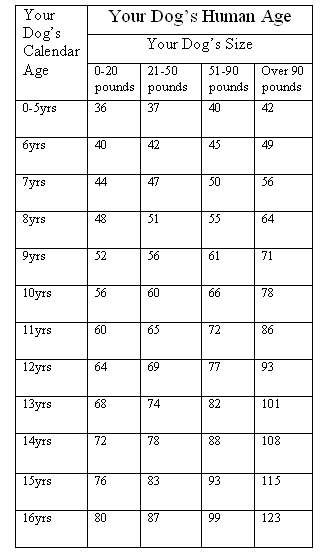
There are other caveats that play a role in determining your dog’s age, such as environment, diet and mental health. To determine your dog’s real age, look at the conversion chart pictured below to determine your dog’s human age. Then, subtract years from your dog’s human age, when applicable, after answering the following questions:
Is your dog spayed or neutered? If so, subtract 5 years from your dog’s human age.
Having your female dog spayed helps minimize the risk of mammary cancer and having your male dog neutered protects him from testicular cancer and prostate problems.
Does your dog visit the veterinarian at least once a year for physical examination, vaccinations, heartworm and/or flea prevention? If so, subtract four years from your dog’s human age.
An annual exam is recommended for dogs under the age of six years of age; a biannual exam for dogs over six years of age. All vaccination programs are not the same; some require annual vaccinations, while others may only be once every three years. Ask your vet for a schedule specific to your dog’s health care needs and be sure to follow up every year. Certain vaccines, such as rabies, are required by law.
Do you make sure that you feed your dog a high-quality brand of dog food and read the ingredients? If so, subtract four years from your dog’s human age.
Make sure your dog is getting fed from the five food groups – meat, dairy, vegetables, fruit and grain – plus essential fats and oils. The meat sources of your dog’s good should be from a named meat such as turkey, chicken, beef, etc. and not from a meat by-product. Always follow your veterinarian’s instructions for feeding a sick or senior dog requiring special prescription food.
Do you walk your dog for at least 45 minutes per day? If so, subtract four years from your dog’s human age.
Dogs of all breeds and ages need daily exercise to keep them healthy. Recent studies have shown heart functions are affected by obesity even in young dogs. Some dogs require short walks around the block while others require hours of running and playing to match their activity levels. Make sure your dog is getting the exercise he needs. And always remember to use a leash on your dog in public.
Does your dog have a proportional figure, with slightly padded ribs and a distinct waist? If so, subtract two years from your dog’s human age.
Overweight dogs are more susceptible to certain health conditions. Excess weight increases a dog’s risk of health complications that can affect the respiratory, cardiovascular, and skeletal systems. One easy way to combat overweight dogs is to provide food at scheduled feedings times only and avoid leaving food out all day long. Talk to your veterinarian for more information if you think your dog is overweight.
Does your dog ride in a carrier inside your vehicle when he rides in the car with you? If so, subtract 2 years from your dog’s human age.
The safest way for a dog to travel by car is inside a carrier in the back seat of the car. If a carrier is not available, try using a harness with a seat belt or a regular leash attached to the armrest. Never allow your dog to ride in an open bed of a pick up truck. Not only is this unsafe, but it’s also illegal!
Is your home free from toxins such as cigarette smoke, poisonous plants, rat poison, phenol and ammonia household cleaners? If so, subtract 2 years from your dog’s human age.
Research shows that the chances of developing smoking-related cancers, as well as lung infections, respiratory problems, asthma and other health problems are greater for dogs living in smoking environments. And keeping your household free from poisonous plants and other types of toxins helps keep your dog safe.
Do you brush your dog’s teeth and/or regularly give dental treats? If so, subtract 1 year from your dog’s human age.
Periodontal disease, caused by plaque buildup, can ultimately affect various organs of the body and the nervous system if left untreated. Dogs over the age of five years old become more susceptible to dental diseases, so it is important to keep your dog’s teeth and gums clean with regular home dental care. Providing teeth cleaning chew bones is an easy way to help with plaque buildup.
Please be aware that this real age test is only a guideline and there are other determinants such as genetics or breed that may factor into your dog’s age. As always, talk to your veterinarian for more information on how to help your dog live a long and healthy life!