Safari Adventures in Botswana
Into Africa

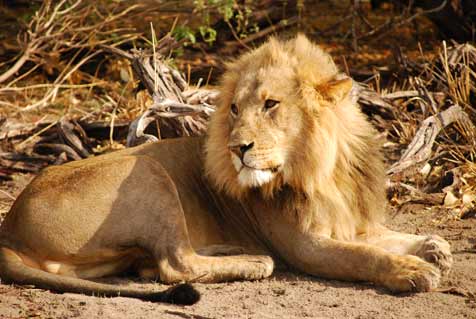
We’d heard the lions roar, and suddenly there they were, two huge males eyeing us from about 40 feet away. In a few bounds, they could have sprung into our open-air truck and torn our lungs out. But they just kept sunning themselves, probably wishing we’d leave them to nap.
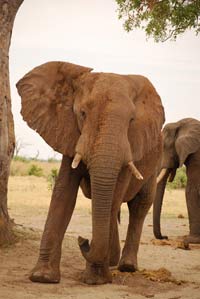
Earlier in the day, a bull elephant could have mauled us. He lumbered toward our truck, ears waving, tusks jutting, clearly warning: Don’t come any closer. We didn’t and he didn’t.
We were on safari in Botswana, in wild Africa, not some tame game park. The rules were clear: Stay in the four-wheel-drive Toyota and the animals will see no challenge from this box-like thing. But get out and approach them and look out!
Hippos, reputedly Africa’s most dangerous animal, were fun to watch as they sloshed around in the shallow streams. But when they’re on dry land and you get between them and the river, you’ll find out how fast they can run, which is faster than you.
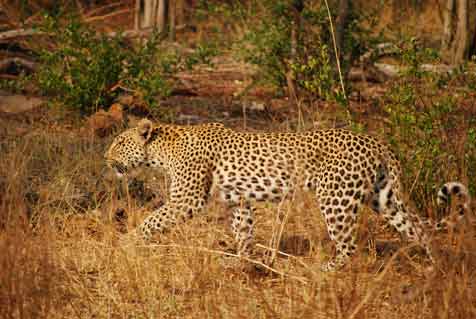
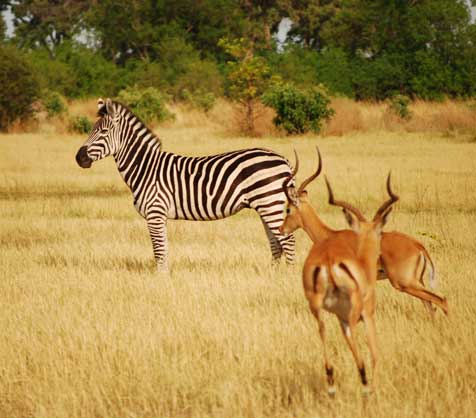
But most of the critters we came across-giraffes, zebras, baboons, wildebeest, kudu, warthogs, leopards, cheetahs, impalas, crocodiles, elephants, hippos, lions, and more-were content to let us rubberneck and take photos.
During our first dawn patrol prowling the bush, any fear we might have brought with us was overwhelmed by the excitement of seeing so many wild animals in the vast wilderness of Botswana, a Texas-sized country just north of South Africa. It’s clear why hitting the safari trail is a booming adventure for Europeans and Americans. I was surprised how many of our friends have just gone or are planning a trip.
But I’m not talking cheap thrills. Johannesburg, South Africa, jumping-off city for safaris in that country and Botswana, is a long haul by plane from Santa Barbara and mighty expensive unless you’re using airline miles. Sue and I flew from LAX to London, via my favorite airline, American, then to Johannesburg on British Airways, a terrible experience aboard a once-great airline that now seems to care little about its customers.
From Johannesburg you take a flight to the tiny town of Maun, deep in Botswana, and, surrounded by other safari-bound folks, meet your safari contact, hop into a small plane, and head for your camp.
Botswana is becoming the safari land of choice by cognoscenti, partly because of its high-quality safari companies and wide-open wilderness areas and preserves but also because the country is safe and has a stable government.
My camping days are behind me, so I skipped the let’s-camp-out budget safari outfits. Sue and I chose two camps in the luxury category, Savute Elephant Camp and Khwai River Camp, run by the trusted Orient-Express people. In just four days we were able to see practically every animal available, as well as exotic birds, thanks to our sharp-eyed guides. There were no endangered rhinos in the area.
The daily routine at both camps went like this: At about 5:30 a.m., a staffer comes to your tent with coffee and cookies. You take a light breakfast at 6 in the main lodge and then hop aboard a vehicle for a game drive. You’re back in time for the 11 a.m. brunch, then take a siesta or swim before the second drive of the day at 4. After that, you clean up and gather for drinks before 8 p.m. dinner.
You stay in luxury “tents” with polished wood floors, soft wide beds with mosquito netting, and a modern bathroom with flush toilets and hot showers. We never used the netting because, although we were taking malaria pills, we never heard or saw a pesky mosquito during our late-October trip.
Of all the creatures that walked, crawled, or flew, we found elephants the most interesting to watch. They have a complex social structure, like to hang around together, especially the females, with one dominant granny running the show. We had plenty of time to observe them at the Savute camp, because a herd was always gathered around the water hole just below our main lodge, continually jostling for position.
The Chobe National Park is in arid northern Botswana, but when we flew over to the Khwai River Camp, we found a wide wetlands stretching along the tranquil stream, where hippos wallowed and deer-like red lechwe grazed in the meadow.
The third Orient-Express camp, Eagle Island, which we didn’t get to, is located in the storied Okavango Delta, where crystal clear water from Angola’s mountains flood in every spring, creating islands, channels, and lagoons where wildlife flourishes. Here, fish eagles scream as they dive for dinner, hippos bellow, and crocodiles await the unwary. You explore in mokoro boats poled by guides.
Roughly one quarter of Africa’s estimated 500,000 to 600,000 elephants are thought to live in Botswana. But in the Congo basin jungle areas farther north, poaching has decimated some elephant herds. The main market for illegal ivory is China, and in the Victoria Falls area of Zimbabwe, operators have been accused of capturing young wild animals in preserves for “training” to provide rides for tourists.
On the way back, we overnighted at Johannesburg’s best hotel, the Westcliff, on a hill overlooking a city dotted with jacaranda trees. We swam in the infinity pool, had a drink with the locals at the Polo Lounge, and watched the sun set. Then it was on to one of the world’s great tourist cities, Cape Town, a 90-minute flight away.
There we dropped our bags at the classic 107-year-old Mount Nelson hotel, a grande dame in fine shape. The Planet Champagne Bar is a good place to mingle with the local movers and shakers and young pre-dinner crowd. The Cape Colony restaurant is said to be the best in town.
Sue is mad for sunsets, so we found one just outside town at the ultra-modern Twelve Apostles Hotel and Spa. I sipped a rum and Coke at the Leopard Lounge, gazed at the fiery sun sinking in the Atlantic, and we talked about returning someday soon to explore the Okavango.