Better Living Through Gaming?
UCSB Program Heralds Health Benefits of Video Games
Pale, doughy, and uncommunicative. Ask someone to describe the stereotypical video game player and you’ll likely hear words like these in the response. Times change, however, and the most recent video games demand more from the people who play them-more mentally, more socially, and more physically. So what, then, might be the benefits of these games? That’s the question Debra Lieberman, PhD-a UCSB communication researcher since 1999-wants to answer. And while she’s been studying the field for years, she’s now preparing to do so with the help of an $8.25 million grant from the Princeton-based Robert Wood Johnson Foundation that’s funding Health Games Research, a one-of-a-kind program that will allow Lieberman to study how games could improve health.

Lieberman has straddled the fields of education and entertainment since 1973, when she began work as an adviser for Sesame Street. After what she called an “epiphany moment” with an early video game-a simple multiple-choice interface-Lieberman said she realized the enormous potential for interactive games to aid learning. “There are skeptics who wonder whether a video game could ever be educational,” she said, adding that a growing number of studies show that well-designed games played during leisure time are indeed improving players’ knowledge, problem-solving skills, and behaviors, in addition to other benefits. The principles are startlingly basic. Once, during a study in which Lieberman asked 50 children whether they’d most like to learn from books, videos, or video games, 49 chose video games. “And the reasons why were so insightful,” Lieberman recalled. “I got answers like, ‘A video game tells you when you’re wrong.’ It was amazing.”
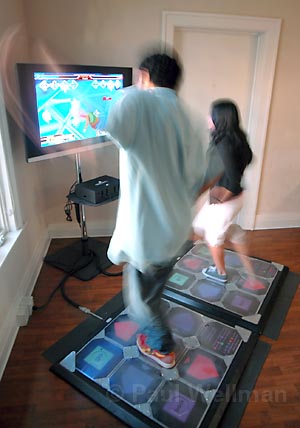
Those without children-or without a child-like mentality-may not be aware that video games have made considerable advances away from button-mashing. Lieberman points out the game Dance Dance Revolution as one of her favorites. Since 1998, the internationally popular series has had players stomping, tapping, and pivoting on a control pad on the floor that allows legs to do the work that twitching fingers would otherwise do. Home versions exist, but perhaps Dance Dance Revolution is most familiar as the machine in arcades and movie theater lobbies at which children and teenagers work up a sweat as they stomp. A West Virginia study released earlier this year indicated that the game pays off physically-a group of obese children who used it regularly stopped gaining weight, as well as improved aerobic capacity and blood flow.
A year ago, the game market saw the arrival of Nintendo’s new home console, the Wii, which departs from typical control schemes by utilizing TV remote-like controllers that players must wave around. Other games depart even more wildly from the traditional setup. The Brain Age games for Nintendo’s portable system, for example, have players solving puzzles and math problems purportedly to maintain mental acuity. And the upcoming Wii Fit will equip gamers with a balance board they can use to exercise, weigh themselves, and theoretically achieve real-life exercise goals.
Clearly, these innovations could change video games-as a means of entertainment, as a field of study, and as a lucrative market. With her extensive background with games, Lieberman stands out as the person who might understand these changes better than anybody.
For her, the word “game” refers to a wide collection of media. “The definition of ‘game’ is a controversial subject,” Lieberman explained. “I’ve always defined it broadly as a rule-based activity that involves challenges to reach a goal.” The broad definition is integral to Health Games Research because she didn’t want to exclude anything that might yield worthwhile research: robots, medical devices, handheld wireless networks, GPS devices, or any other kind of technology that can challenge a user to play a game and achieve certain set goals.
Some of her most famous work, however, involves research and design of games like Captain Novolin, a 1992 Super Nintendo title in which players fought junk food and learned valuable information about diabetes, or Bronkie the Bronchiasaurus, in which players improve asthma management skills. Such “edutainment” titles can draw scorn from hardcore gamers, but Lieberman looks back fondly on her previous work, which she said proved that those games increased people’s health-related knowledge while they played. “I still vouch for those games,” Lieberman said.
She recalled a clinical trial in which approximately 60 children with type 1 diabetes were each asked to play video games as little or as much as they wished. Half the group received Packy and Marlon-a Captain Novolin successor-while the other half received video games with no health content. At the end of the study, Lieberman said, the average 2.5 annual diabetes-related urgent care and emergency medical visits per child dropped by 77 percent for the group that played Packy and Marlon. Furthermore, Lieberman said the game’s two-player option helped diabetic children teach their non-diabetic friends about the disease. “It was a springboard for discussion,” Lieberman said. “Kids could talk with their friends about the disease, and this helped removed the stigma.”
Chinwe Onyekere, a Robert Wood Johnson Foundation program officer, said Lieberman’s expertise in the fields of gaming and health made Lieberman a natural choice as the program’s director. “We thought she’d be a fantastic person, based on her knowledge of video gaming, health, and healthcare,” Onyekere said. “We were extremely interested in video games, and, knowing that there are so many in people’s homes, we’re looking into whether interactive games can improve health.” Part of Lieberman’s long-term duties in directing the center, Onyekere explained, would be developing an online database of information on health games that will allow anyone with an idea for a new product to find out how best to develop it. The program will also fund other health game-related research, and those interested can apply for grants online.
The new program won’t stop Lieberman from the work that got her where she is today. Right now, she’s working on a new study that looks at versions of a cancer education game with varying amounts of storyline-one emphasizing dramatic action and the nurturing of cancer patients, while the other is stripped-down to a shoot-’em-up game in which players shoot chemotherapy at cancer cells. Lieberman wants to see who learns best, and changes their cancer prevention behaviors best, with which version. “Many health games are really lousy-or just not fun to play,” she admitted. “But the people who make those games haven’t had the opportunity to work with cutting-edge game designers who know what works and what doesn’t. We need to demonstrate clearly how important it is to make games fun and challenging and based on well-researched design principles that are known to improve health behaviors.” Lieberman and the Health Games Research program may do just that. At the very least, she might give you something to think about while you play.