Middle Eastern Oasis
Phoenix Palms

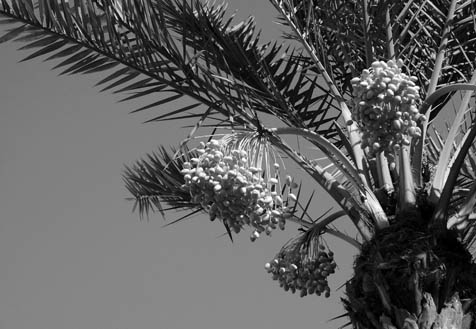
Across the burning Middle Eastern desert the outline of palms against the sky means not only relief from the incessant sun, but that water will be close to the surface to slake parched throats. These landmark trees are Phoenix dactylifera, the date palm. Most palms require plenty of water and these desert-dwellers are no different. They only occur in oases or where river water can be channeled to their plantations. This cultivation has been going on for more than 8,000 years, and date palms are now grown throughout the Middle East as well as in other warm zones such as the hot inland valleys in southern California. In fact, the California plantations are losing ground to imported dates for economic reasons and many of the mature date palm trees are being dug up and relocated as landscape trees instead.
Phoenix palms have pinnate (feather-like) leaves that form more or less dense crowns and the related species that thrive in our cooler coastal climate provide that same iconic oasis look. Although none of them produces edible fruits, they all go by the name “date palm.” There are three common species in our landscape in a range of sizes. The most diminutive is Phoenix roebelenii. Called the pygmy date palm, it is native to the humid forests of Laos, Thailand, and Vietnam. It grows rather slowly and may eventually reach 10 feet in height. In cultivation it is most often a solitary palm, but occasionally it occurs as a multistemmed cluster just as it does in the wild. A fairly rare type may also branch above the ground forming a sort of candelabra shape. Because it can tolerate a fair amount of shade and remains small, it is often used in planters and courtyards.
The stoutest Phoenix is the solitary Canary Island date palm (P. canariensis). As its name suggests, it is native to the Canary Islands. It can reach 75 feet in height on a trunk about three feet in diameter. The large crown of pinnate leaves may contain as many as 200 fronds and spread to 40 feet in diameter. Clearly, this palm is not for small gardens, but it is widely planted as a street tree and in parks and public spaces. It has striking orange inflorescences in winter and early spring.
The Senegal date palm (P. reclinata), naturally growing along river banks in southern Africa, has clusters of tall slender stems. They grow to 25 feet or more and are only 4-7 inches in diameter. This species continues to send up new shoots and, throughout the years, the clumps can become quite large. As the stems grow upward they must arch away from the center, giving the palm its species name that means “reclining.” There are plants with much thicker stems that are believed to be hybrids with Phoenix canariensis. In fact, Phoenix palms interbreed easily and many hybrids are believed to exist arising from their popularity as landscape plants.
In the Santa Barbara area, these three species are easy to grow. Once established, the Canary Island date palm can survive without supplemental water. The Senegal and pygmy date palms require regular water to keep them in good health. In nature, old leaves on the Canary Island date palm may persist for many years and in most landscape situations, they will be pruned off periodically for a neater appearance. The other species drop their leaves more readily, leaving bumps or scars in a regular pattern. Care should be taken when working on these palms as their lower leaflets are reduced to stiff spines. They can easily puncture skin so heavy gloves and long sleeves are a must. Protective eyeglasses or goggles are also recommended.
A couple of less common species can occasionally be found in the landscape and at nurseries specializing in palms. Phoenix rupicola, known as the India date palm, is native to the forests of the Himalayan region of India. It is a slender, single-trunked palm that grows to 35 feet. It is slightly less spiny than its cousins and deserves to be more widely planted. The silver date palm (P. sylvestris) is also native to a wide area of India below the Himalayas. As its common name implies, its leaves are silvery green. It is also a solitary palm and is not as stout as a Canary Island date palm, nor as graceful as the India date palm. Nonetheless it is a very handsome species and grows to about 30 feet in height.
Virginia Hayes, curator of Ganna Walska Lotusland, will answer your gardening questions. Address them to Gardens, The Independent, 122 W. Figueroa St., S.B., CA 93101. Send email to vahayes@lotusland.org.